


Pilot Nick - 10 min read
In this post
Why Thanksgiving morning, Christmas Day and New Year’s Eve are some of the easiest flying of the year, with last year’s TSA numbers to prove it
The de-icing clock that turns a 20-minute delay into two hours on a busy day
Five hints for booking the next two months, including what to do now that the fare sweet spot has passed, and the December 11 date to watch
For paid readers: the one holiday window I won’t book my own family on, and three holiday bookings scored
It's a Monday night in late October, Thanksgiving is 31 days away, and you're on the couch with the laptop and the family group chat open on your phone.
Your sister has booked Wednesday evening. Your parents want everyone at the table by Thursday at three. The Wednesday fares look like a typo, and every time you refresh, another seat disappears from the map.
There’s a flight at 7:05 on Thanksgiving morning for a lot less. You hover over it, then picture landing on the holiday itself, with everyone asking why you didn’t come the night before, and you go back to Wednesday.
From the left seat, the holiday calendar looks completely different. The days you’re avoiding are the days I’d pick for my own family.
I’ve spent 28 years and more than 12,000 hours up front, and a fair share of those hours fell on holidays. This is what the airport, the airspace and the crew look like on the days everyone hates, and why they’re some of the easiest flying of the year. It's the holiday sequel to The Flight Times Everyone Hates and Why Pilots Secretly Love Them.
Everyone flies on the same handful of days
The busiest day in the history of US airport security was the Sunday after Thanksgiving last year.
On November 30, 2025, the TSA screened 3,133,924 people, nearly all of them trying to get home before Monday.
Christmas followed the same pattern. On Sunday, December 28, 2025, nearly 2.92 million people went through the checkpoints. Three days earlier, on Christmas Day, it was about 2.07 million, roughly 850,000 fewer people at the airports.
New Year’s Eve is quieter still. In TSA data from 2021 through 2025, it’s the quietest ordinary day of the whole season.
The fares follow the crowds. Going, the flight-deal site, studied 2025 holiday prices and found that flying on the holiday itself saved about 15 to 30 percent. Thanksgiving Day was the cheapest day to fly out of three of the five US regions it looked at, and Christmas Day was the cheapest out of the Midwest and the Northeast.
One thing first, for anyone who gets nervous: a packed Sunday is every bit as safe as a quiet Christmas morning. The rules, the checks and the margins don’t change with the crowd. What changes is how likely you are to leave on time and arrive the same day, and that’s where the quiet days win.
What a quiet day looks like from up front
On Christmas morning you notice a shorter security line and a calmer gate area. I notice the sky, the de-icing pad and the crew.
The sky has room. When weather cuts the number of airplanes a big airport can land each hour, the FAA holds flights on the ground before they even leave. It calls these ground delay programs and ground stops. Your airplane is fine and your crew is ready, and you sit at the gate because Newark can only take so many arrivals in a snow shower at 5 PM. On a holiday with fewer flights scheduled, the same weather backs up fewer airplanes, so those programs are rarer and shorter. You feel it as a pushback on time. (For why your phone's forecast gets this wrong, see Your Weather App Is Lying to You About Your Flight.)

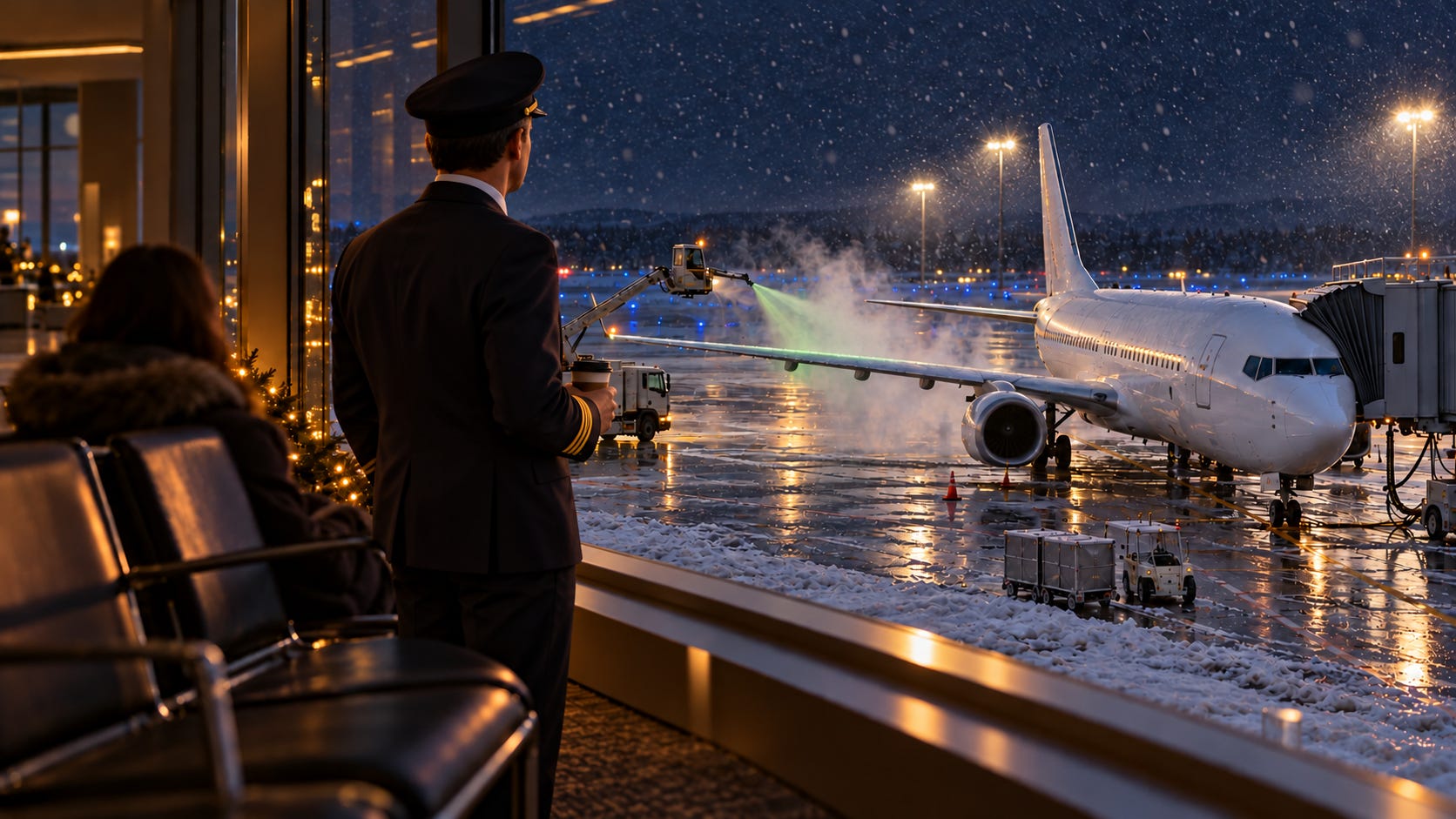
The de-icing line moves. When snow or freezing drizzle is falling, the airplane usually gets sprayed twice. The first fluid, hot and usually orange-tinted, cleans the snow and ice off. The second, thicker and usually green, coats the wings so new snow can’t stick. That coat only protects us for a limited time, called the holdover time. It depends on the temperature, the type of precipitation and how hard it’s falling, and in steady snow it can be well under half an hour.
The clock starts when the green coat goes on. If we’re still in the line for the runway when it runs out, we normally taxi back, get sprayed again, and join the line again.
On a peak day, with a long queue between the de-icing pad and the runway, that loop is how a 20-minute delay turns into two hours. On Christmas morning, we get sprayed and taxi almost straight onto the runway with the fluid still doing its job.
Hint from up front: green fluid on the wing is the protective coat. If you only see orange, that’s normal too. On a cold, dry morning with nothing falling, cleaning is all the airplane needs. The faint sweet smell in the cabin during spraying is the fluid, and it’s harmless.
Want the whole de-icing story, from the orange spray to the green coat? I wrote it up in April:

The crew isn’t running from behind. Every pilot and flight attendant has a legal limit on how long they can be on duty. On a peak day, small delays stack up from one flight to the next, and by evening some crews run into that limit. When a crew times out, the flight can’t leave with them, and if the airline can’t find a fresh crew, it cancels.
Airlines keep reserve crews and a few spare airplanes for exactly this, and on the busiest days they get stretched thin by evening. On the holiday itself, with fewer flights scheduled, there’s usually more slack, and a small problem gets fixed with a phone call.
Who’s up front on a holiday comes down to seniority. Some senior crew bid those trips for the holiday premium many contracts pay, and plenty of junior crew are there because they couldn’t hold the day off. Either way, nobody on a quiet holiday flight is running late, and the cabin feels it.
“One Christmas morning, when I was a young first officer on the MD-80, the terminal was so quiet I could hear the wheels of our crew bags all the way to the gate. A flight attendant brought a box of chocolates, and we passed it around before boarding the handful of passengers waiting outside. It was a short flight, and up front we worked through the checks with paper coffee cups tucked beside our flight bags and the low winter sun coming through the windscreen. I missed being home, but once we were airborne, I remember thinking that working Christmas wasn’t quite as bad as I’d expected.”
The three days I’d book
Thanksgiving morning (Thursday, November 26). Take the first departure of the day, ideally before 8 AM. That airplane spent the night at your airport, the crew starts fresh, and there’s no earlier flight that can make it late. Most short and mid-length trips put you on the ground before noon, with time to spare before the turkey.
Hint from up front: book the nonstop, even if it costs a little more. On a holiday morning the connection is usually the only thing that can go wrong.
Christmas Day (Friday, December 25). It’s one of the quietest days of the holiday season at the airports, and in 2025 it was the cheapest day to fly out of two whole regions. Morning flights get you there for lunch. Evening flights tend to be the lightest of all.
Hint from up front: check the seat map before you pay for extra space. Your odds of an open seat beside you are usually better than on the busy days around it. If you’re choosing a seat anyway, here’s how I pick mine: The Captain’s Guide to Better Seats — How Pilots Actually Pick the Best Seats

New Year’s Eve (Thursday, December 31). The quietest ordinary day of the season. Fly during the day, land by early evening, and you’re at the party with time to change.
Hint from up front: fly home on New Year’s Day or Saturday the 2nd, and keep away from Sunday, January 3, when most of the country heads back for work. Both are usually much lighter than that Sunday return wave.
Five more hints for the next two months
Missed the sweet spot? Fly the quiet day. Last October I wrote that Google Flights data puts the best Thanksgiving fares about 35 days before the holiday. (the 35-day rule)
This year that was last Thursday, October 22. If you haven’t booked yet, the busy days have already started to climb, and the quiet ones are where the value is left. Last year Thanksgiving Day itself was the cheapest day to fly out of three of five US regions. Set a fare alert for Thursday morning before you give up on the trip.
Book Christmas with one eye on December 11. Congress has funded the government through December 11. If it isn’t extended, a lapse would land right as Christmas travel begins. During last year’s shutdown, the FAA ordered flight cuts at 40 airports. Nobody knows what will happen this time, so for Christmas trips, favor fares you can change without a penalty and the first flights of the day.
Read the fare before you buy it. The cheapest holiday fares are often basic economy: no seat choice, and on some airlines no full-size carry-on. For a family, check the airline’s family-seating policy first: several US airlines now seat young kids next to a parent for free, even on basic fares (the age cutoff varies by airline). The next fare up is still often worth it for the carry-on, because a checked bag that misses a connection on a peak day can take days to catch up.
Put the airline app on your phone before you leave home. When a flight cancels, the app usually offers a new seat before the agent at the gate can get to you. If the airline cancels and you decide not to travel at all, US rules now entitle you to a cash refund, not just a voucher.
Leave the gifts unwrapped. The TSA may need to open a wrapped present to check it. Use gift bags or ship them ahead, and put wine and snow globes bigger than a tennis ball in a checked bag.
Those are the days I’d pick, which leaves the opposite question, the day I won’t fly. Most people guess the Sunday after Thanksgiving, because it holds the record and it’s a hard day, but it isn’t my answer.
There’s one window, a few hours long, when I won’t book my own family at any fare. Most people pick it because it feels like the sensible choice, and from up front it’s when everything I described above goes wrong at the same time.
If someone in your family is booking that window right now, this is a good post to share with them.
Free subscribers get what happened. Paid subscribers sit up front with me: the crew’s view, my call from the left seat, and direct access to ask me anything.
Below the line: the window I’d never fly and exactly why, the rebooking math that turns one cancelled flight into a lost holiday, and three typical holiday bookings scored the way I’d score them for my own family. Plus the five-line card I check before I book any holiday flight.
