
Why Your Plane Is Getting Hosed Down With Green Liquid
And Why You Should Be Glad
By Pilot Nick — ⏱ 7 min read
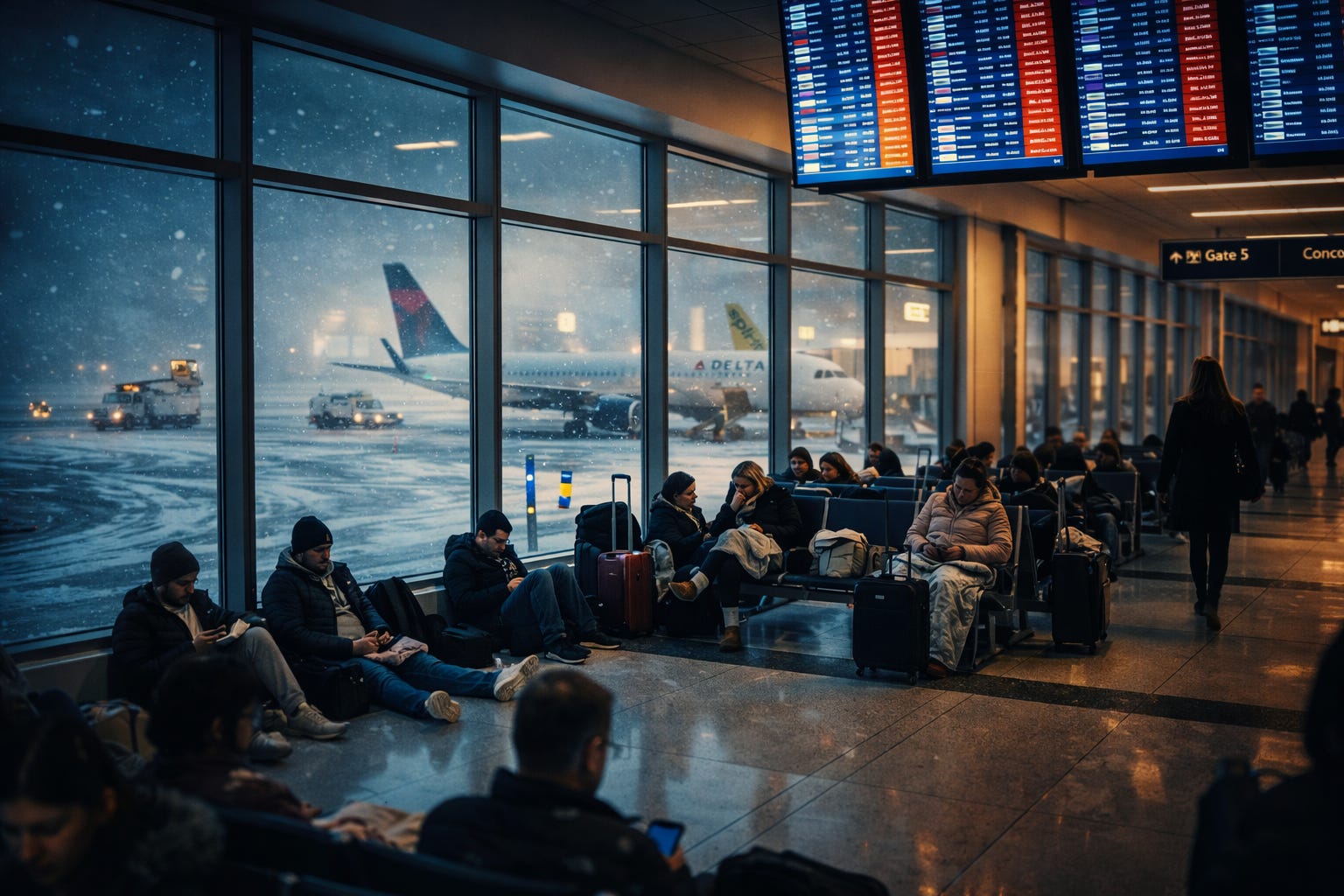
You’re sitting at the gate. It’s January. Boarding was on time, the doors are closed, and then… nothing happens.
A few minutes pass. Then you see it through the window — a truck pulling up with a long mechanical arm, and suddenly your airplane is getting hosed down with a bright green (or orange) liquid. The captain comes on and says something about “de-icing procedures” and a brief delay.
Half the cabin groans. A few people pull out their phones to text about running late.
But here’s the thing: what you just watched might be the single most important thing that happens to your airplane all day.
And from the cockpit, we’re not frustrated by the delay.
We requested it.
Let me show you what’s really going on.
Lessons From The Flight Deck ✈ is a reader-supported publication. To receive new posts and support my work, consider becoming a free or paid subscriber.
What You’re Actually Seeing Out There
When temperatures drop near or below freezing, any moisture in the air — rain, sleet, snow, even fog — can form a thin layer of ice or frost on the wings. Sometimes you can see it clearly. Sometimes it’s a nearly invisible glaze that looks like the wing is just wet.
Here’s the part that surprises most people: it doesn’t take much.
A layer of frost as thin as medium-grit sandpaper can reduce the wing’s lifting ability by 20–30%. I’m talking about something you’d barely feel if you ran your hand across it.
Why? Because a wing isn’t just a flat surface. It’s a precisely engineered shape — a curved airfoil — designed so air flows faster over the top and slower underneath, creating the pressure difference that holds a 180,000-pound airplane in the air. Even a thin layer of contamination disrupts that flow, creating tiny pockets of turbulent air right where you need smooth, attached airflow the most.
The result? The wing stalls at a lower angle and at a higher speed. That’s a problem during takeoff, when the aircraft is heavy, slow, and climbing.
That’s why we don’t gamble. Ever.
In aviation, we follow something called the Clean Aircraft Concept. It’s not a guideline — it’s a regulation. No aircraft may attempt takeoff with frost, ice, or snow adhering to the wings, control surfaces, or engines. Period. There are no exceptions, no pilot discretion overrides. It’s one of the most black-and-white rules in commercial aviation.
What’s Actually Happening From the Cockpit
Before we push back, my First Officer and I are checking the weather, the wing conditions, and talking with the ground crew. If there’s any contamination on the aircraft — frost, ice, snow — we’re calling for de-ice.

And here’s something most passengers don’t realize: there are actually two separate steps to this process.
Step one is de-icing. That’s the hot fluid — usually orange, called Type I — heated to around 150–180°F (65–80°C) and sprayed at high pressure. It melts and washes away whatever has already accumulated on the aircraft. Think of it like a hot shower for the airplane. It removes the problem.
Step two — and this is the clever part — is anti-icing. That’s a thicker fluid, often green or yellow, called Type IV. It’s applied right after de-icing and clings to the surfaces like a protective gel. Its job is to prevent new ice from forming while we taxi to the runway. It’s basically giving the airplane a raincoat before sending it back into the storm.
The reason you sometimes see us pull away from the gate before getting sprayed? That’s intentional. Many airports have dedicated de-icing pads closer to the runway. This shortens the time between treatment and takeoff and as you’re about to learn, that matters. A lot.
After the spraying is done, the ground crew does a final visual inspection and reports back to us: “Aircraft is clean.” We confirm, log the fluid types and the exact time of application, and only then do we call ready for taxi.
The Clock Is Ticking — and We’re Watching It
Here’s where timing becomes everything.
That anti-icing fluid doesn’t last forever. Every fluid type has what we call a holdover time — a window during which it remains effective. That window depends on the temperature, the type of precipitation, and how heavy it is.
Some examples to give you a sense:
Light snow at -3°C (25°F): roughly 30–45 minutes of holdover
Moderate snow at -10°C (14°F): maybe 15–25 minutes
Light Freezing rain: 2-5 minutes (essentially No Go)
We have detailed charts in the cockpit for this. We check them constantly. And if we’re sitting in a long taxi line and our holdover time is about to expire, we go back and do it again.
Yes, that means another delay. And yes, we will make that call every single time, without hesitation.
I’ve done it. More than once. I’ve been number three for takeoff and told the tower we need to return for re-treatment. Is it frustrating for everyone on board? Absolutely. Is it negotiable? Not a chance.
There’s also something we do right before takeoff that you’ll never see: a pre-takeoff contamination check. One of us visually inspects the wings from the cockpit window (or requests an external check if visibility is limited). We’re looking for any signs the fluid has failed — bare spots, ice crystals reforming, or fluid that’s lost its gel-like appearance.
If anything looks off, we stop. Full stop.
No pilot — not one I’ve ever met in 25 years — will take a contaminated wing into the air ever.
“But Is It Really That Dangerous?”
I get it. From your seat, it looks like a minor inconvenience — some trucks spraying liquid and adding 20 minutes to your day.
But the aviation industry learned this lesson through hard experience, decades ago. The procedures we follow today are built on that knowledge. Modern de-icing is incredibly thorough, highly regulated, and designed with enormous safety margins.
Here’s one thing that might put it in perspective: the amount of testing and certification that goes into those de-icing fluids is extraordinary. Every type of fluid is tested against specific ice types, temperatures, wind conditions, and precipitation rates. The holdover time charts we use aren’t estimates — they’re derived from thousands of controlled tests.
So when you see that truck pull up? That’s not a problem. That’s the system working exactly as it should.
Thanks for reading Lessons From The Flight Deck ✈! This post is public so feel free to share it.
For the Nervous Flyer 💙
If winter flying makes you uneasy, let me offer you this:
That delay you’re experiencing at the gate? It’s proof that nobody is cutting corners. Every single person in that chain — the pilots, the ground crew, the dispatchers — is trained to prioritize this above schedule, above convenience, above everything.
We don’t rush it. We don’t skip it. And if conditions change while we’re waiting, we start over.
That green fluid on the wing isn’t a sign something is wrong. It’s a sign everything is going right.
Here’s something else that might help: once we’re airborne, wing icing is managed by a completely different system. Modern jets have anti-ice systems built into the engines and the wing leading edges. These use hot bleed air from the engines, routed through channels inside the wing’s front edge, to keep ice from forming in flight. On some newer aircraft, electric heating pads do the same job. These systems run continuously whenever conditions call for it.
You’re covered on the ground by the de-icing crews. You’re covered in the air by the aircraft’s own systems. And you’re covered at every point in between by a crew that’s trained to err on the side of caution — always.
One more thing. If you’re sitting at the gate watching the de-icing and your anxiety is climbing, try this: narrate what you’re seeing. Seriously. “That’s the Type I hot wash. Now they’re switching to Type IV anti-ice. Now they’re inspecting.” Turning uncertainty into understanding is one of the most effective things a nervous flyer can do. You’re not a passive passenger — you’re an informed one.
Take a breath. You’re in good hands.
Insider Tips for Winter Travel ✈️
A few things I’ve picked up over thousands of cold-weather departures:
Book early morning flights when you can. Overnight frost is usually lighter and faster to treat than active snowfall. If a storm is rolling in during the afternoon, the morning flight often gets out cleaner — and closer to on time. Airlines also tend to have more reserve aircraft and crew available in the morning, which means fewer cascading delays.
Build buffer into your connections during winter. If you’re connecting through a northern hub — Chicago, Denver, Minneapolis, Toronto — in January, a 45-minute connection that works fine in July might not survive a de-icing queue. I’d aim for at least 90 minutes on winter connections through weather-prone hubs. Give yourself the margin.
If you see the de-ice truck, watch the wings. You’ll notice the fluid changes color between passes. Orange first (the hot wash), then green or yellow (the protective coat). Now you know what each one does — and you can narrate it to the nervous flyer sitting next to you.
Window seat on a winter day? You might notice a faint shimmer on the wing during taxi — that’s the anti-ice fluid still doing its job. If you see it streaking off during the takeoff roll, that’s completely normal. The fluid is designed to shear away clean as we accelerate, leaving a bare wing at rotation speed.
If the captain announces a return for re-treatment, don’t panic and don’t be annoyed. You just witnessed a crew making the most conservative, safest call available. That is exactly the crew you want flying your airplane.
Traveling for business? If you’re worried about explaining a delay to your boss or missing a meeting, here’s the honest framing: “The crew went back for re-treatment because conditions changed. It’s a regulatory safety procedure — not optional.” Anyone who flies regularly will respect that. And if they don’t, send them this article.
Check your airline’s winter hub performance. Some airports are simply better at de-icing operations than others. Airports in Scandinavia, Canada, and the northern U.S. have this down to a science — they process hundreds of aircraft per storm day with remarkable efficiency. If you have a choice of routing, consider which hub handles winter better.
Next Time You Fly in Winter…
Pay attention to the ground ballet happening outside your window. Watch the trucks, the fluid, the hand signals, the coordination. There’s a team of people out there in freezing temperatures — often working through the night — making sure your wing is perfect before you leave the ground.
And if a fellow passenger complains about the de-icing delay, you now know something they don’t: that “delay” is one of the most carefully timed, thoroughly tested safety procedures in all of commercial aviation.
Want me to explain what happens when we actually take off into a snowstorm? The systems running inside the wing, the way we manage icing at altitude, and what those little white streaks are on the engine intakes? I’ll break that down next.
Fly Safe,
Pilot Nick
If this gave you a calmer perspective on winter flying, consider subscribing to Lessons From the Flight Deck. Every week, I pull back the curtain on what’s really happening up front — the things we see, the calls we make, and why flying remains the safest way to travel.
And if winter flying is something that really gets under your skin, my [Fearless Flyer’s Guide] walks you through every season, every scenario, one calm explanation at a time.
See you at cruising altitude.


Regarding deicing, here in Maine we had a tragic private plane crash in Bangor this winter and it's pretty clear that the deicing protocol was not followed properly. 6 died.
Your descriptions are so clear. Thank you.