


If you’ve ever gripped your armrest during turbulence or felt your stomach drop during takeoff, what I’m about to tell you will both terrify and comfort you in equal measure.
It’s a story about one of the bad thing that could happen in a cockpit — and the best of what humans are capable of when everything goes wrong.
🌅 A ROUTINE MORNING, A CATASTROPHIC FAILURE
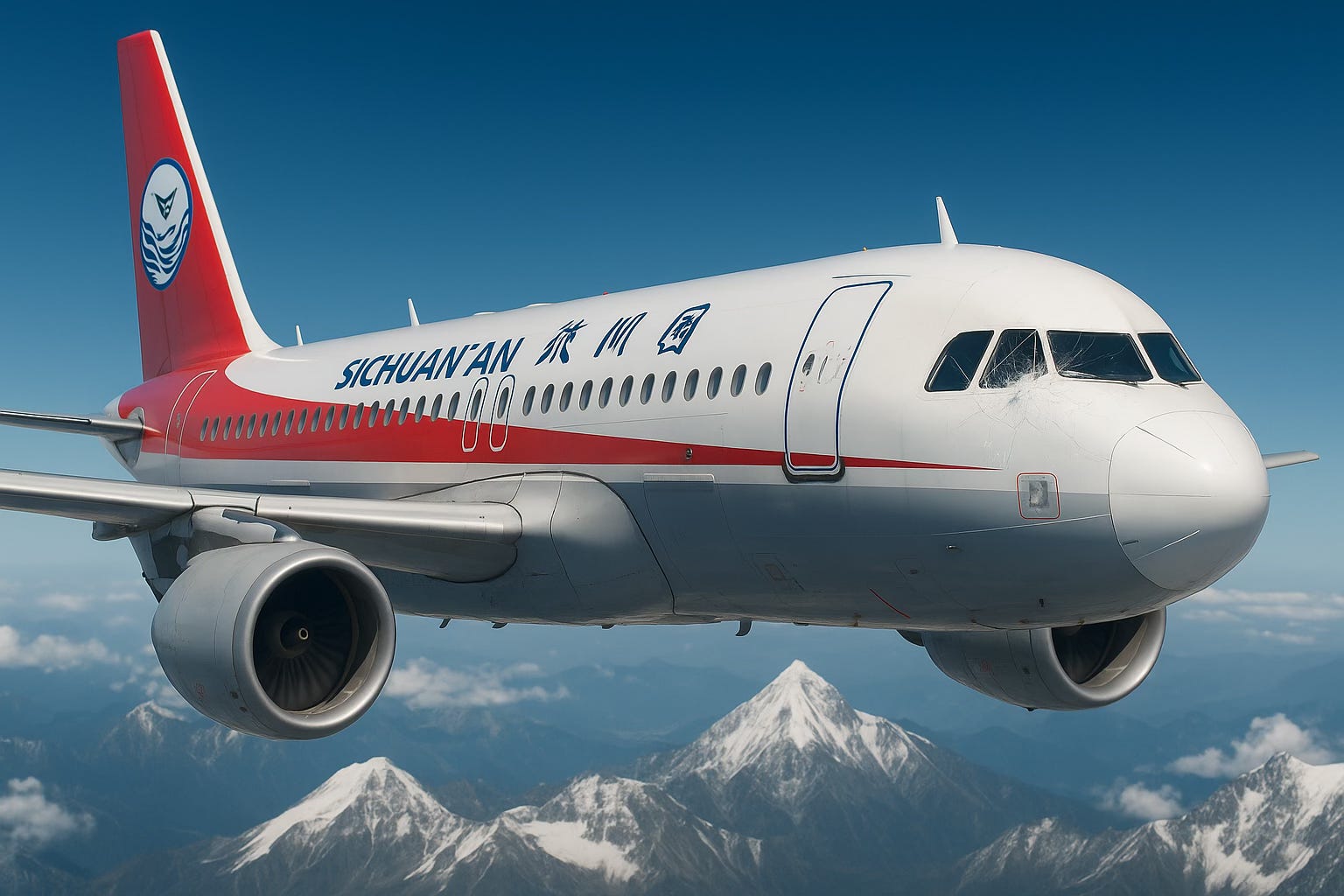
May 14, 2018 started like any other day for the crew of Sichuan Airlines Flight 8633. The Airbus A319 departed Chongqing at 6:27 AM, bound for Lhasa, carrying 119 passengers and 9 crew members. Captain Liu Chuanjian, a former military pilot with over 20 years of flying experience, was at the controls alongside his co-pilot.
They had just leveled off at cruise altitude — 32,000 feet, nearly six miles above the Tibetan Plateau — when the unthinkable happened.
BANG. 💥
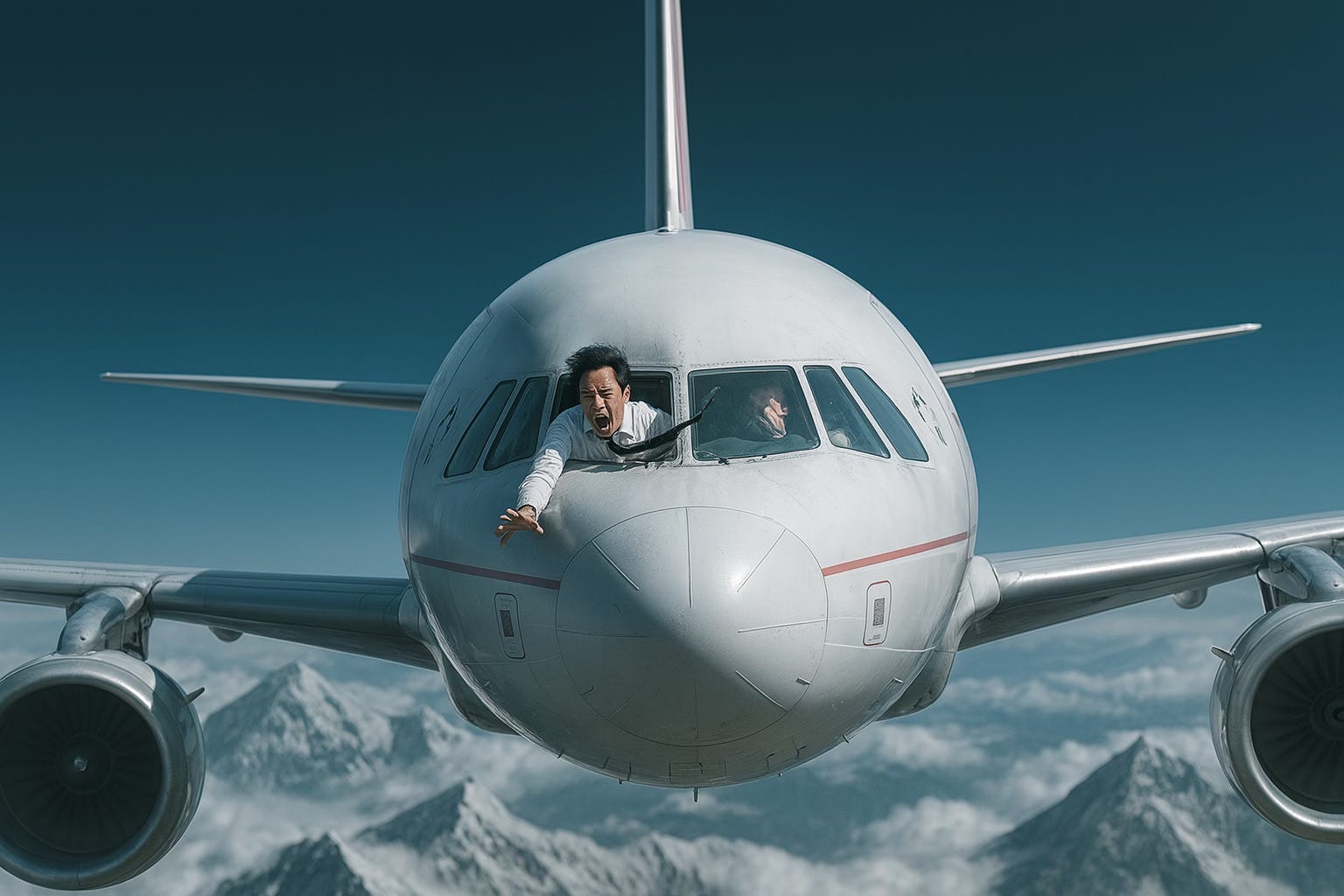
The right-side cockpit windshield didn’t just crack. It exploded.
In an instant, the pressurized sanctuary of the flight deck became a screaming vortex of chaos. The sudden decompression created a force so violent that the co-pilot was ripped from his seat and pulled halfway out of the aircraft. His body was pinned against the exterior of the plane by 500-mph winds, his legs flailing inside the cockpit.
Only his seatbelt that thin strap we’re all told to keep fastened, stood between him and a fatal fall into the mountains below.
😱 INSIDE THE NIGHTMARE
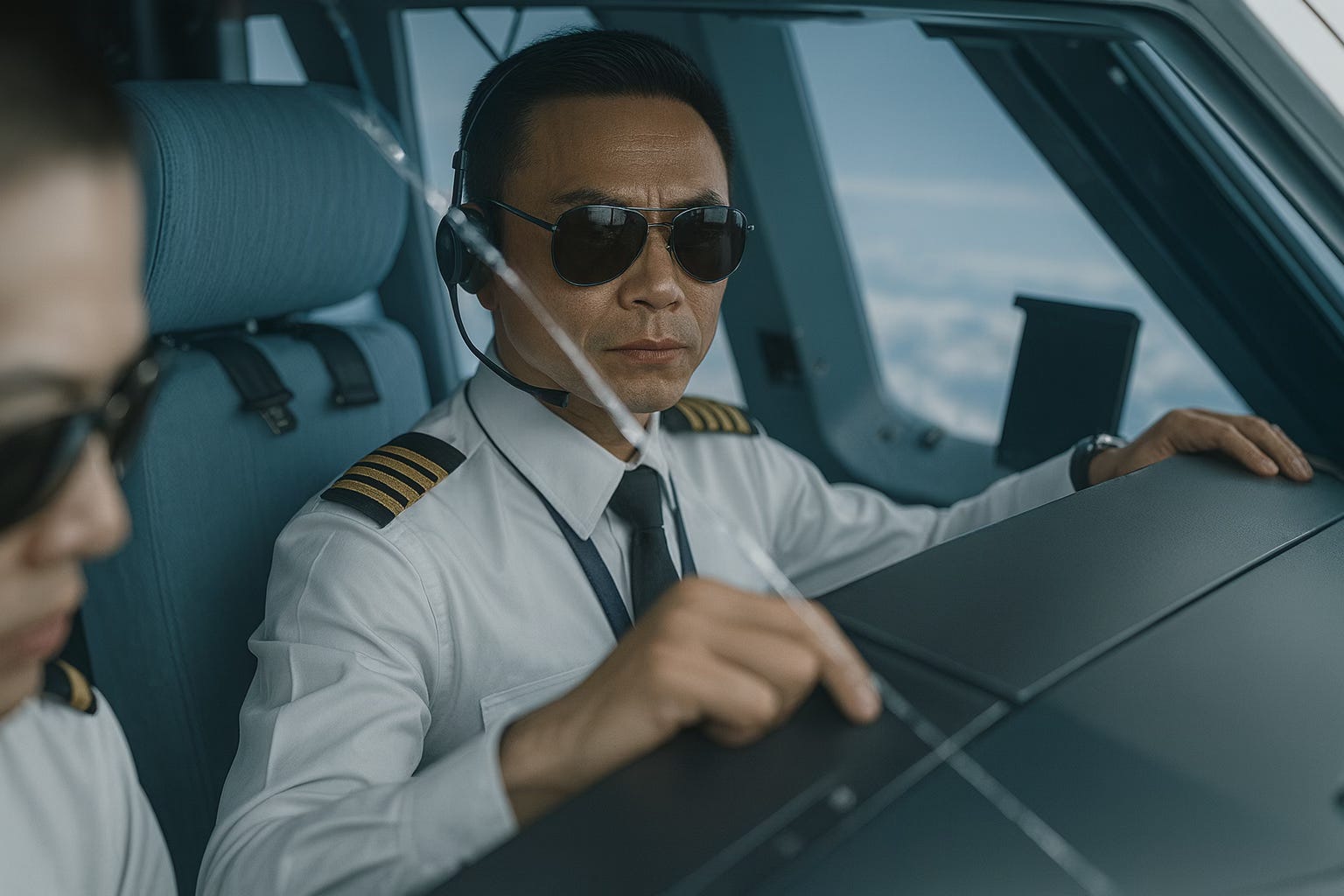
Try to imagine what Captain Liu was experiencing in that moment:
Temperature: The outside air at cruise altitude is around -40°C (-40°F). That arctic blast was now roaring directly into his face.
Noise: The sound of wind screaming through a shattered cockpit window at cruising speed is deafening — loud enough to make communication nearly impossible.
Visibility: Ice began forming on his face and instruments almost immediately. Papers, charts, and debris swirled through the cockpit like a tornado.
Equipment failure: Critical instruments were damaged or ripped away entirely. Radio communication was compromised.
Physical stress: The sudden decompression meant thinner air, making every breath harder, every thought more difficult.
And through it all, he had to fly the plane.
🛩️ THE DESCENT
With his co-pilot incapacitated and hanging partially outside the aircraft, Captain Liu did what his training and instincts demanded: he took full control.
He couldn’t rely on autopilot — the system had disconnected. He couldn’t clearly communicate with air traffic control — the radios were damaged. He couldn’t even reference some of his flight instruments — they were gone or obscured.
What he could do was fly.
Captain Liu initiated an emergency descent, fighting to bring the aircraft down to an altitude where his crew and passengers could breathe more easily. Every control input had to be deliberate. One mistake, one moment of panic, and 128 lives would be lost.
Meanwhile, in the cabin, flight attendants sprang into action. Despite their own terror and the violent shaking of the aircraft, they moved through the aisles, calming passengers, ensuring oxygen masks were in use, and preparing everyone for the possibility of an emergency landing.
The crew managed to manually pull the co-pilot back inside the cockpit. He was alive, bruised, bloodied, and likely in shock but alive.
⏰ TWENTY MINUTES OF HELL
For the passengers, those twenty minutes must have felt like hours. They could hear the roar of the wind. They could feel the plane descending rapidly. Many later said they thought they were going to die.
But in the cockpit, Captain Liu was already planning the landing. He diverted to Chengdu Shuangliu International Airport, one of the busiest airports in western China. Airport emergency crews were alerted. Runways were cleared. Everyone held their breath.
At 7:46 AM — just 34 minutes after the windshield blew out — Flight 8633 touched down safely in Chengdu.
🏁 THE AFTERMATH
When the aircraft came to a stop, the full scale of what had happened became clear:
The co-pilot had survived being partially ejected from an aircraft at 32,000 feet. His injuries? Facial abrasions and a fractured wrist. Serious, yes, but miraculously not fatal.
One flight attendant was injured during the ordeal.
All 119 passengers walked away without life-threatening injuries.
The shattered cockpit told the story: twisted metal, missing instruments, a gaping hole where reinforced glass should have been. The fact that anyone survived, let alone everyone seemed impossible.
💡 WHY THIS MATTERS TO YOU
If you’re a nervous flyer reading this, I know what you’re thinking: “This is supposed to make me feel better?”
Here’s why it should:
First, windshield failures like this are extraordinarily rare. Modern aircraft windshields are marvels of engineering, multiple layers of specially treated glass and plastic designed to withstand bird strikes, hail, and extreme pressure differentials. The Sichuan Airlines incident remains one of only a handful of complete cockpit windshield failures in commercial aviation history.
Second, this incident showcased what the entire aviation system is designed to do: handle the worst-case scenario. Captain Liu’s training kicked in immediately. The cabin crew performed exactly as they’d been drilled to do. The aircraft, despite catastrophic damage, remained controllable. Emergency services were ready and waiting.
Third, and most importantly: it worked. Everyone survived.
For frequent flyers, this is a reminder of something you already know deep down — the pilots sitting up front aren’t just button-pushers. They’re highly trained professionals prepared for scenarios most of us can’t even imagine. Captain Liu’s military background certainly helped, but every commercial pilot undergoes rigorous training in emergency procedures, including rapid decompression scenarios.
🏆 THE RECOGNITION
Captain Liu Chuanjian became a national hero in China. He and his crew received numerous awards and honors, including the prestigious “Hero Pilot” title. When asked about the incident later, Liu was characteristically modest: “I just did what I was trained to do.”
The story captivated the world. In 2019, Chinese filmmakers released The Captain, a dramatic retelling of Flight 8633 that became one of the highest-grossing Chinese films of the year. The movie introduced millions to the story of courage at 32,000 feet.
🤔 THE QUESTIONS THAT REMAIN
Investigators eventually determined that the windshield failure was likely due to a manufacturing defect or installation issue, a reminder that even in an industry obsessed with safety, human error and material flaws can occasionally slip through.
But here’s what also slipped through that day: panic, chaos, and catastrophic failure didn’t win. Training, courage, and crew coordination did.
THE NEXT TIME YOU FLY
The next time you board an aircraft whether you’re a million-miler or someone who needs a stiff drink before takeoff — remember Flight 8633.
Remember that sitting in that cockpit are people who train for years to handle situations you hope never to encounter. Remember that every crew member walking up and down that aisle has drilled for emergencies until their responses are automatic. Remember that the aircraft itself is a triumph of engineering, designed with redundancy upon redundancy.
And remember Captain Liu, who stared into the freezing void at 32,000 feet and refused to let go.
🧠 Lessons for Flyers
This wasn’t luck, it was skill and composure.
Airplanes are designed with redundancy: multiple systems backed up the failed instruments.
Pilots are trained to handle the unthinkable: when automation failed, raw flying skills took over.
Even when the worst happens, aviation is built for survival.
That’s why Flight 8633 is remembered as a miracle but also as proof of why aviation remains the safest form of travel.
🌍 Why This Story Resonates
We all face moments where something “explodes” in our lives—a job loss, a health scare, a sudden crisis.
In those moments, panic doesn’t save us. Preparation, teamwork, and calm execution do.
Captain Liu’s words after landing capture it best:
“All I could do was hold onto the controls and believe.”
💬 Your Turn
If you were sitting on Flight 8633, what would you want to hear from the captain?
Drop your thoughts in the comments, I’ll share my own answer in the next note.
Fly safe out there.
Pilot Nick

Wow what a story, thanks for sharing Nick. I'm grateful for all the training pilots get to keep everyone safe!
Yes knows