


Pilot Nick - 8 min read
Thirty seconds.
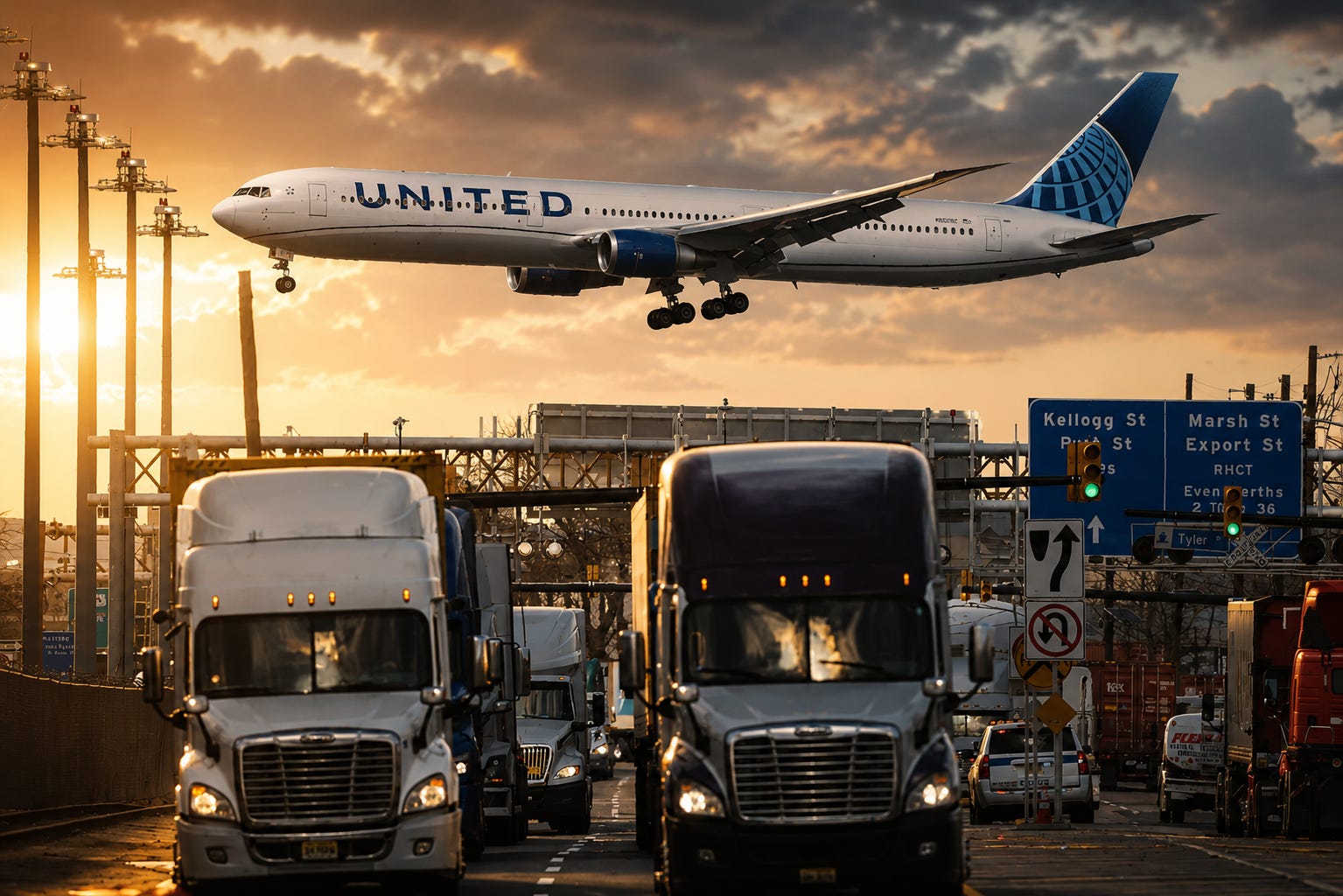
That’s roughly how long it took a Boeing 767 over New Jersey to go from a textbook approach to clipping a light pole on a highway. At 500 feet, by the crew’s own account, the airplane was on speed and on profile. By the time it reached the airport boundary, it was about six feet off the ground — over a turnpike that sits short of the runway, where a stabilized approach would have it crossing the actual threshold near fifty feet.
Six feet instead of fifty.
That’s the whole story, and it’s worth understanding exactly how thirty good seconds became thirty dangerous ones.
I’ve now read the NTSB’s preliminary report on the May 3rd United approach into Newark a few times. I want to do something different with this one. Not reassure you — teach you. I’m going to put on my analyst hat and walk through this approach the way I’d debrief it in a training department, line by line.
Two things before I start.
One: the report is preliminary. The NTSB has not published a probable cause, and won’t for a while. Nothing below is an official finding. It’s my read of the published flight-data and cockpit-voice information, as a pilot who has flown this exact kind of approach hundreds of times.
Two: this is not a pile-on. Every honest pilot reading this report feels the same cold flicker of there but for the grace of God. The value here isn’t blame. It’s the lesson — because the lesson is one that keeps the rest of us alive.
First, the thing my regulars already know: what “stable” actually means
If you’ve read my earlier pieces on the stabilized approach, you can skip this. For everyone else, here’s the spine of the whole thing, because you cannot understand this incident without it. You can read below my article on approach stabilization:

Long before the runway, every airline approach has to pass through a gate, a specific altitude, usually 1,000 feet in cloud or 500 feet in visual conditions. At that gate, the approach must be stable, which means all of these are true at once:
On path — on the correct vertical glidepath and lined up on centerline.
On speed — at the target approach speed, not fast, not slow.
Configured — gear down, flaps set for landing, nothing left to change.
Controlled descent — a normal rate down, not a dive.
Thrust set — engines spooled to a sensible power, not idle.
Briefed and checked — every checklist complete, both pilots on the same page.
Here’s the part that matters most: if the approach is not stable at that gate, the rule isn’t “try to fix it.” The rule is go around. Climb away, sort it out, come back and try again.
A stabilized approach is not bureaucracy. It is the single most reliable predictor of a safe landing in all of aviation. Unstable approaches are behind a huge share of landing accidents — and almost every one of them had a go-around available that wasn’t taken.
Hold that thought. We’ll need it.
The approach that was working
Now the flight. And I want to be fair to this crew, because the front half of this approach was normal.
It was a gusty afternoon — wind from the west at 19 knots, gusting 30, enough to give them what the captain described as moderate turbulence. Their landing runway had been changed three times during the descent, finally settling on runway 29, a runway with no precision electronic glidepath, where you fly the last segment visually using the runway’s approach lights.
At 500 feet, the first officer reported they were on speed and on profile. The captain answered the automated five-hundred-foot callout with one word: stable. By the book, that’s the gate passed.
So far, so normal. Gusty, busy, but normal.
Then came the choice that, in my read, set the trap.
The duck-under and what really happened…
It's a technique nearly every pilot has used and gotten away with. Below, I'll show you exactly what he did, the thirty seconds it came apart, and the one option that sat on the table the whole way down to six feet.
