
Lessons From The Flight Deck ✈

Lessons From The Flight Deck ✈

Cockpit Confidential

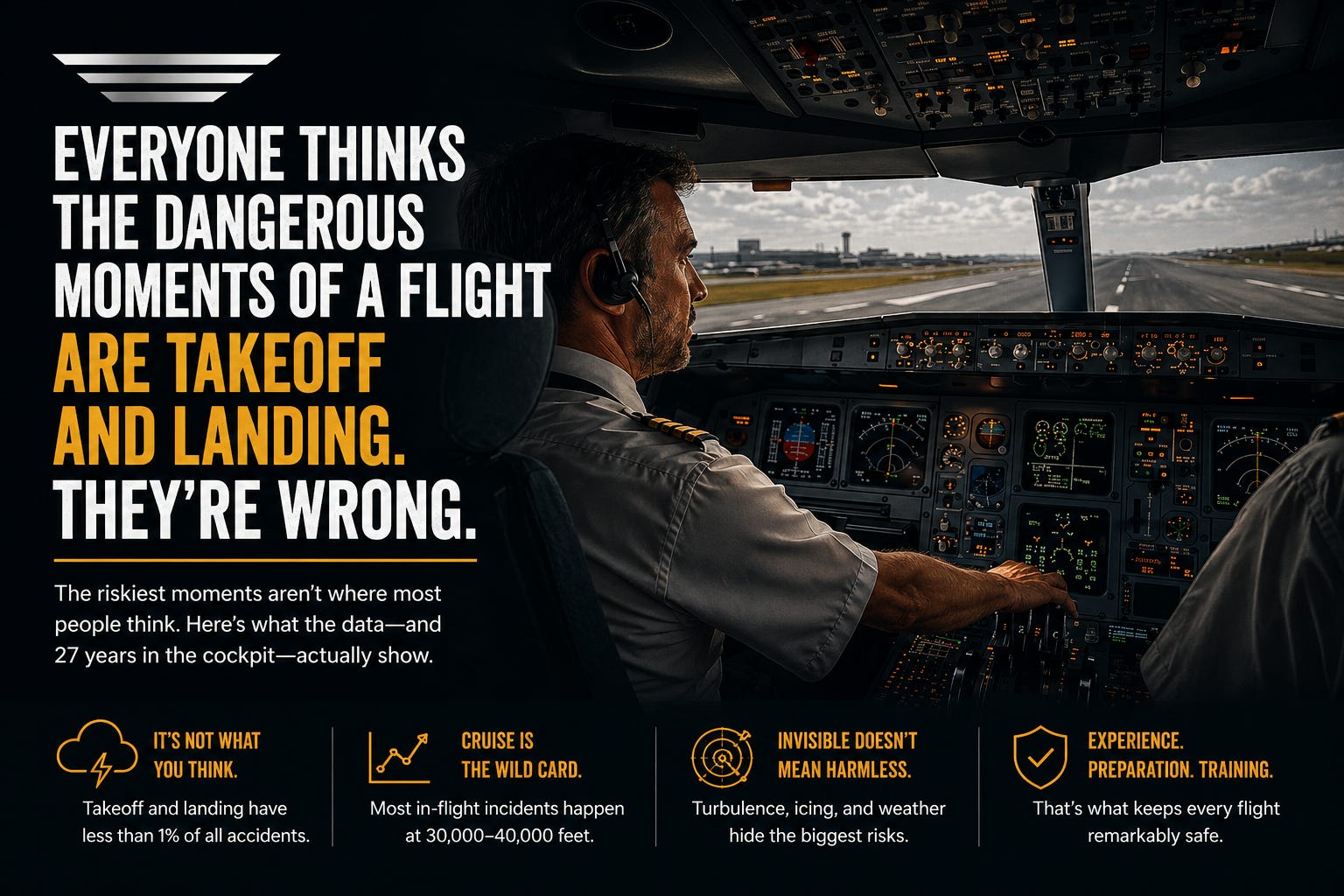
Everyone Thinks the Dangerous Moments of a Flight Are Takeoff and Landing. They're Wrong.

The moments pilots actually watch most carefully aren't what you think and they're built around two hard rules designed to take judgment out of the cockpit entirely.

Pilot Nick 👨🏻‍✈️'s avatar
Pilot Nick 👨🏻‍✈️
Apr 24, 2026
∙ Paid

Pilot Nick — 7 min read

Here’s something that might surprise you.

On a normal flight from New York to London, there are roughly 7 hours where I’m calm, alert, and doing my job at a relaxed pace.

And then there are two windows each about 90 seconds long where every pilot on the flight deck goes completely silent, locks onto the instruments, and runs through a very specific mental checklist.

Most passengers never notice either one.

No announcement. No change in engine sound. No visible cue from the cabin.

But if you knew what we were watching for, you’d realize something: the two most carefully monitored moments of your entire flight aren’t takeoff and landing themselves.

They’re the moments inside takeoff and landing that almost no one outside the flight deck has ever heard of.

Both have hard rules. Both can be aborted. And both exist because decades of accident data taught the industry something uncomfortable: the most dangerous mistake a pilot can make is trying to salvage a bad situation instead of making a clean decision.

Let me show you both.

Lessons From The Flight Deck ✈ is a reader-supported publication. To receive new posts and support my work, consider becoming a free or paid subscriber.


Moment One: The First 90 Seconds

Think back to the last takeoff you experienced.

You felt the engines spool up. The aircraft surged forward. You were pressed gently back into your seat. The runway markings started flashing past faster and faster.

Somewhere in there, you probably relaxed a little once the wheels left the ground.

But on the flight deck, something very specific was happening and it wasn’t the moment of liftoff that had our full attention.

It was the moment just before.

Normal Take-off sequence

The Decision That Has to Be Made in Less Than a Second

Every takeoff has a speed we call V1.

I won’t bury you in aviation theory, but here’s what V1 actually is, in plain language:

It’s the exact speed at which we can no longer safely stop the aircraft on the remaining runway.

Below V1, if something goes wrong, an engine fails, a warning lights up, a tire blows, a bird hits the windshield, we can reject the takeoff. We pull the thrust levers back, deploy the brakes and spoilers, and bring the aircraft to a stop with runway to spare.

Above V1, we can’t.

Above V1, if something goes wrong, we are flying. We will get airborne, climb out, deal with whatever the problem is in the air, and come back around to land.

There is no in-between. There is no “let me think about it.”

V1 is the hardest binary decision in all of commercial aviation. One second you can stop. The next second you cannot.

And the entire takeoff roll, everything from brake release to V1 is built around watching for exactly that decision.


Why “Go” Is Almost Always the Right Answer After V1

Here’s the uncomfortable truth, and it takes new pilots a while to internalize it.

Once you cross V1, you are going to fly. Even if an engine has failed. Even if a warning is screaming. Even if something on the aircraft has broken in a way you don’t yet understand.

You fly.

Because the alternative trying to stop from above V1 means running off the end of the runway at high speed. And every crash investigator will tell you: a high-speed overrun is far more dangerous than taking a damaged aircraft into the air, climbing to a safe altitude, troubleshooting calmly, and landing again.

This is why the pre-V1 window is so intensely watched. It’s the only window where we have a choice. After that, the choice is made for us by physics.

So in that short sprint down the runway usually 30 to 45 seconds both pilots are watching for a very specific, very short list of things that would trigger a rejected takeoff.

And here’s the part that might surprise you: most potential problems that arise during the takeoff roll don’t trigger a reject. We are trained to be extremely selective. The list of things that would cause us to abort is short, and it’s short on purpose.

Because an unnecessary rejected takeoff is itself a dangerous event.

Thanks for reading Lessons From The Flight Deck ✈! This post is public so feel free to share it.

Share


What We’re Actually Watching For (Below 80 Knots vs. Above)

This is where it gets interesting.

The takeoff roll is actually split into two distinct phases, with two different sets of rules.

Below roughly 80 knots, we will reject the takeoff for almost any abnormality. A caution light. An unusual vibration. A door warning. A tire pressure indication. The aircraft is still slow, the runway ahead is long, and stopping is easy and safe.

Above 80 knots and below V1, the list shrinks dramatically. At high speed, we will only reject the takeoff for a very short list of serious events: an engine failure or fire, a clear indication that the aircraft will not fly safely, or a directional control problem. Almost everything else cautions, minor warnings, even some failures, we take into the air and deal with at altitude.

Why the change? Because above 80 knots, the risk of a high-speed reject starts to approach the risk of just flying the damaged aircraft. So we narrow the decision down to only the things that genuinely cannot be flown with.

There’s a call you’ll never hear as a passenger but happens on every takeoff. At 80 knots, the pilot monitoring calls “eighty knots” and the pilot flying responds “checked.” That short exchange isn’t ceremonial. It’s the moment we both acknowledge we’re crossing from one rule set to the other.

From that point, we’re watching a very short list but most of the failures will be inhibited anyway by the airplane until 400ft above the ground.

But we’re are still watching it with an intensity that doesn’t really exist anywhere else in the flight.

Until, that is, the other end of the flight.

Lessons From The Flight Deck ✈ is a reader-supported publication. To receive new posts and support my work, consider becoming a free or paid subscriber.


Moment Two: The Last 90 Seconds

Now fast-forward eight hours.

You’re 10 minutes from landing. You’ve felt the aircraft start its descent. The flaps are extending. The landing gear drops with a reassuring clunk. You stow your tray table. A flight attendant walks past checking seatbelts.

That’s the part you remember.

But somewhere in that sequence usually when the aircraft is about 1,000 feet above the ground something very specific happens on the flight deck.

The pilot flying calls out their instruments. The pilot monitoring runs through a mental list. And for the next 90 seconds or so, we are watching a very short set of parameters with an intensity that mirrors what we were doing at the other end of the flight.

We’re not nervous. We’re not worried.

We’re doing something called verifying a stabilized approach.

And if any one of those parameters isn’t exactly where it needs to be, we don’t try to fix it on the way down. We don’t muscle through it. We don’t hope it improves.

We go around.

We push the thrust levers forward, climb back up, and fly the whole approach again.

Both pilots locked in eyes on instruments, silently cross-checking every parameter in the stabilized zone

Why Pilots Love Go-Arounds (And Passengers Fear Them)

Here’s one of the biggest disconnects between how pilots and passengers view flying.

When passengers experience a go-around, that sudden burst of power, the climb, the circling many of them assume something went wrong. They imagine a near-miss. A dangerous landing averted at the last second. A pilot who “made the save.”

It’s almost never that.

A go-around is the system working exactly as designed. It’s a pilot looking at their instruments at 1,000 feet and saying, “This isn’t quite right and instead of trying to force it, I’m going to take us back up and set it up again properly.”

It’s not a failure.

It’s the opposite of a failure. It’s the decision that prevents a failure from ever happening.

In 28 years of flying, I’ve done go-arounds for wind shifts, for an aircraft that was slow to clear the runway ahead of us, for a glideslope that wasn’t capturing correctly, for a gust that pushed us off centerline, and once for a flock of birds that decided to cross the approach path at exactly the wrong moment.

Every single one was uneventful. Every single one was the right call.

Go-Around Sequence, Power, pitch up, lanidng gear up and Slats/Flaps up

Share


The Second Hard Gate

If V1 is the hard gate at the start of the flight, the stabilized approach gate is its mirror image at the end.

At 1,000 feet above the ground on an instrument approach (or 500 feet on a visual approach), every major airline in the world has the same rule, written almost word-for-word in their operations manual:

If the approach is not stabilized by this point, the crew must execute a go-around.

Not should. Must.

It’s not a judgment call. It’s not optional. It’s not something a pilot can override because they feel confident.

It’s a hard gate.

The reason it exists is because decades of accident data showed something uncomfortable: the vast majority of approach and landing accidents involved aircraft that crossed this gate with something already slightly off, a little too fast, a little too high, a little misaligned and the crew tried to salvage it instead of going around.

So the industry drew a line.

At 1,000 feet, you either have everything in a very specific configuration, or you climb away and try again.

No exceptions.

The question is: what exactly are we checking?

The answer is a concrete, measurable list of conditions that all have to be true at the same time, at the same moment, or the approach is abandoned. There are roughly seven of them, depending on the airline.

Some are about the aircraft’s configuration. Some are about its energy state. Some are about the crew itself. And one of them — the one pilots will tell you is the most commonly missed — has almost nothing to do with the aircraft at all.

It’s about what’s happening inside the flight deck in those final seconds.

User's avatar

Continue reading this post for free, courtesy of Pilot Nick 👨🏻‍✈️.

Or purchase a paid subscription.
© 2026 Nicolas · Privacy ∙ Terms ∙ Collection notice
Start your SubstackGet the app
Substack is the home for great culture