
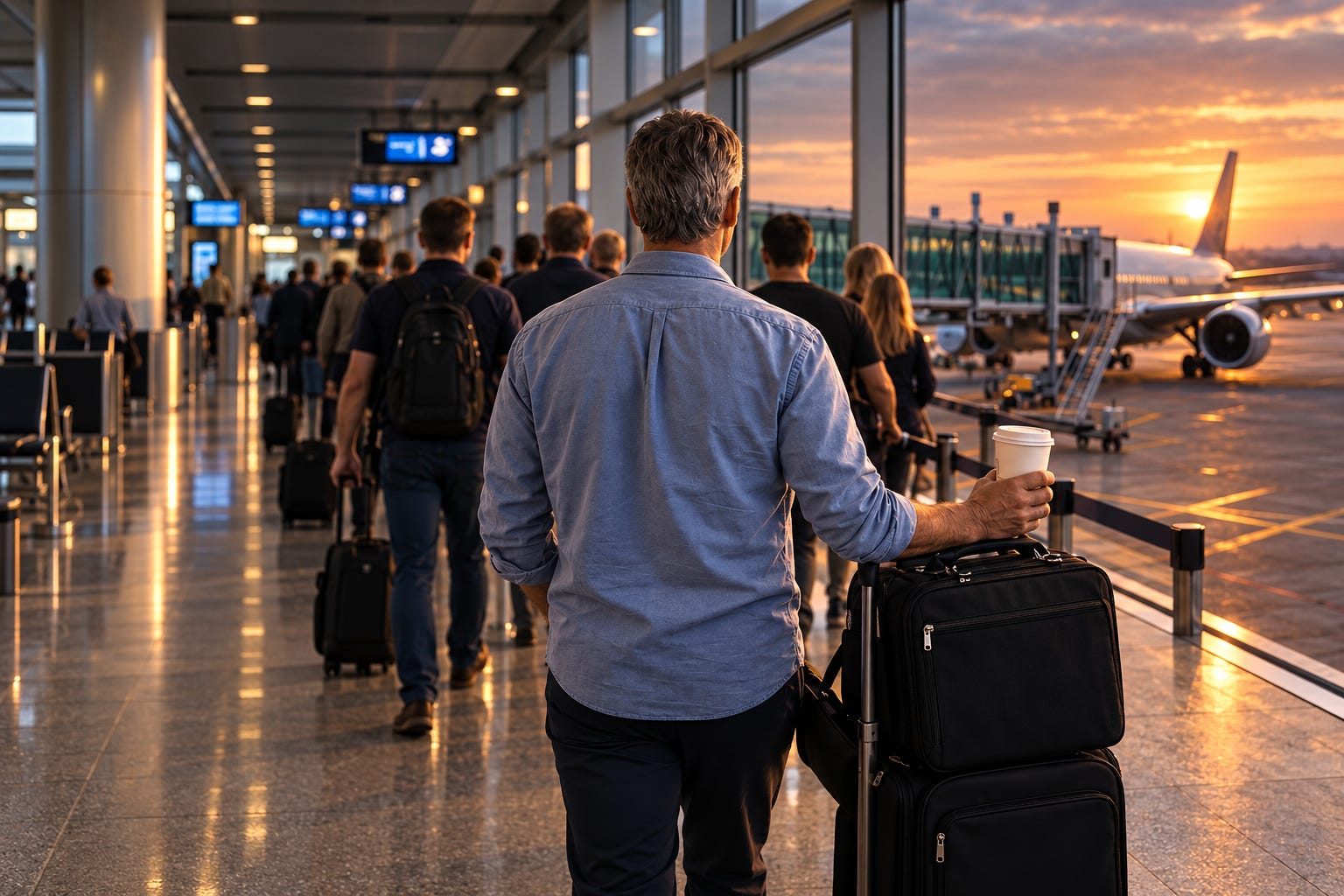
How I Know If My Flight Will Leave On Time — Before the Gate Agent Does
The 7-point checklist I run in my head from terminal to door close.
I’ve logged over 10,000 hours in the left seat.
But a few times a year, I’m just like you boarding pass in hand, backpack under the seat in front of me, trying to figure out if the guy in 24B is going to claim both armrests.
Here’s the thing most passengers don’t know:
I never stop being a pilot.
Even when I’m in row 24 with a ginger ale, there’s a quiet checklist running in the back of my head before the flight. It’s not anxiety. It’s not paranoia. It’s just the habit of 25 years of flying, the same instincts that kick in before I push the throttles forward.
It runs fast. A minute or two, tops. And most of what I’m checking boils down to one question: is this flight going to leave on time?
So today I’m handing it to you. Seven things I check before every single flight from the moment I walk into the terminal to the moment we close the doors.
Screenshot this one. You’ll use it on your next trip.
1. The Weather — But Not the Way You Think
Most passengers check the weather at their destination. Will it rain? Do I need a jacket?
I check three things:
Departure airport weather (wind, visibility, thunderstorms nearby)
Destination weather (same, plus the forecast for my arrival window)
Anything big happening between the two (a line of storms over the Midwest, for example)
Why? Because weather doesn’t just affect takeoff and landing. It shapes the route. A line of thunderstorms over Kentucky might mean a smoother — or bumpier — ride depending on how we go around it.
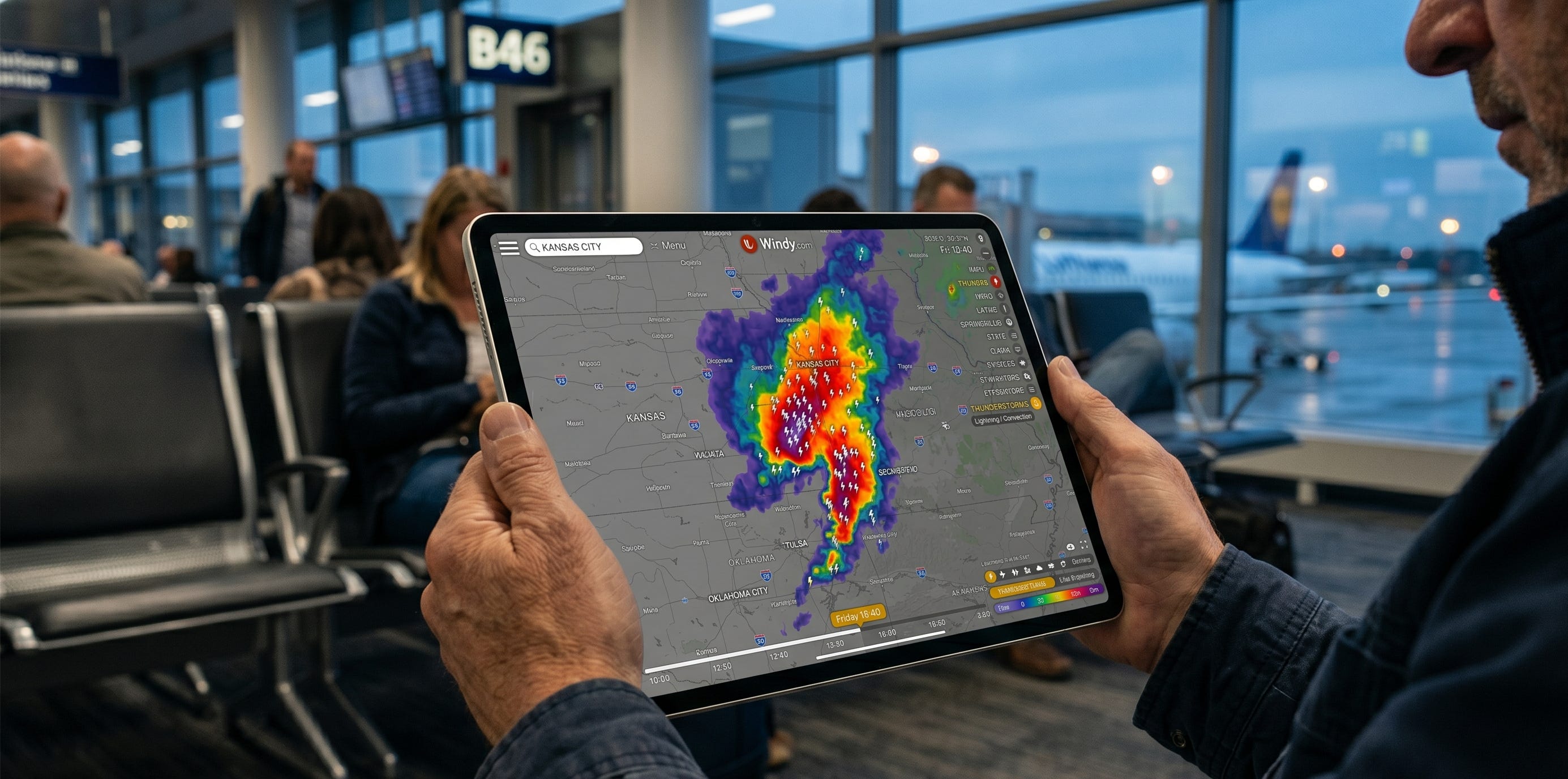
You don’t need to be a meteorologist. I use the same free app most pilots glance at: Windy.com. Zoom out. Look at the big picture between your two cities. If you see a big red blob, expect some deviations. That’s not scary, that’s your crew doing their job.
Read below if you want to know more about Weather App 👇🏻
2. The Aircraft Type — and My Boarding Strategy
This one takes 10 seconds on the airline app and completely changes how I play the boarding game.
If you’ve read The Boarding Mistake 90% of Passengers Make, you already know this:
The goal isn’t to be first on the plane, it’s to minimize your time sitting in a packed cabin or worst in the Jetty.
That’s the principle.
(I’ll link the article below if you missed it👇🏻)
But the right wait time depends entirely on what aircraft you’re on. Here’s how I adjust:
Widebody (777, A350, 787, A380): Boarding 250-400 people takes a while. I wait. Sometimes 20-25 minutes after boarding starts. I want to be one of the last 15% on the plane. Overhead bin space is not a concern — there’s plenty. My carry-on will find a home near my seat. What I’m avoiding is 30 extra minutes of sitting in a metal tube while the rest of the cabin files in past my knees.
Narrow-body mainline (737, A320, 757): My sweet spot. 10-15 minutes after general boarding begins. The initial jam has cleared, most bins are still open, and I can walk straight to my row without the stop-and-go shuffle.
Regional jet (CRJ, E175, Embraer 145): Here’s where my strategy flips. On a small regional jet, overhead space is brutally limited — those bins barely fit a backpack, let alone a 22-inch roller. Board too late and you’ll be forced to gate-check your bag, then wait on the jet bridge at your destination to reclaim it.
So on a regional jet, if I’m traveling with a carry-on I actually need? I board earlier. Not in the first wave, never in the first wave but I don’t push my luck either. 5-7 minutes after boarding starts is my move. Enough to let the jam clear, early enough to protect my bag.
The quick rule: Big plane = wait longer, protect your sanity. Small plane with a carry-on = board earlier, protect your bag.
3. My Seat Position
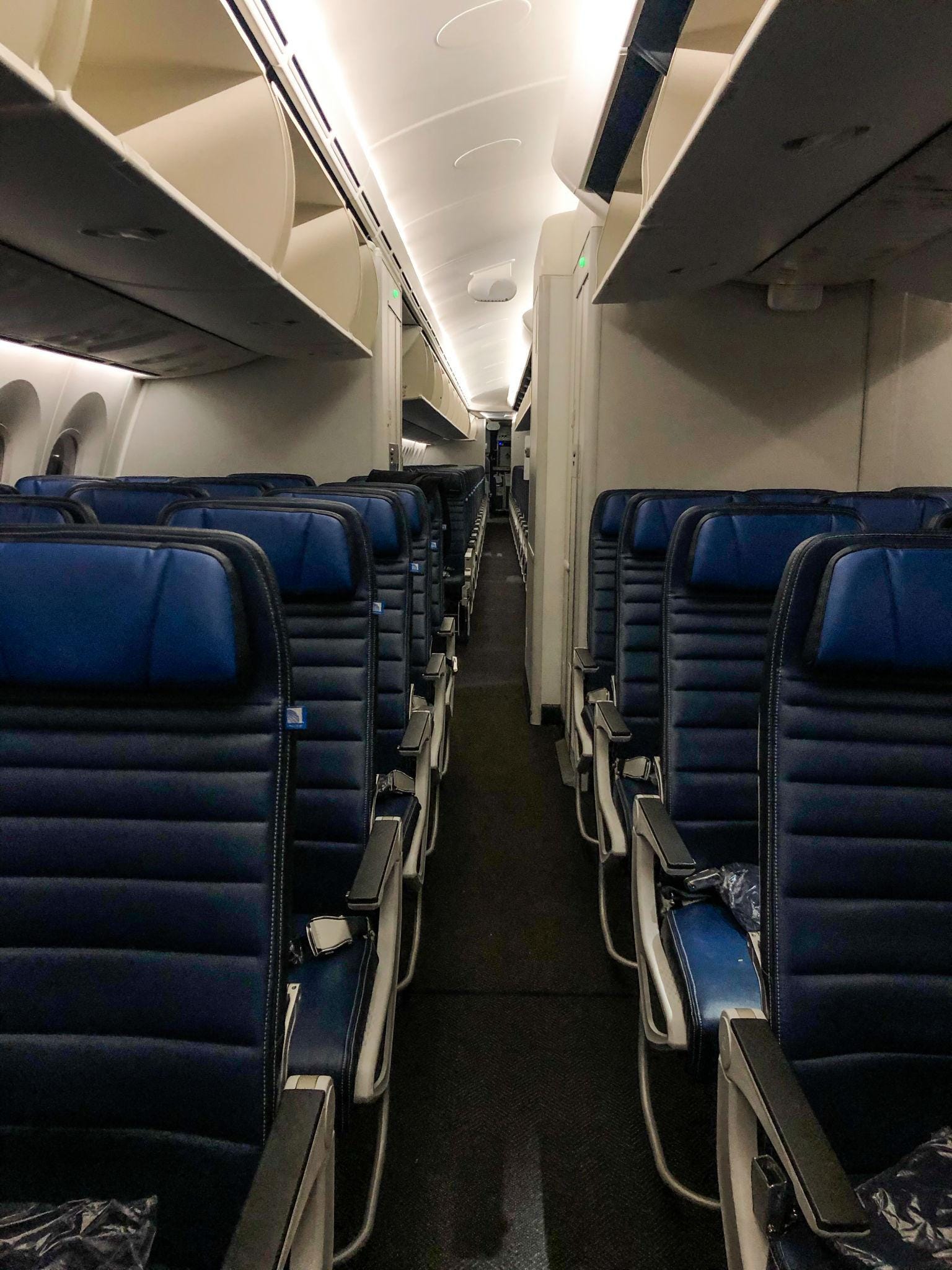
If you’re a nervous flyer, my advice hasn’t changed: sit over or just ahead of the wing. I wrote a full breakdown of why in Pilot’s Secret for a Smooth Flight: Sit Here. Short version — the wing is the pivot point of the aircraft, so turbulence feels noticeably milder there. If bumps make you anxious, that’s your seat.
Read my article below explaining the bext seat for a smooth flight 👇🏻
But when I’m flying as a passenger? My priorities are different. Here’s what I actually look for:
Aisle, always. Especially on long flights. I don’t want to climb over two strangers to stretch my legs or use the lavatory. My knees thank me. My bladder thanks me.
The farther forward, the better. The front of the aircraft is quieter. Less engine noise. Less galley clatter. And this one matters on long-hauls, you deplane faster.
Avoid the back of the plane like it’s on fire. The last few rows are the worst seats in the cabin. You’re next to the galley (carts rattling, flight attendants prepping meals, bright lights that never fully dim). You’re next to the lavatories (the smell, the line of people standing right next to your head for hours, the flushing every 90 seconds). You’re in the loudest part of the plane. And you deplane last.
Avoid any seat within 3 rows of a lavatory. On a 10-hour flight, you do not want to be near that line. Trust me.
If I can grab an exit row, I take it. More legroom. And — this is the pilot in me — if something ever went wrong, I’d rather be in a position to help the cabin crew than be a passenger they have to manage. That’s not a dark thought. It’s just how I’m wired after 25 years in this industry.
The quick rule: Aisle. Forward. Not near the bathroom. Exit row if you can get it.
Book early. The good seats go fast for a reason.
✈️ Enjoying this pilot’s checklist?
I write these from 10,000+ hours in the cockpit — not theory.
Paid subscribers get:
Real-time flight insights
Deep dives on turbulence, safety, and delays
Direct “Ask the Pilot” access
👉 Upgrade here to fly with a captain in your pocket
4. My Hydration — Before I Even Get to the Gate
This is the one nobody talks about.
Cabin air is dry. Really dry. Airline cabins typically hover around 10-20% humidity — drier than most deserts. Dehydration makes you feel tired, anxious, and physically unwell. It also makes turbulence feel worse because your body is already stressed.
So before I even park at the airport, I drink 16-20 oz of water. Then I refill my bottle after security. I aim for another 8 oz per hour of flight time.
Coffee and alcohol? Fine in moderation. But not as a replacement for water. Especially if you’re a nervous flyer — caffeine + dehydration + adrenaline is a bad cocktail at 35,000 feet.
5. Is the Aircraft Already at the Gate?
This is the first thing I do when I walk up to the gate area. Before I sit down. Before I find a coffee. I look out the window.
Is my airplane there?
If yes — great news. That’s one big variable removed. The aircraft is here, the ground crew is working it, and barring something unexpected, we’re on track.
If no — I start running the math.
Here’s what I’m thinking about:
Where is the inbound aircraft coming from? The airline app (Flightradar24 or FlightAware) will tell you. If your aircraft is a flight inbound from somewhere with bad weather, there’s a real chance of delay. If it’s inbound from a sunny hub 90 minutes away and still in the air, you’re probably fine.
How much buffer does the airline have between flights? Standard turnaround for a narrow-body is 45-60 minutes. Widebody can be 90 minutes to several hours. If the inbound is landing 30 minutes before your scheduled departure, that’s tight. Expect a delay.
Is there weather, ATC, or a crew issue that hasn’t been announced yet? I check three things fast like described above: the weather at my departure airport, the weather at my destination, and the FAA’s ground stop map (if I’m flying in the US). If there’s a ground stop or a flow restriction into my destination, the delay is coming, the airline just hasn’t posted it yet.
If I’m flying in Europe, I check for an ATC slot. This is a big one that confuses most passengers. In Europe, when airspace or a destination airport is congested, Eurocontrol assigns your flight a CTOT a Calculated Take-Off Time. It’s a 15-minute window when your aircraft is allowed to depart. Miss it, and you’re waiting for the next one.
Here’s the part passengers don’t know: the slot can improve or get worse but only if you’re ready.
To be eligible for a better slot, the aircraft has to be fully ready: everyone on board, doors closed, pushback crew standing by, and the flight crew or dispatch has to send a “ready message” to Eurocontrol. Only then can the system offer you an earlier slot if one opens up.
This is why, in Europe, boarding sometimes feels oddly urgent even when the posted departure time is later. The crew isn’t rushing for fun, they’re racing to get the ready message out so you can catch an earlier slot instead of waiting another 45 minutes.
If you ever hear “we’re waiting on a slot” from the captain, now you know exactly what that means.
And I take a quick look around the aircraft itself. This is a pure pilot habit. If the aircraft is at the gate, I spend 15 seconds scanning the ramp through the terminal window. I’m not inspecting anything, the professionals do that. I’m just looking for what I don’t expect to see.
A maintenance truck parked next to the aircraft with the hood open? A cowling panel sitting on the ground? Mechanics walking around with tools and clipboards instead of the usual baggage-loading choreography? Those are yellow flags for a potential delay.
What I want to see is boring: baggage carts moving, the catering truck coming and going, the fuel truck doing its thing, the ground crew in their usual calm rhythm. Boring is good. Boring means on-time.
What this tells me: Whether I have time to grab a proper meal, or whether I should stay close to the gate. Whether I should text the person picking me up. Whether I need to rethink my connection.
None of this changes whether the flight is safe. It just removes the surprise. And if you’re a nervous flyer, surprise is what feeds the anxiety. Knowing the delay is coming 30 minutes before the gate agent announces it puts you back in control.
The quick rule: Aircraft at the gate = good news. No aircraft = open FlightAware and find out why.
6. My Exit Row Awareness
I’m not suggesting you obsess over this. But I always note where my nearest exit is and I count the rows between me and it.
Why count? Because in the extremely unlikely event that the cabin fills with smoke or the lights go out, you won’t be able to see. You’ll have to feel your way. Counting seat backs is how you find the exit.
“Three rows forward. Two rows back.” Ten seconds. Done.
This isn’t fear. It’s preparation. It’s the same reason I brief every single takeoff in the cockpit, even after thousands of them. Preparation is what allows calm.
7. The “Boarding Completed” Call and Pushback
This is my last check — and the one most passengers don’t even know to listen for.
Once I’m in my seat, I’m not really paying attention to anything until I hear two things:
The flight attendants announce “boarding is complete” and the cabin door closes
The aircraft starts moving — pushback from the gate
If those two things happen within a few minutes of each other, we’re good. On time. Everything worked.
If there’s a gap — if the door is closed but we’re still sitting at the gate 10, 15, 20 minutes later with no pushback — something is cooking.
Here’s what’s usually going on behind the scenes:
Waiting for the pushback tug. Ground crew is backed up, our tug is still pushing another aircraft.
Still loading bags. The cargo doors have to be closed and weight-and-balance paperwork signed before we go anywhere.
Paperwork delay. The final load sheet, fuel numbers, or flight release from dispatch isn’t in yet.
ATC flow control. We’ve been given a later departure slot because of traffic or weather at our destination.
Something mechanical. A warning light, a system check, a write-up in the logbook that needs maintenance to sign off.
A good captain will come on the PA and tell you what’s happening. If you hear that announcement, actually listen — it’s the most accurate information you’ll get all day. No gate agent guessing. No app notification delay. It’s coming straight from the front.
If you don’t hear a PA and you’re just sitting there, that’s okay too. Sometimes the crew is still gathering information and doesn’t want to speculate. Give it 5-10 minutes.
For my nervous flyers: A delay on the ground is not a sign something is wrong with your flight. It’s usually the opposite — it means the crew is making sure everything is exactly right before we move. I’d rather leave 20 minutes late than leave with a question unanswered. Every pilot feels the same way.
The quick rule: Door closed + pushback within a few minutes = on time. Door closed + sitting still = wait for the PA. It’s coming.
And that’s the checklist. Seven habits. About two minutes of total attention spread across the hour before departure.
None of this makes the flight safer, flying is already one of the safest things you’ll do this year. What it does is remove the surprise from your travel day. It turns the unknown into the known. And it’s why, when I’m in row 24 with my ginger ale, I can close my laptop the moment we push back and actually enjoy the flight.
I’ll be running this checklist next time I fly as a passenger.
I hope you’ll run it too.
If This Was Useful, Here’s Where to Go Next
If you’re a frequent traveler who wants more of the operational, insider stuff — delays, boarding strategy, connections, packing — you’ll want The Smart Traveller’s Guide. It’s the ebook I wish every passenger boarded with.
If flying still makes you anxious — especially turbulence, strange sounds, or the silence from the cockpit — the Fly Calm Masterclass walks you through what’s actually happening up front, step by step. Most students tell me it’s the first time flying has ever made sense to them.
If you have a specific flight coming up and you just want a pilot to walk through it with you — weather, route, what to expect — that’s what my 1:1 Pilot Briefing is for 20-30 minutes on Zoom. Personal. Direct. No sales pitch.
And if you just want more free posts like this one subscribe below. One calm, clear post a week, straight from the flight deck.
Safe travels,
Pilot Nick ✈️
P.S. If you found this useful, hit the ❤️ it helps other nervous flyers find this newsletter. And if there’s a specific part of the flight that makes you anxious, drop it in the comments. The next “Ask the Pilot” post is being built from your questions.


I’m not a nervous flyer but I’ve always wanted to see what the seat path lighting actually looks like.
Great list, appreciate you sharing the experience gained over all those flights! Maybe do one on pre-arrival/arrival? For example, I have learned to remain seated when everyone else jumps up at the ding! No need to stand until all the rows ahead have cleared. Here's to CAVU for your next flight!