


Forty minutes after takeoff. The seatbelt sign just went off, you’re somewhere over the ocean, and a thought slips in: “What if an engine quits out here?”
You look out the window at that huge engine hanging under the wing. There’s one more on the other side. That’s it. Two. No spare.
Here’s what nobody tells you: two is already one more than the airplane needs.
Every commercial jet is certified to take off, climb, cruise and land with one engine shut down. Each engine is powerful enough to fly the airplane on its own, and we practice flying on one engine in the simulator every six months.
Twin-engine jets crossing oceans go even further. Under rules called ETOPS, they’re approved to fly for three hours or more on a single engine to reach the nearest suitable airport. An engine failure is serious, but for the airplane it’s a planned-for event, not a catastrophe.
So no, there’s no backup engine.
The second engine is the backup
Pilots and engineers have a word for this: redundancy, meaning backups for the backups. You’re not flying in a machine that could fail. You’re flying in a machine designed to handle failure.
And engines are just the first layer. Here are five more backup systems working for you on every flight.
Let me walk you through five of my favorite behind-the-scenes safety systems that are working hard for you on every single flight and engines are just the first layer. Here are five more backup systems…
1. Dual (and Triple!) Hydraulic Systems
Those big, heavy control surfaces on the wings? The landing gear that tucks up so smoothly? The brakes that stop a 200-ton airplane? They're all powered by hydraulic systems basically super-strong fluid power.
What if one fails? Here's the beautiful part: most commercial planes don't just have one hydraulic system. They have two or three completely independent systems. If System 1 decides to take a coffee break, System 2 is already on the job. If System 2 gets tired? System 3 is standing by.
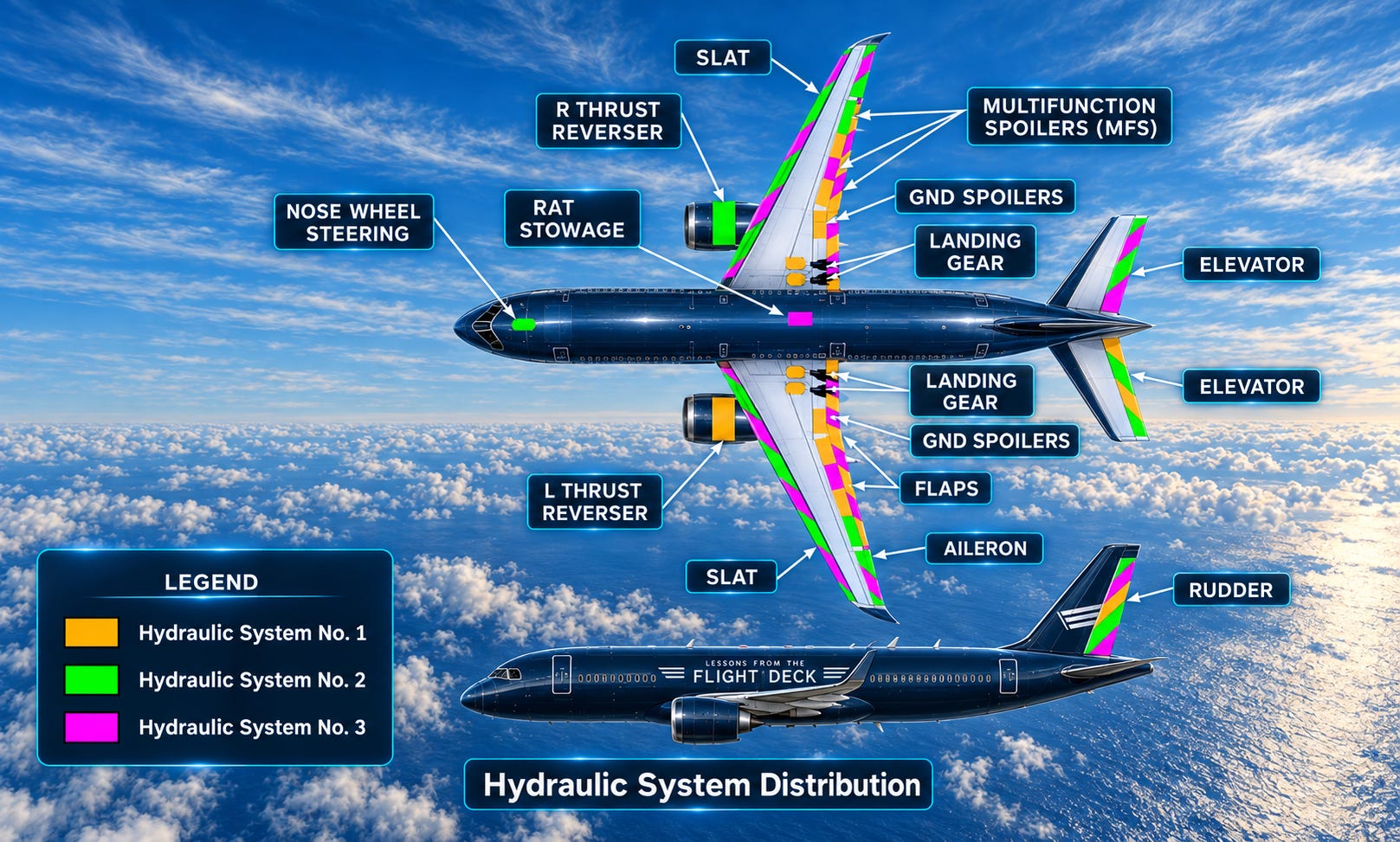
I've actually experienced a hydraulic failure myself on a flight from Denver to Chicago. Did we declare an emergency? Nope. Did passengers even notice? Not a chance. The backup system took over so seamlessly that the only difference was some extra paperwork for me after landing and maintenance had to fix before the next flight.
2. Multiple Ways to Keep the Lights On
From the screens in the cockpit to the reading light above your seat, everything needs electricity. So what powers a flying metal tube at 500 mph?
Primary power comes from generators attached to the engines. But what if those engines aren't running (like when we're parked at the gate)? We've got the APU Auxiliary Power Unit, basically a small jet engine in the tail that exists just to make electricity.
But wait, there's more. Every plane carries backup batteries. And my personal favorite? The RAT Ram Air Turbine. This little wind-powered generator literally pops out of the plane like a jack-in-the-box if we lose all other power sources. The airplane's own forward motion spins it up and voilà: emergency power

I love the RAT because it's so wonderfully simple. No computers, no complex systems. Just good old physics keeping the essential systems running.
Flight Air Transat 236 landed safely because of more than piloting. The RAT and other backup systems most passengers never see kept the essentials running. Read my article below 👇🏻
Air Transat Flight 236: The Azores Glider Story, Told by a Pilot

Air Transat Flight 236: the Azores Glider, and the pilots who flew it
3. Breathing Easy at Altitude
At cruising altitude, the air outside is too thin to breathe comfortably. That's why we pressurize the cabin to feel like you're only 6,000 to 8,000 feet up, a bit higher than Denver.
The cabin pressure system has three levels of backup: automatic, standby, and manual. The automatic system handles everything normally. If it gets confused, the standby system steps in. And if all else fails, pilots can control cabin pressure manually — we actually practice this scenario regularly in training.
And if something goes really wrong? Those yellow oxygen masks aren't just for show. They drop automatically if cabin pressure gets too low, giving everyone plenty of breathing time while we descend to a safer altitude.

Fun fact: those masks provide oxygen for about 12-15 minutes which sounds scary until you realize that's more than enough time for us to get down to 10,000 feet where you can breathe normally again.
Most passengers misunderstand those yellow masks, including what’s actually in them and why the crew tells you to put yours on first. I explain it all here 👇

4. Never Really Lost

Modern navigation is incredibly sophisticated, but what if all that fancy GPS technology decides to take a nap?
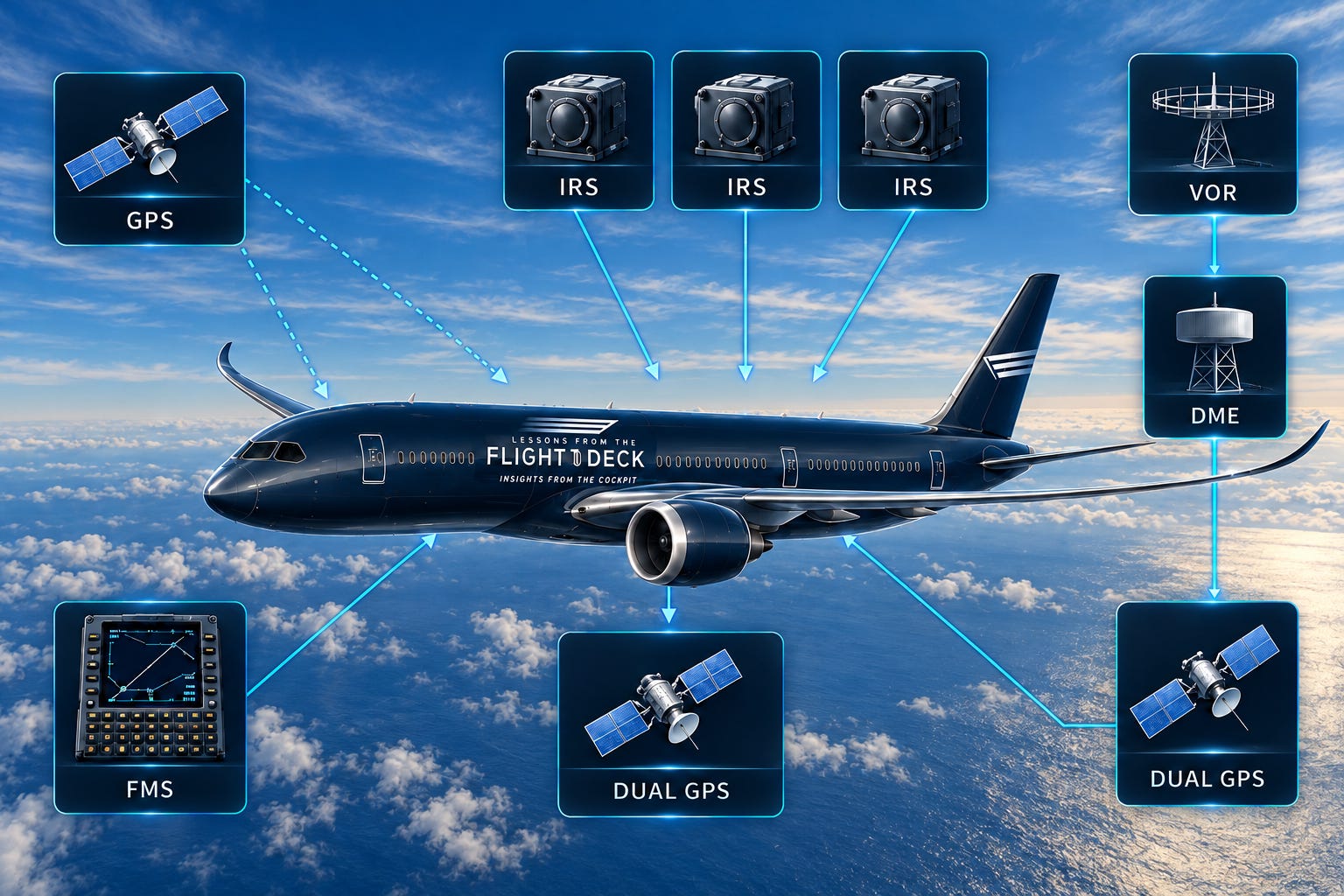
Commercial aircraft carry multiple independent navigation systems: GPS, inertial navigation (which basically remembers where it's been), ground-based radio navigation, and even old-school compass headings. It's like having Google Maps, Apple Maps, Waze, and a paper road atlas all running at the same time.
Radio communication works the same way. We typically have at least three separate radio systems on board. Air traffic control can reach us through multiple frequencies, and we can reach them just as easily.
I once had all my primary navigation displays go dark on a flight (turned out to be a simple display issue, not a navigation problem).We switched to the backup displays, carried on, and the passengers never knew."
5. Human Redundancy (Yes, We're Backups Too)
This might be the most important backup system of all: there are always two of us up front.
Both pilots are fully trained and certified to fly the airplane solo if needed. We regularly practice scenarios where one pilot becomes incapacitated, and the other takes over completely. In fact, some of our most intense training sessions involve exactly these situations.
But it goes deeper than that. We're trained to cross-check each other constantly. When I read a checklist item, my co-pilot confirms it. When they set a frequency, I verify it. We're not just two pilots flying together, we're a safety system designed to catch each other's mistakes before they become problems.
And speaking of training, we don't just learn this stuff once and call it good. Every six months, we're back in the simulator, practicing emergency procedures. Engine failures, electrical problems, hydraulic issues, bad weather approaches we've seen it all in training, multiple times, so if we ever see it in real life, it's just another Tuesday.
On long-haul flights, there are often three or four pilots on board, so each of us can take proper rest breaks in a dedicated bunk. On every flight, at least two of us are always up front.
Why This Should Actually Make You Feel Better
I know what some of you might be thinking: "All these backup systems exist because things DO go wrong!"
But here's how I want you to think about it: Flying isn't safe because nothing ever fails — flying is safe because it's designed to handle failure gracefully.
Your car has seat belts, airbags, and crumple zones. That doesn't make driving dangerous — it makes it safer. Same principle applies here, just with a lot more engineering behind it.
Every system I've described has been tested thousands of times. The procedures have been refined through decades of experience. The training never stops. And all of this happens behind the scenes while you're settling in with your book or scrolling through the in-flight entertainment.
When I'm sitting in the cockpit during a smooth flight, I'm not thinking about all the things that could go wrong. I'm thinking about all the brilliant engineering and careful planning that makes these routine trips possible. I'm grateful for every backup system, every redundant component, and every safety protocol that lets me bring you and your fellow passengers safely to your destination.
Your Turn
I know this probably doesn't answer every "what if" scenario floating around in your head. And that's okay, anxiety isn't always logical, and it doesn't always respond to facts and statistics.
But I hope this gives you a peek behind the curtain at just how much thought, engineering, and preparation goes into every single flight you take.
What's your biggest flying fear? Hit reply and tell me. I read every email, and I'll tackle the most common concerns in future newsletters. No question is too basic, no worry too small.
Maybe you're wondering about turbulence (spoiler: it's uncomfortable but not dangerous). Maybe you want to know what all those sounds during flight really mean. Or maybe you're curious about what happens if we lose an engine (also not as scary as it sounds). Tell me in the comments.
Whatever it is, I'm here to help you understand what's really happening up there.
Because here's the thing: you're not alone in this. Every person on that airplane — from the pilots to the flight attendants to the mechanics who signed off on the aircraft has a personal stake in getting you safely to your destination.
We've all got families waiting for us too.
If flying anxiety ever pulls you out of the moment whether it’s turbulence, strange sounds, or silence from the cockpit, I’ve created a few resources to help.
My ebooks and short masterclass walk you through what’s really happening in the aircraft, explained the way pilots think about it calmly, clearly, and without drama.
They’re there whenever you need a bit more reassurance.
👉 Explore the Calm Flying Guides
Fly Safe,
Pilot Nick

P.S. — If you found this helpful, feel free to forward it to any fellow nervous flyers in your life. Sometimes knowing you're not alone in your worries is half the battle.
When you said "backup," I thought you meant an engine for backing up. Of course, airliners are usually towed for backing up.
But that reminded me of the crash of the Lauda Air Boeing 767 in Thailand in 1991. The thrust reverser for one engine spontaneously deployed while climbing, causing a stall and a descent that exceeded the speed of sound, tearing the plane apart. Everyone on board died.