


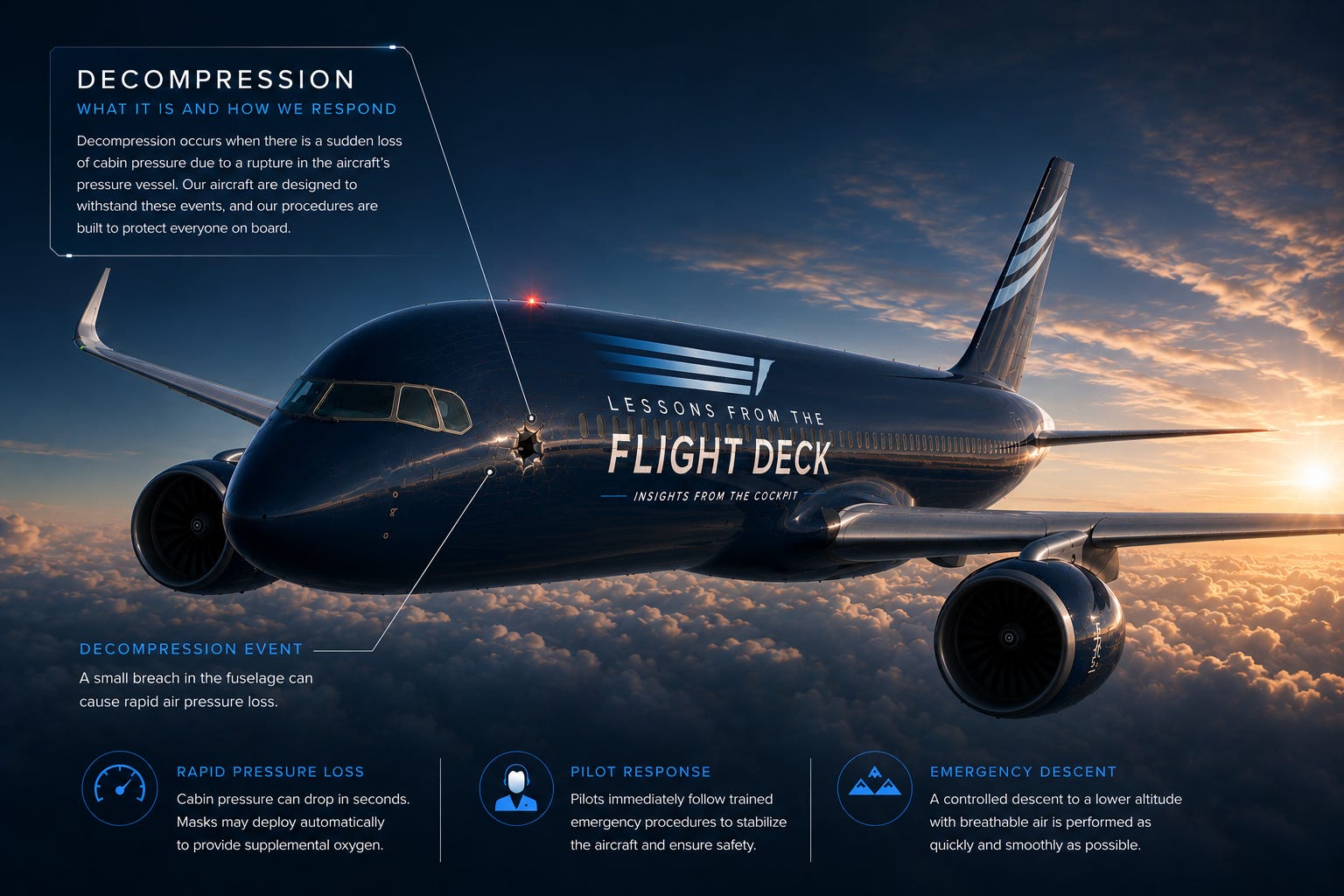
Pilot Nick · 8 min read
You’re in seat 24C, three hours into the flight, somewhere over the ocean.
The cabin lights are dim. The person next to you is asleep. You glance up at the little compartment above your head, the one you’ve never seen open and you think, just for a second:
what would it actually feel like if those masks dropped right now?
You’ve seen the safety video a hundred times. You know “put yours on before helping others.” You know it means breathe normally.
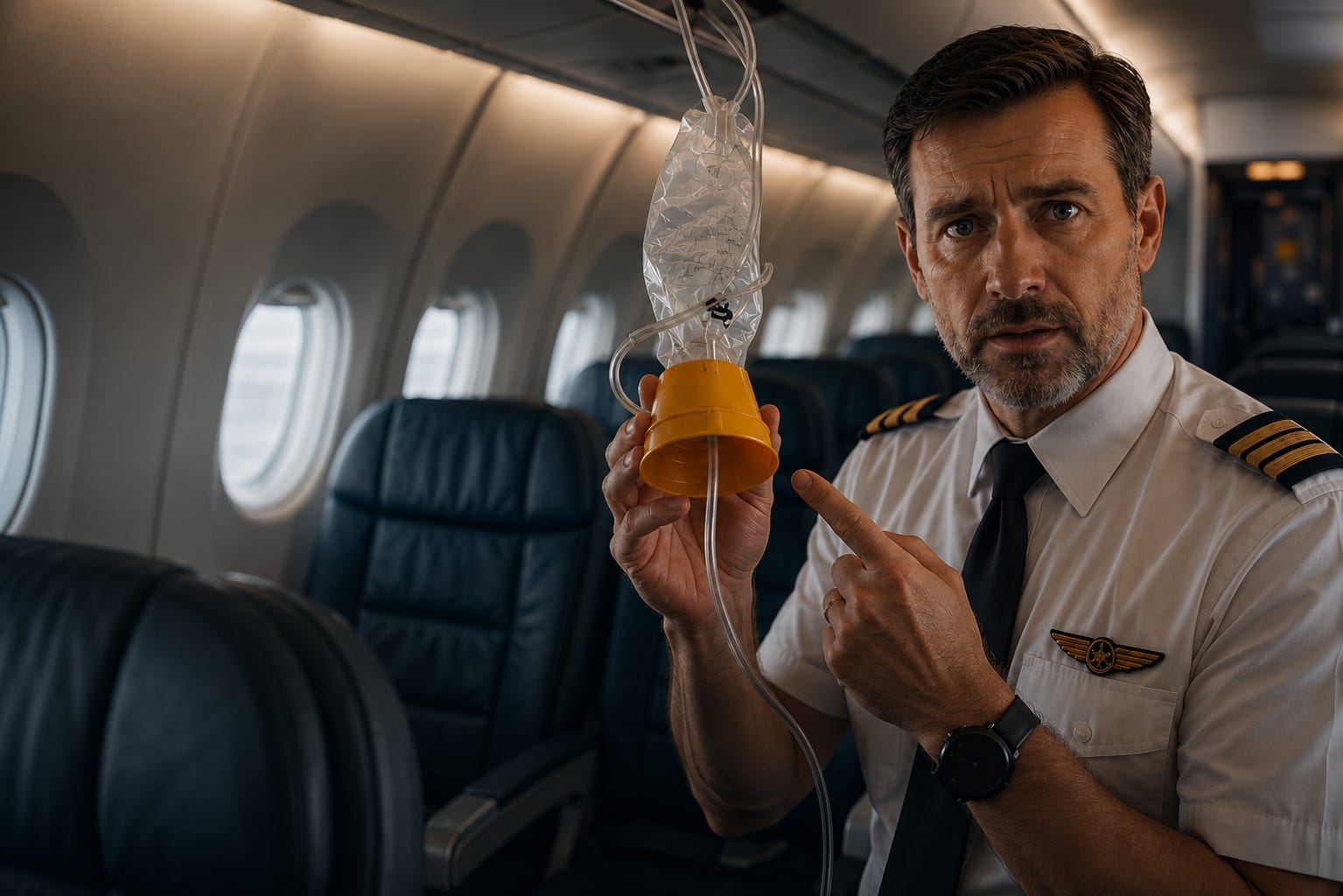
You also know, somewhere in the back of your mind, that the safety video doesn’t tell you what comes before the mask. Or after. Or what the pilots are doing in the 30 seconds you’d be fumbling with the elastic.
Up at 35,000 feet, we know that feeling too, not as passengers, but as the pilots who train for this scenario more than almost anything else in the simulator.
What most passengers get wrong about that yellow mask
Most people think the scary part of cabin pressure is the moment the mask falls from the ceiling.
I’ll tell you what’s actually scary if you’re a pilot: the version where the mask doesn’t fall because the cabin never gave anyone a warning loud enough to react to.
The cabin pressurization system is one of the most reliable systems on the aircraft. So reliable that most passengers fly thousands of hours over a lifetime and never give it a thought.
That reliability is also why, when something does go wrong, the second-most-feared cabin event for nervous flyers becomes the one almost nobody understands.
Here’s the truth your safety card doesn’t have room for: those yellow masks aren’t a parachute.
They’re a clock.
And once you understand the clock, you understand the entire procedure including why the pilots’ first job isn’t to comfort you.
It’s to dive.
Even if we fail, the airplane doesn’t
Most modern private jets and the Airbus A350 are equipped with a system called Automatic Emergency Descent — AED for short or ADM (Automatic Descent Mode)
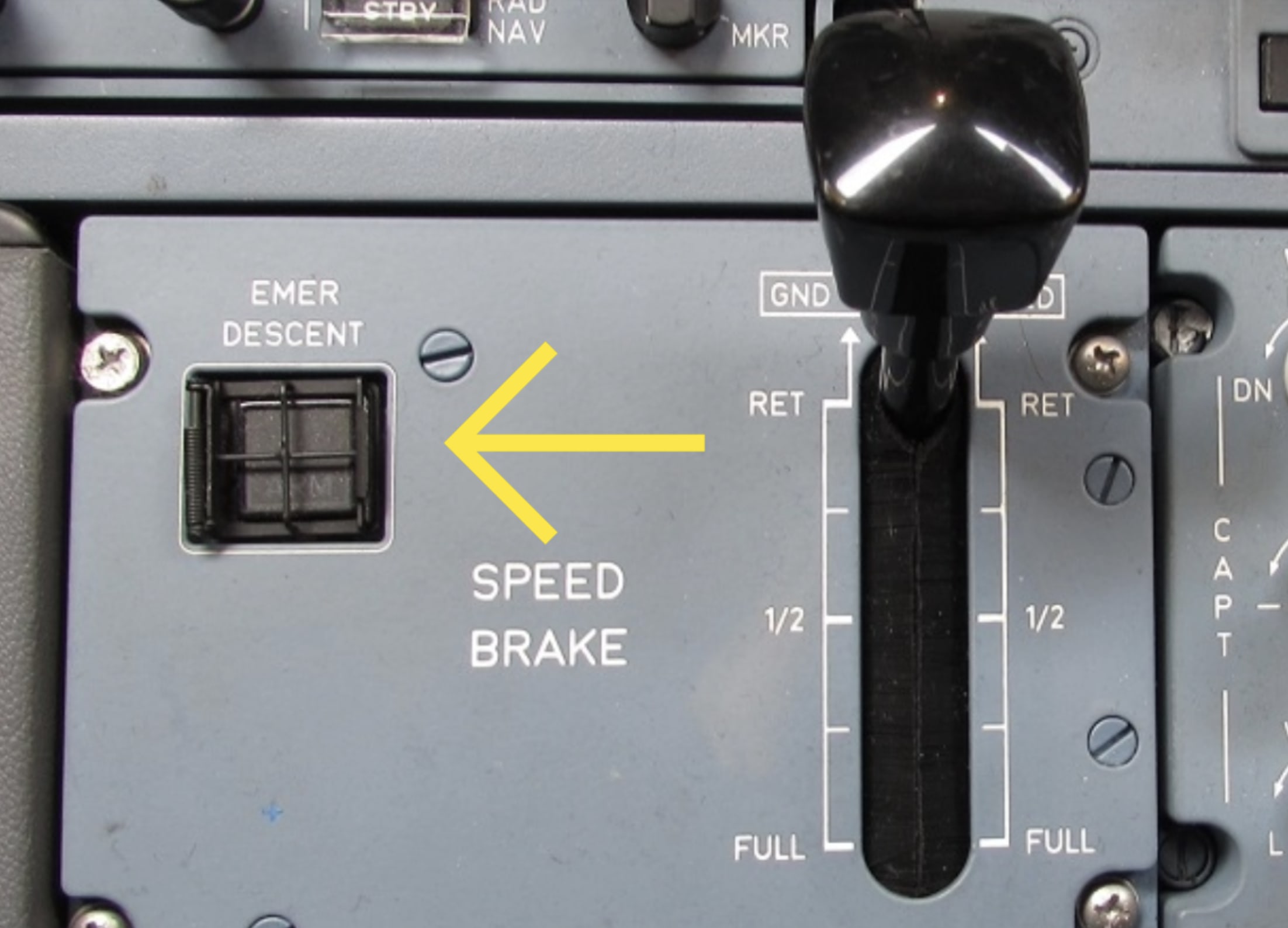
If the cabin altitude crosses a critical threshold and the pilots don’t react within seconds — because they’re already hypoxic, incapacitated, or simply too slow — the autopilot and autothrottle take over. The airplane disconnects from its cruise route, banks roughly 90 degrees off the airway to clear traffic below, pulls the throttles to idle, deploys the speed brakes, and dives toward 10,000 feet on its own.
No pilot input required.
On every other airliner — which is still the majority of the fleet flying today — the pilots execute the exact same maneuver themselves. And that is precisely what we train, in a full-motion simulator, every six months.
It was engineered into the airplane for one reason: because hypoxia takes away the judgment to recognize hypoxia, the system can no longer assume a human will catch it in time. So the system catches itself.
This is the second clock you didn’t know was running. The first is the oxygen in the yellow mask. The second is the airplane itself already programmed to do what your body would be trying to do, if it could.
What we actually train for and what “emergency descent” really means
Every six months, I sit in a full-motion simulator for a recurrent training session. Cabin decompression is on the syllabus almost every single time — right alongside engine failure on takeoff, fire warning at altitude, and a rejected takeoff at decision speed. It is, statistically, one of the four scenarios airline pilots rehearse more than any other.
This is not a “we covered it once” kind of training. This is a “we run it until our hands move before our brain does” kind of training.
So when you hear the phrase emergency descent, here’s what’s actually happening in the cockpit:
Masks on, within two seconds. Both pilots reach for their quick-don oxygen masks the moment the cue is recognized. Mask first. Communicate second. The cockpit oxygen system is independent of the cabin’s — stored at high pressure, lasts far longer, and is the reason the pilots can keep flying the airplane while you breathe through your yellow one.
Autopilot stays engaged. Modern philosophy is to let the automation do the precision work while the humans manage the procedure. We don’t disconnect to “fly it manually” because we’re brave. We let the autopilot fly because it doesn’t get hypoxic.
90-degree turn off the airway. Other traffic is below us; we need to get out of their cruising level before we descend through it. The turn is automatic on aircraft equipped with ADM, manually flown on those that aren’t.
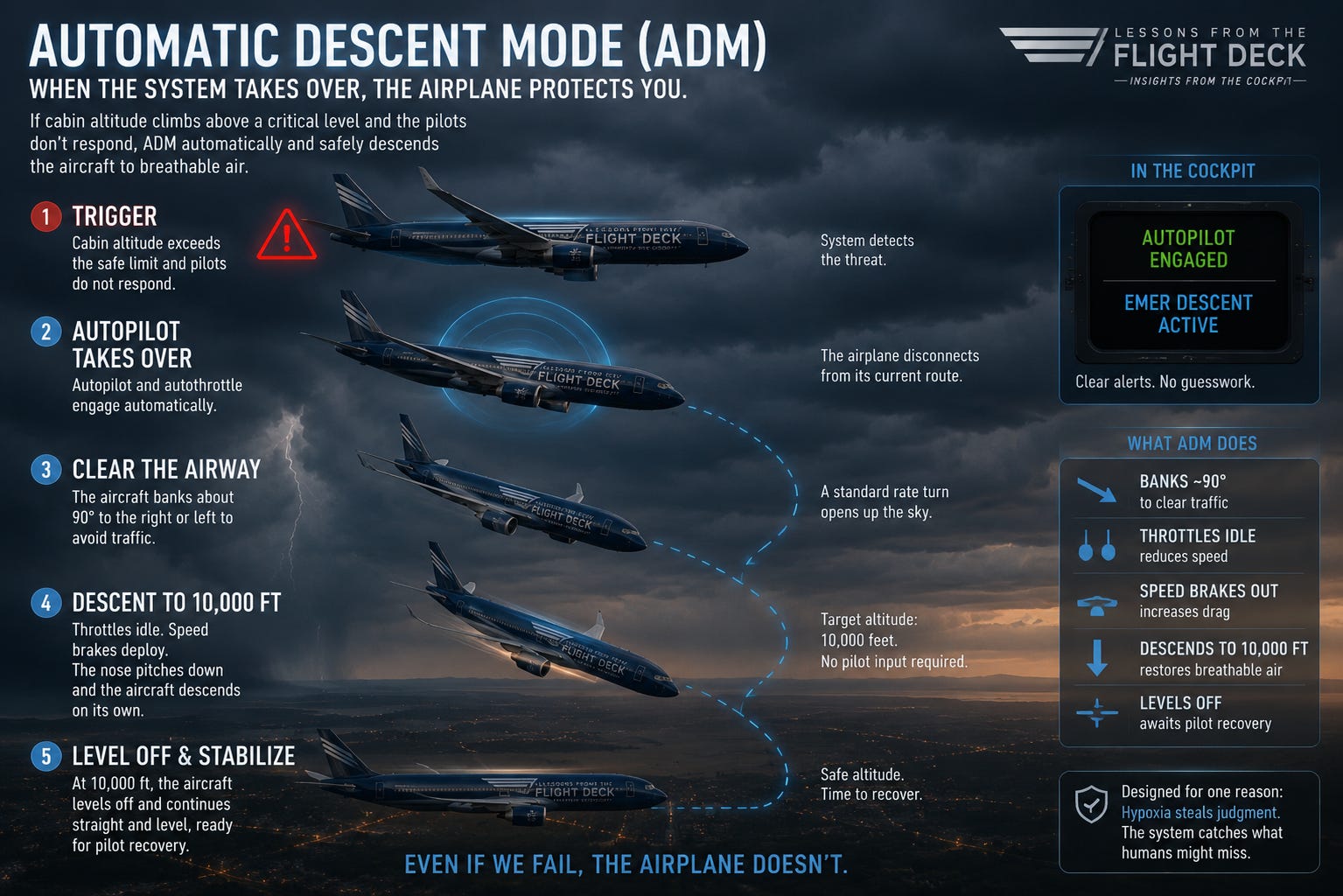
Throttles to idle. Speed brakes out. Nose down. The airplane is now in a high-speed descent at, or just below, its maximum operating speed (Vmo/Mmo) typically 4,000 to 6,000 feet per minute, roughly the descent rate of a fast express elevator.
Level off at 10,000 feet or the minimum safe altitude over terrain, whichever is higher. Below 10,000, the air outside is breathable on its own. The clock stops there.
The whole sequence, from chime to level-off, is usually complete in 3 to 5 minutes.
From the cabin, it feels like the plane is falling. From the cockpit, it feels like the airplane is running the same checklist we’ve run forty times in the simulator — because it is.
The quietest decompression is the deadliest
Pilots are trained for three kinds of cabin pressure loss, each with a different time signature:
Explosive — under half a second. A bang, a violent rush of air, ice crystals in the cabin in the same heartbeat. Impossible to miss.
Rapid — seconds. This is what made Alaska 1282 famous. The bang, the fog, the cold — all the cues your senses are built to detect.
These two are loud. They get headlines. They are also, statistically, the events most likely to end with everyone walking off the airplane.
The one that doesn’t is the third.
Slow or “insidious.” No bang. No fog. The cabin altitude rises gently over minutes, and the only sign is a small white needle on an instrument the passengers never see.
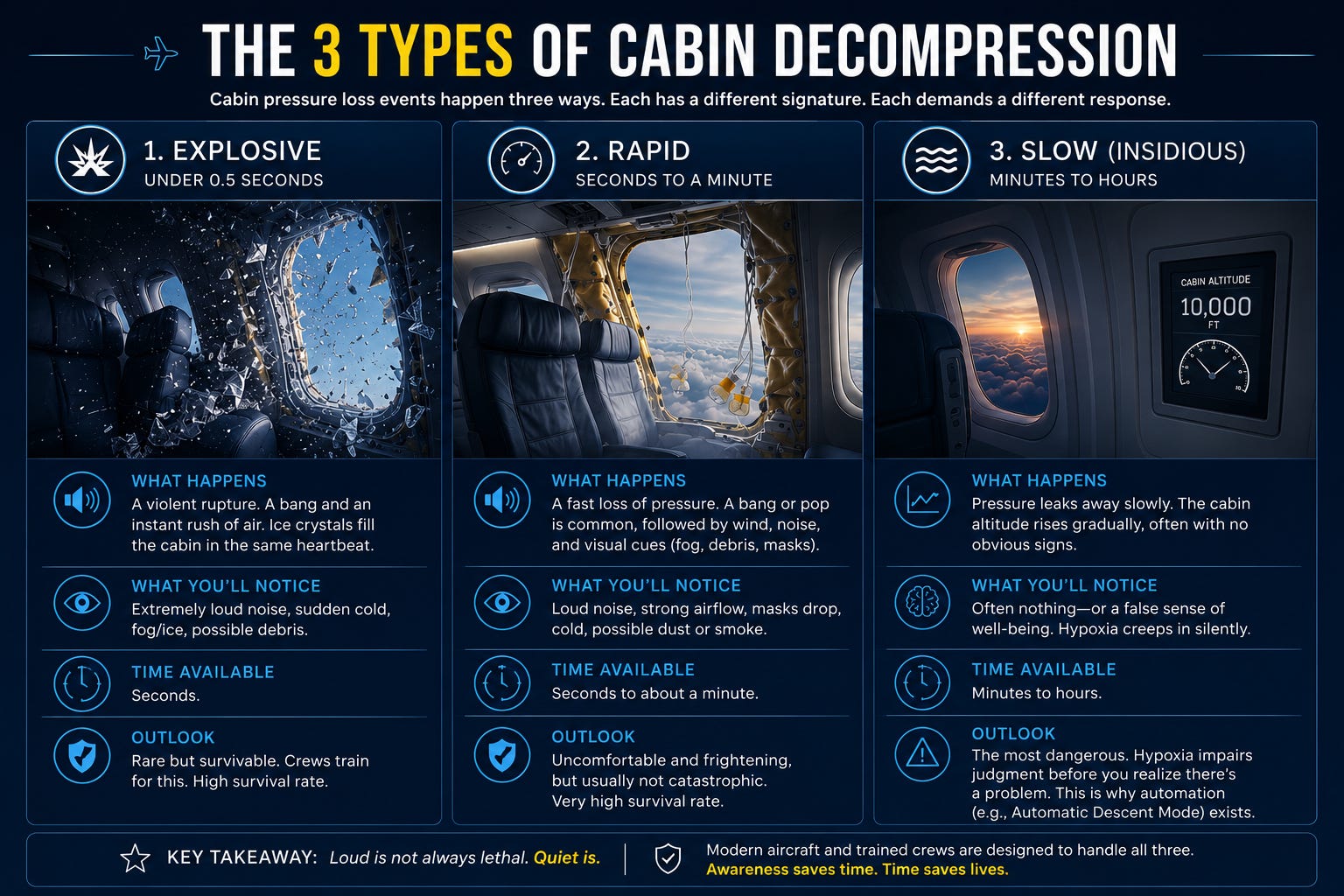
The danger isn’t the pressure differential. It’s the hypoxia.
Hypoxia doesn’t feel like suffocation. It feels like being fine. Mild euphoria. Slightly slurred speech. A little tunnel vision. The judgment to recognize what’s happening is one of the first things hypoxia takes away.
The textbook example is Helios Airways Flight 522. August 2005. A Boeing 737-300 climbed out of Larnaca with its pressurization controller left in MANUAL after maintenance the night before. The cockpit warning sounded and the already-hypoxic crew misread it as a different alarm. The passenger masks dropped automatically. The system worked. The people didn’t.
The aircraft flew its programmed route alone for over two hours before fuel exhaustion. 121 souls lost. No mechanical failure only a missed switch, a confusing alarm, and a kind of decompression that doesn’t announce itself.
Helios is the reason almost every modern airliner and corporate jet manufactured since has been engineered with Automatic Descent Mode. The same chain of events on a 2026 aircraft ends with the autopilot saving everyone before hypoxia ever finishes its work.
You don’t gamble with the quiet kind and the engineers, after Helios, made sure the airplane wouldn’t either.
The cockpit sequence above is what we do. Below the line, the 5-step framework turns the procedure into yours — what to feel for, what to do, what not to do. Plus three real cabin-pressure events most nervous flyers fear (the slow leak you'll probably never feel, Alaska 1282, and the Spring Airlines dive), and the printable Cabin Pressure Checklist I'd want every nervous flyer to fold into their boarding pass.
