


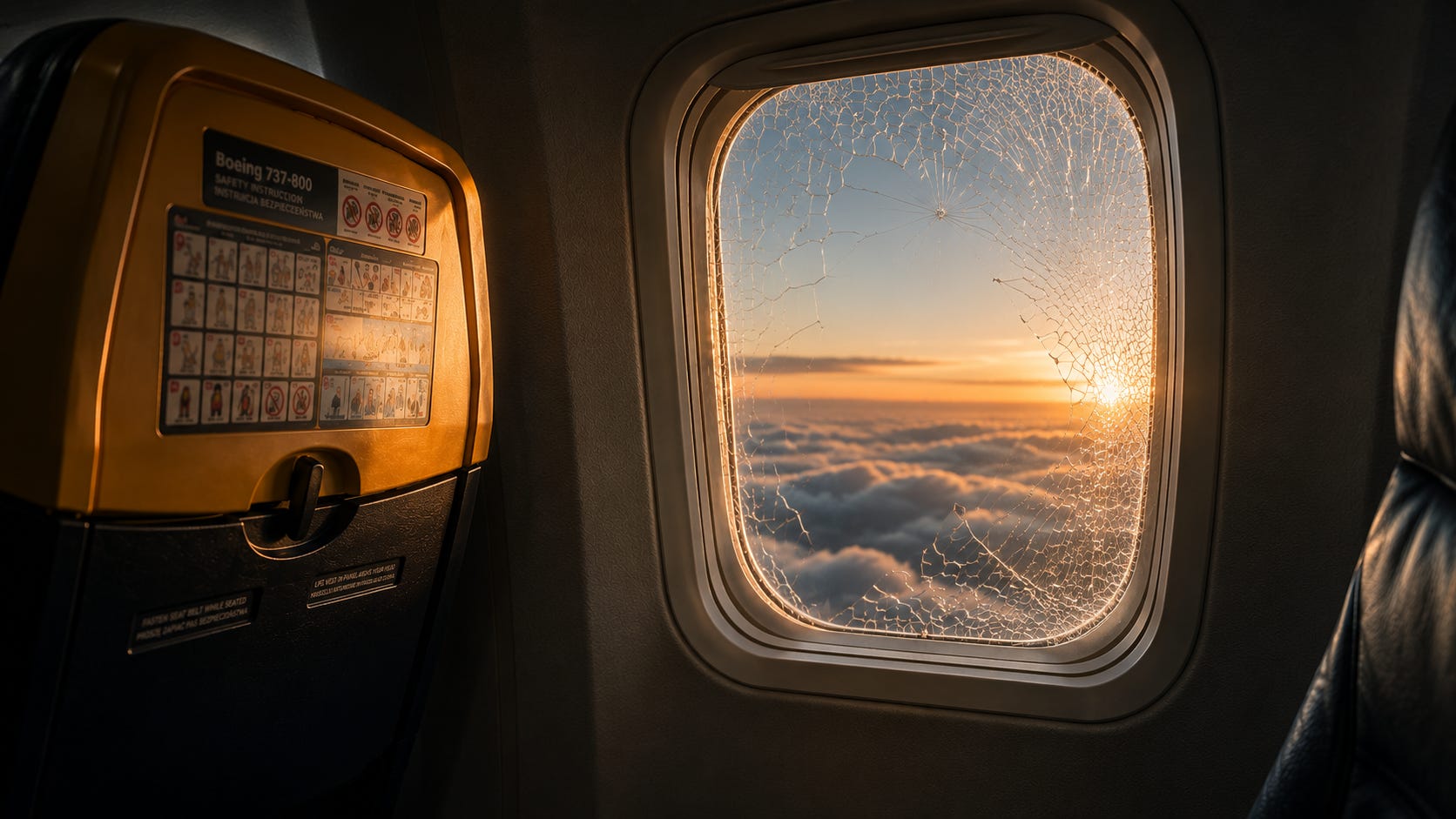
Pilot Nick — 6 min read — Black Box Series
I saw the headline before I finished my coffee.
Passenger sucked out of Ryanair window. A photo of a hole where a window should be. A 61-year-old man in a hospital in Thessaloniki. And somewhere in a drawer, your own boarding pass for next week.
You read it twice. And a small, quiet voice asks the question you’ve been not-asking for years: what is actually holding that thing together?
Up in the flight deck, we’ve been rehearsing this exact morning for twenty-five years. Not the headline — the morning. The bang, the mist, the yellow masks, the turn back. Every six months, in a simulator, with someone marking us on it.
So let me tell you what happened over northern Greece at 06:20 this morning, from the seat with the controls in it.
What most people get wrong
When you read that a window failed and a man was pulled halfway out of it, your brain draws one conclusion: the aeroplane is fragile.
Here’s the thing. The aeroplane held.
Something broke a window. And then nothing else broke. The fuselage stayed intact. The wings stayed on. The remaining engine kept turning. The crew flew it home and landed on the runway they’d left an hour earlier.
The aeroplane was never in danger. The man in that seat was.
Those are two completely different sentences, and almost every article you’ll read today collapses them into one.
What actually happened
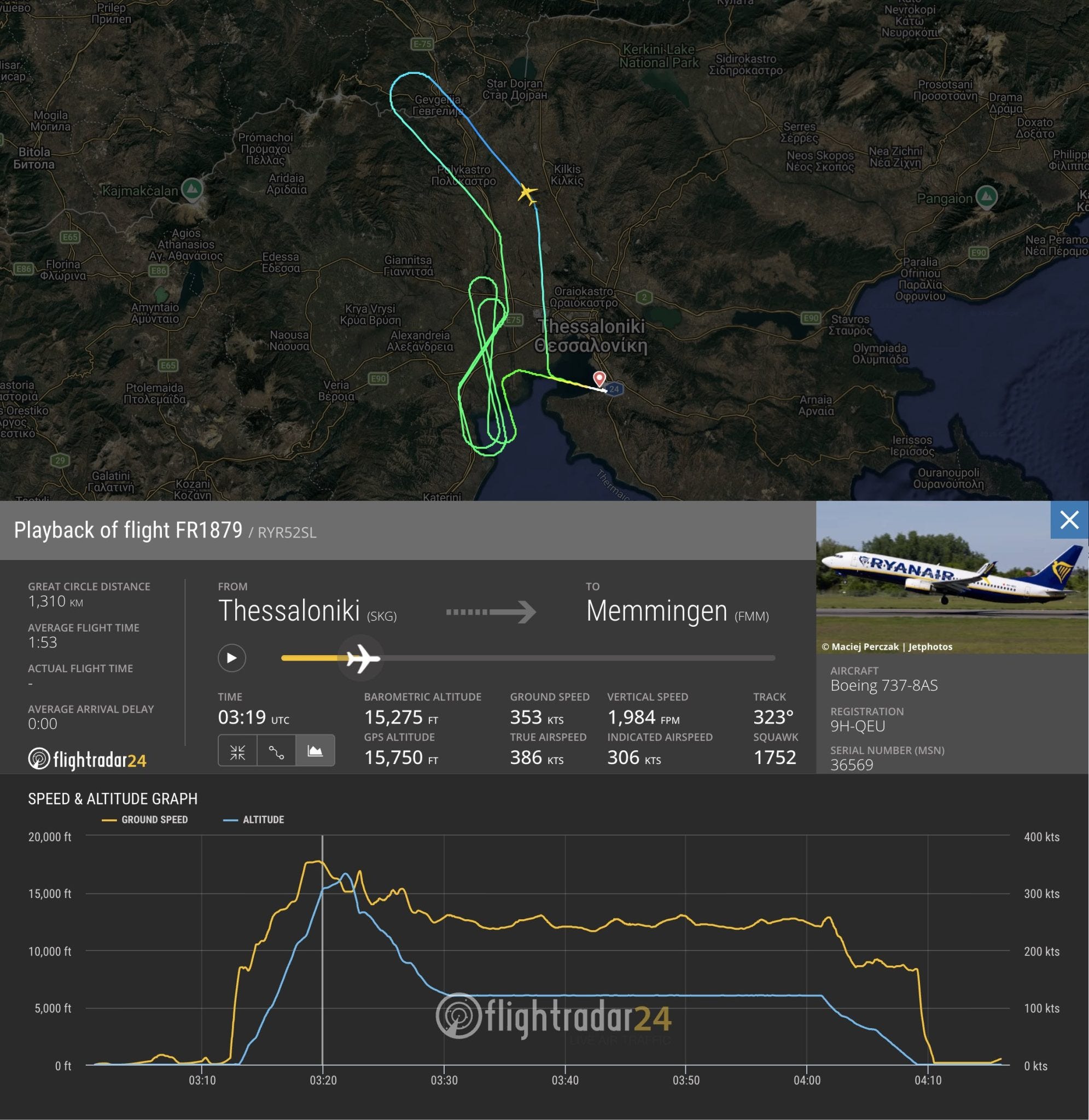
Ryanair FR1879, a Boeing 737-800 registered 9H-QEU, operated by Malta Air, lifted off runway 28 at Thessaloniki at 06:12 local, bound for Memmingen. Seventeen minutes late. A completely ordinary Friday.
Eight minutes later, climbing through FL150 — 15,000 feet, their maximum altitude that morning — there was a bang. Initial reports, and I stress the word initial, say an engine failed and debris from it struck the fuselage and destroyed a cabin window on the right-hand side.
The cabin depressurised. The masks dropped. A 61-year-old Serbian passenger at that window was pulled partially into the opening — head and shoulders before his wife and travelling companions hauled him back in. He is in hospital in Thessaloniki tonight with a neck injury and friction burns, and he is expected to be fine.
The crew declared an emergency and then did something that will confuse you if nobody explains it: they did not land immediately. They flew for another forty minutes and touched down at 07:08.
Two things in that paragraph deserve more than a news cycle. Start with the window.
Four panes, not one
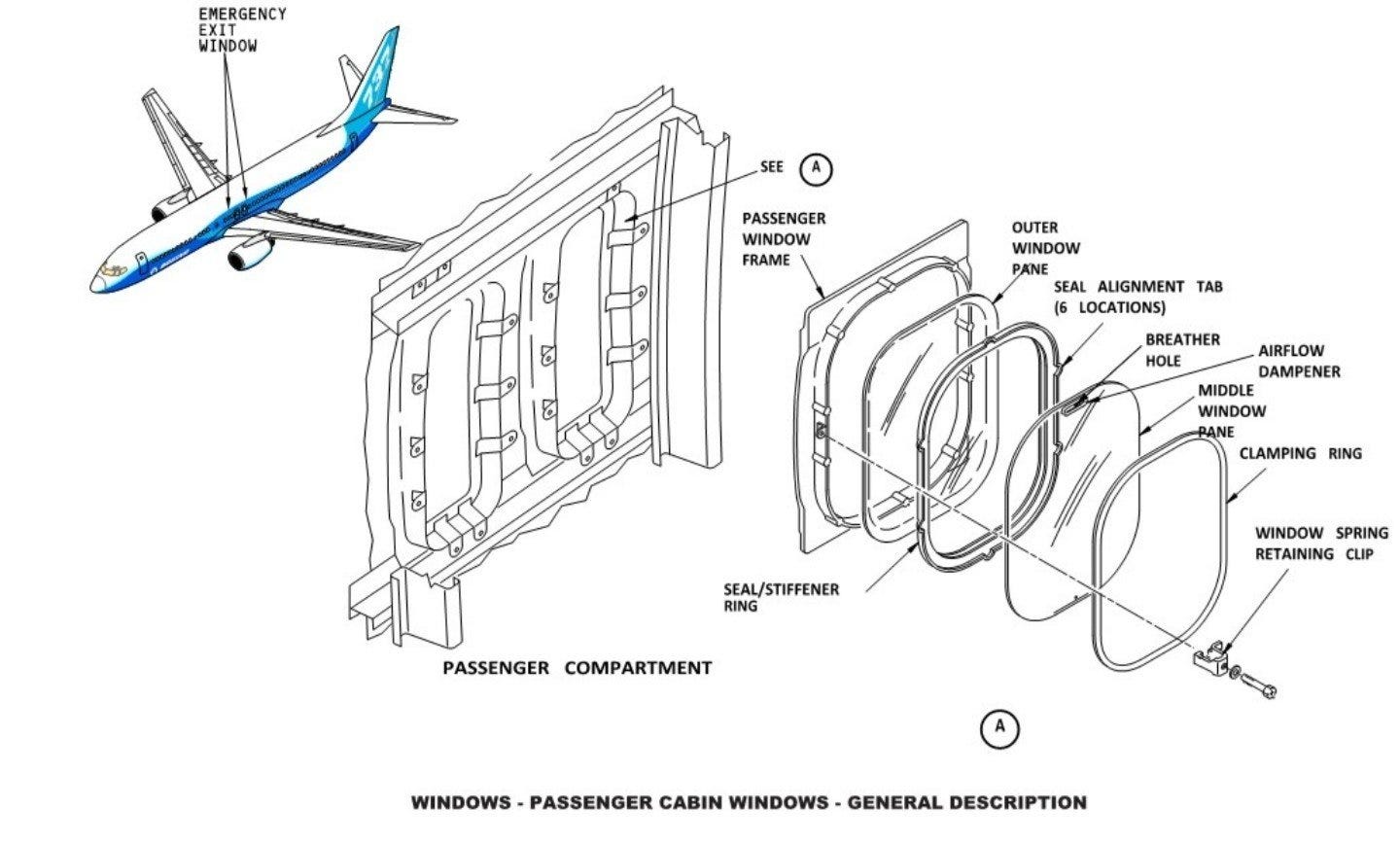
The thing you lean your head against on a 737 isn’t a window. It’s four components stacked together.
The inner pane is the one you touch. Non-structural. Its entire job is to keep passengers, elbows and toddlers away from the panes that matter. It holds nothing back.
The airflow dampener sits behind it — the layer with the little hole everybody notices and nobody explains. It balances pressure between the panes and stops them fogging.
The middle pane is the fail-safe. Fully structural, certified to hold roughly 1.5 times normal cabin pressure on its own, with no help.
The outer pane is the one carrying the load right now, on every flight you’ve ever taken.
Read that again. The outer pane fails, the middle pane takes over — rated for half again more pressure than the cabin will ever ask of it. That’s this entire industry’s design philosophy in one small oval of acrylic: assume the primary structure fails, and make sure the backup doesn’t care.
For the cabin to lose pressure this morning, both structural panes had to go. Together. In the same instant.
That is an extraordinarily rare event. It’s why every pilot I know read this story twice.
The first thing we do is nothing
There’s an old phrase in this trade: wind the clock. From the days when cockpits had mechanical clocks, and the instruction to a startled crew was, literally, wind the clock before you touch anything.
Give yourself eight seconds.
Because the aeroplane in that moment is not falling out of the sky. It’s flying — badly, loudly, alarmingly, but flying. An engine failure on a twin-engine airliner is a condition the machine is certified, tested and licensed to handle. Every pilot flying you today was examined on it inside the last six months.
The failure is almost never what hurts people. What hurts people is the ninety seconds afterwards.
Reach for the wrong switch. Shut down the good engine. Rush a heavy aeroplane at a runway because the cabin is screaming.
So we drill the order until it’s reflex. Aviate. Navigate. Communicate. Fly it. Point it somewhere. Only then, talk.
The five steps
Step 1 — Fly the aeroplane. Someone puts hands on the controls and keeps the wings level. It’s said out loud: “I have control.” One person flies. One person deals with the problem. Nobody does both.
In real life: stabilise before you strategise.
Step 2 — Wind the clock. Almost nothing in an emergency requires an instant response. The exceptions are memorised and fit on one hand.
In real life: the urge to act fast is almost always the emotion talking.
Step 3 — Diagnose before you decide. The FR1879 crew had a bang, a decompression, engine indications and a cabin in chaos. Four problems — or one problem wearing four costumes. Shutting down the wrong engine has killed more people than engine failures ever have.
In real life: name the real problem before you fix the loud one.
Step 4 — Buy back margin. This comes in two halves, and the difference between them is the whole morning.
Half one is not optional. A cabin that loses pressure gets an immediate emergency descent below 10,000 feet, where the outside air alone keeps everyone conscious. The masks that dropped aren’t an endless supply — they’re chemical oxygen generators, good for around twelve minutes. That’s not a limitation. That’s the specification. Twelve minutes is comfortably more than any airliner needs to reach breathable air. The clock the masks start is a clock the aeroplane is built to beat.
Half two is a choice. Once level and breathing, the crew held, and burned fuel. A 737 eight minutes into a two-hour flight is heavy, and landing above maximum landing weight risks a hard, hot, brake-fire arrival on the runway you’re already going to need. So they traded forty minutes for a normal landing. With a hole in the aeroplane. On purpose.
The first half bought oxygen. The second bought margin. They are not the same decision, and this crew did not confuse them.
The masks are the most misunderstood object on the aeroplane, I wrote the whole story of what's actually inside them here: if you want to know more 👇🏻

Step 5 — Communicate last. Only once it was flying, understood and set up did they talk to ATC, to the cabin, to the company. Not because passengers don’t matter — because a pilot on the radio is a pilot not flying.
“Pilots aren’t calmer than you in an emergency. We’re just slower deliberately, systematically slower at exactly the moment everyone else speeds up.”
The framework above is the whole system. Using it while the masks are swinging in front of your face is another thing entirely.
Below the line: the detail about this morning that almost nobody has reported and that changes how you should read the whole story. The printable Cabin Emergency Checklist I’d want my own family to have in their seat pocket. And the one thing about Southwest 1380 — the near-identical failure in 2018 that killed a passenger — that changed how every one of these engines is inspected, including the one that failed today.
