


Pilot Nick — 5 min read
The headline was built to make your stomach drop.
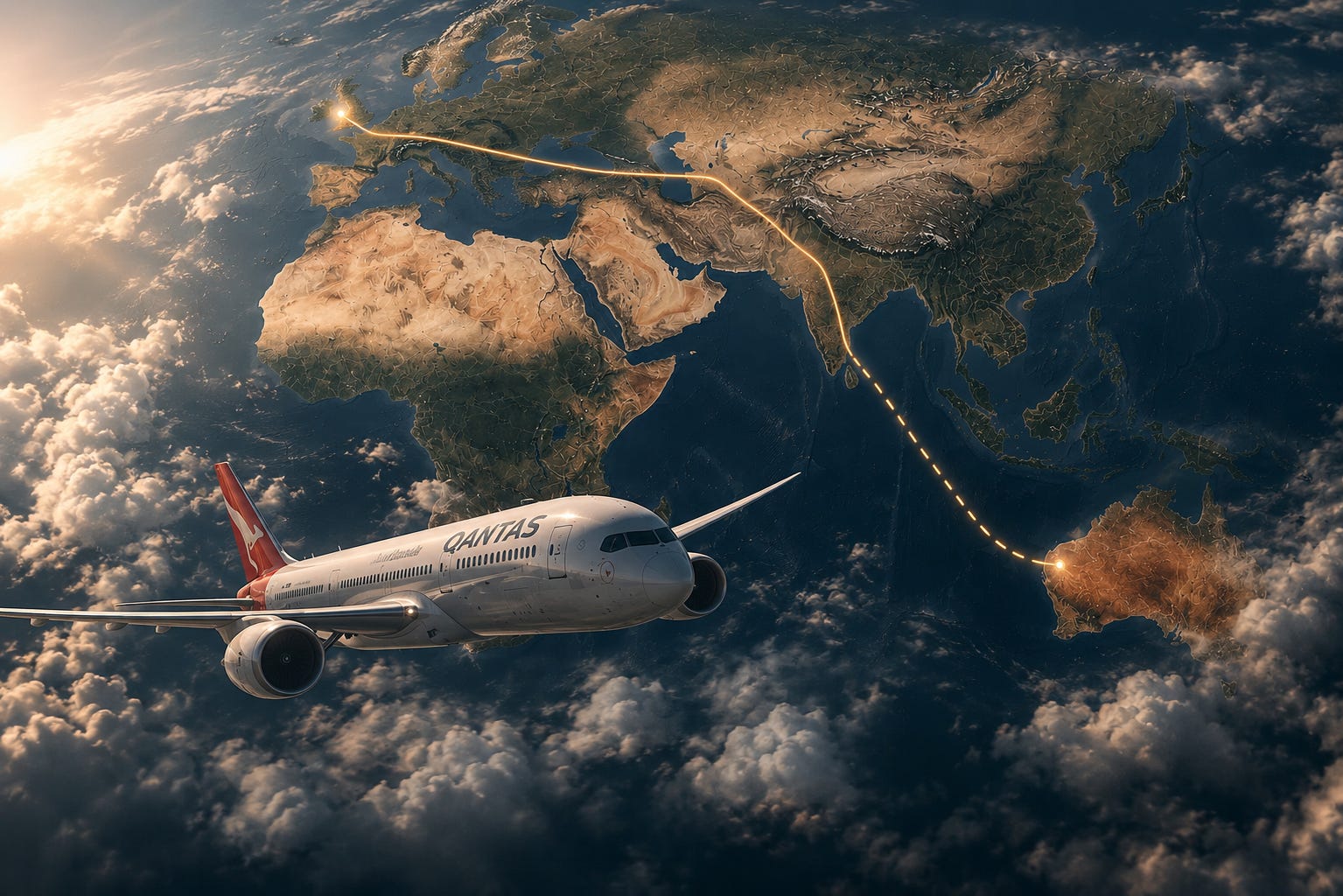
A Qantas jet. Halfway from London to Perth. Not enough fuel to finish.
Forced down in a mining town in the middle of the Australian outback.
If you’ve got a flight booked, that’s the exact sentence your brain files under see, I knew it.
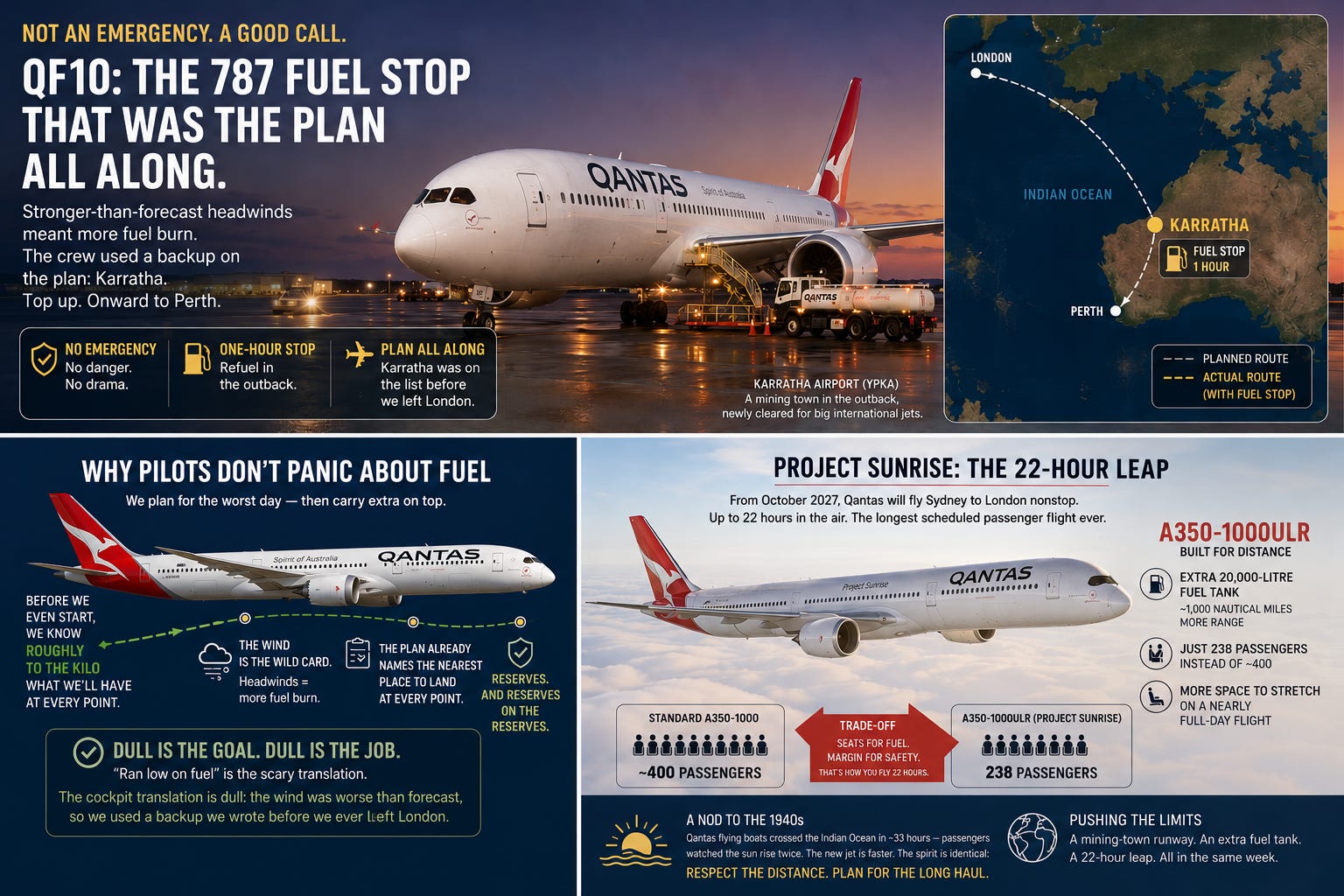
Here’s the part the headline skipped: from inside the cockpit, this was a good day.
Let me show you why and why this week, of all weeks, the timing is almost too perfect.
What actually happened
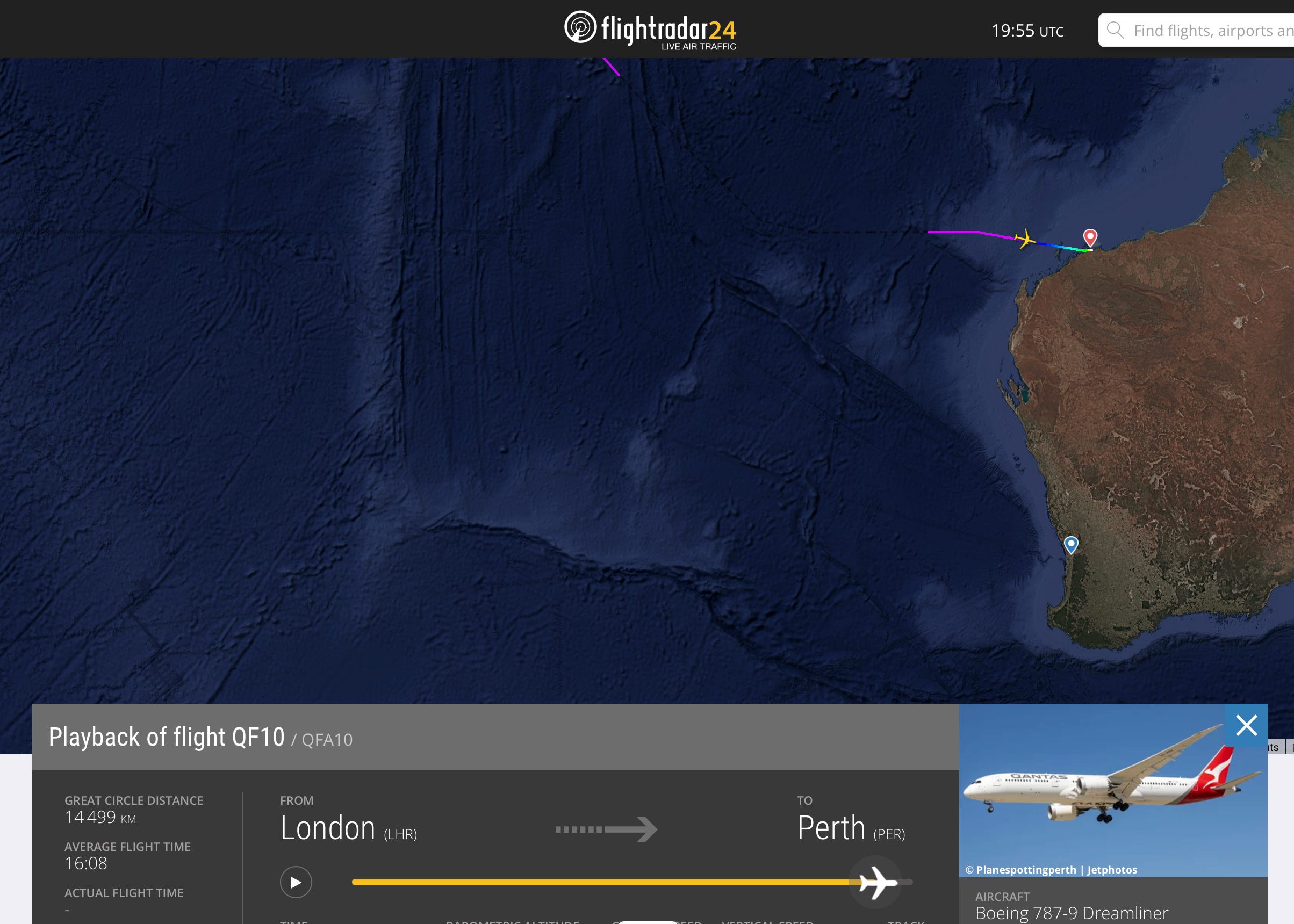
QF10, a Boeing 787-9, left London on one of the longest passenger routes on Earth — roughly 17 hours nonstop to Perth on June 22, 2026.
Somewhere over the Indian Ocean, the wind turned. Headwinds stronger than forecast. (A headwind is just air pushing back at you; fight it for hours and you burn more fuel to cover the same distance.)
So the crew ran the numbers, reached a calm conclusion, and set the 787 down at Karratha a regional airport about 1,500 km north of Perth. One hour on the ground, top up the tanks, on to Perth.
No emergency. No danger. A late arrival and a refuel. That’s the entire story.
Fun fact: Karratha mostly serves the fly-in, fly-out crews of the region’s iron-ore mines. It had only been cleared to handle big international jets a few weeks before QF10 came knocking. Talk about timing.
Why pilots don’t panic about fuel
Here’s the thing most passengers never hear.
A pilot is almost never surprised by fuel. It’s the most predictable thing on the airplane before the engines even start, we know roughly to the kilo what we’ll have at every point along the route.
The fuel isn’t the wild card. The wind is.
So we don't plan for the wind we want. We plan for the wind that ruins the day and we carry the fuel for it in named layers.
On top of the fuel to actually get there, we add contingency fuel usually around 5% of the trip set aside for exactly this: a headwind stronger than forecast, or not getting the cruising altitude we asked for and burning more down low. Then comes alternate fuel: enough to fly to a backup airport if we can’t land at the destination. And underneath all of it sits the final reserve typically 30 minutes of flying we are never, ever allowed to touch.
Layers on layers. That’s the whole game.
There’s something else hidden in that flight plan, too. Over a long ocean crossing, it already names the nearest place to land at every single point along the way. Karratha wasn’t a frantic search at 38,000 feet. It was on the list the whole time, quietly waiting to be useful.
And we usually see it coming a long way off. We’re running fuel checks for the entire flight, so a developing shortfall shows up early often hours before it actually matters. That’s plenty of time to get on the radio to our operations team on the ground and set up the fuel stop calmly, in advance. By the time a jet like QF10 touches down to refuel, the people on the ground have been expecting it for hours.
So “ran low on fuel” is the scary translation. The cockpit translation is dull: the wind was worse than forecast, so we used a backup we’d written before we ever left London.
Dull is the goal. Dull is the entire job.
Now here’s why this week is wild
That little outback detour landed just days after Qantas unveiled the most ambitious flight in its 105-year history.
It’s called Project Sunrise. From October 2027, Qantas plans to fly Sydney to London nonstop — up to 22 hours in the air, the longest scheduled passenger flight the world has ever seen.
To pull it off, Airbus built them a special jet: the A350-1000ULR. Engineers bolted in an extra 20,000-litre fuel tank and stretched its range by around 1,000 nautical miles — far enough to make a route that used to be physically impossible.
And here’s the trade-off that tells you everything. This jet will carry just 238 passengers, instead of the 400-or-so a standard A350 could hold. Qantas gave up real, revenue-paying seats to make room for fuel — and for space to stretch out on a flight that lasts nearly a full day.
That’s the razor’s edge of ultra-long-haul. The longer the flight, the more every kilo of fuel and every gust of wind matters.
Which is exactly why a stronger-than-forecast headwind nudged a 787 into Karratha this week and exactly why Qantas is engineering so much margin into the 2027 jet. This week was a tiny, accidental preview of the whole challenge.
If the engineering grabs you, I took the full tour a few weeks back — four pilots, choreographed sleep in a hidden crew bunk above the cabin, and an 80-hour test programme aimed almost entirely at that new fuel tank — in 22 Hours. 4 Pilots. 10,573 Miles. Inside the Longest Flight in History. If today’s fuel story pulled you in, that one’s the full flight-deck breakdown.👇🏻

Fun fact: The name Project Sunrise is a nod to the 1940s, when Qantas flying boats crossed the Indian Ocean in around 33 hours so long that passengers watched the sun rise twice on a single flight. The new jet is faster. The spirit is identical: respect the distance, plan for the long haul.
What this should actually tell you
If flying makes you nervous: a fuel diversion isn’t the system breaking. It is the system. The plane that lands early to top up is being flown by people who would always rather be an hour late than a drop short.
If you fly often: this is the new normal at the edge of the map. The longer the route, the bigger a vote the wind gets and the more an unscheduled stop becomes a sensible footnote instead of a scare.
And if you just love airplanes: you’re watching the limits of flight get pushed in real time. A mining-town runway, an extra fuel tank, and a 22-hour leap — all in the same week.
The three numbers I’d be watching on QF10 and the one I’d never let drop…
The rest is for paid readers — the part I’d be muttering to my first officer on a flight exactly like this one.
