


Pilot Nick · 10 min read
You’re three hours into a normal flight. The cabin lights are dim. You’ve already eaten one meal, watched half a movie, and looked at your watch twice. Your seatmate is asleep with their mouth slightly open.
You shift in your seat and do the math you don’t really want to do.
Three down. Seven to go. Maybe eight if there’s a headwind.
Now imagine fourteen to go.
Or eighteen.
Or twenty-two.
That’s the question Qantas is about to answer for the first time in commercial aviation history and on Tuesday, June 2, the airplane built to answer it left the ground in Toulouse for the first time.
Up at 35,000 feet, the question we’re asking is different from yours. We’re not asking how you will get through it. We’re asking how we will.

What just happened in Toulouse
On June 2, 2026, the first Airbus A350-1000ULR — the Ultra Long Range variant built specifically for Qantas — completed its maiden flight from Toulouse. Three hours and 43 minutes. Cruise at 41,000 feet over the Bay of Biscay. Two Airbus experimental test pilots and four flight-test engineers on board.
That sortie was the official beginning of an 80-hour flight-test programme that will run for about two months, focused almost entirely on one part of the airplane: the fuel system.
Because this isn’t a normal A350.
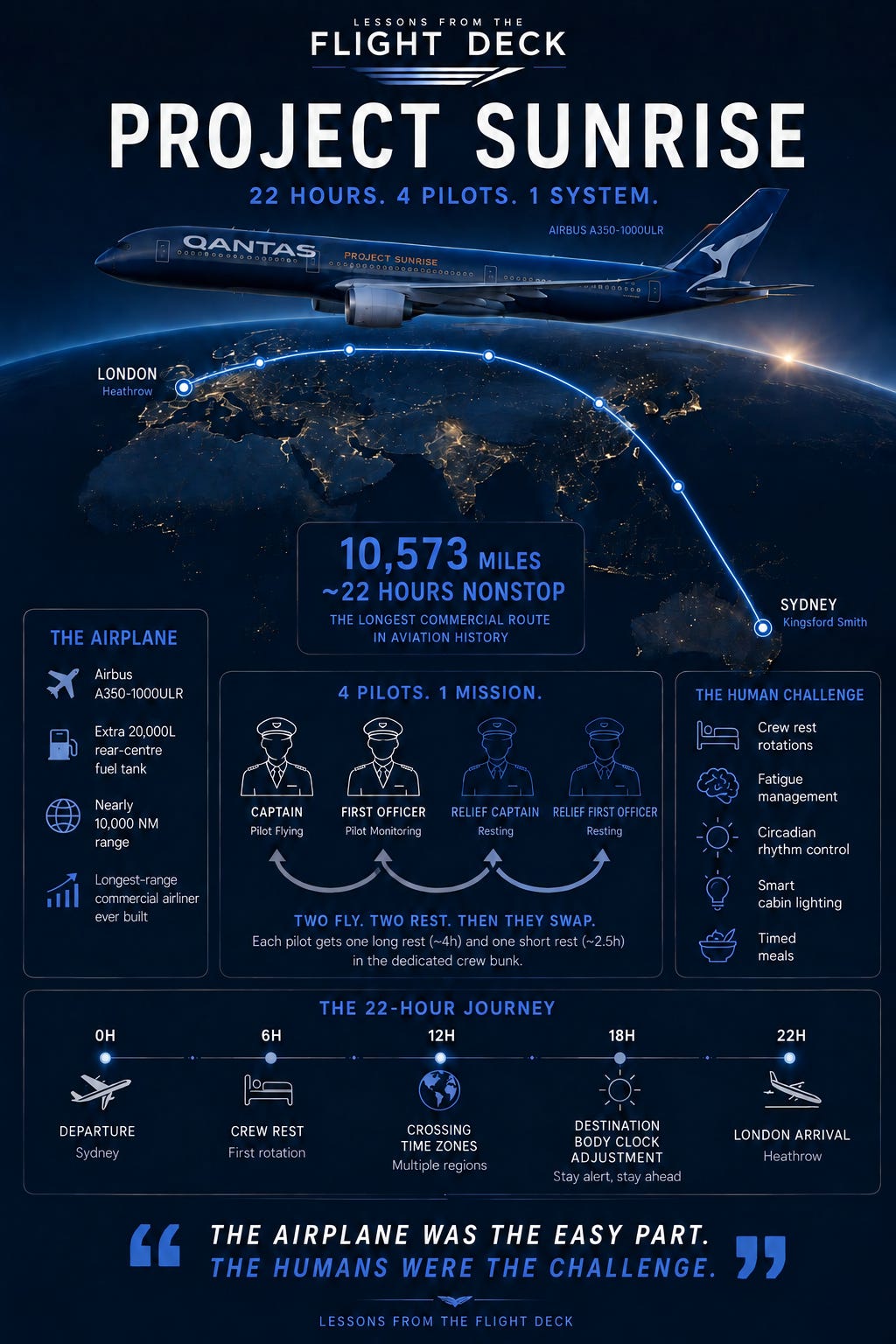
The A350-1000ULR carries a 20,000-litre extra rear-centre fuel tank that adds roughly 1,000 nautical miles of range over the standard -1000, giving the airplane a total range approaching 10,000 nautical miles. When it enters service, it will be the longest-range commercial airliner ever built surpassing the A350-900ULR that Singapore Airlines uses on the Singapore–New York run.
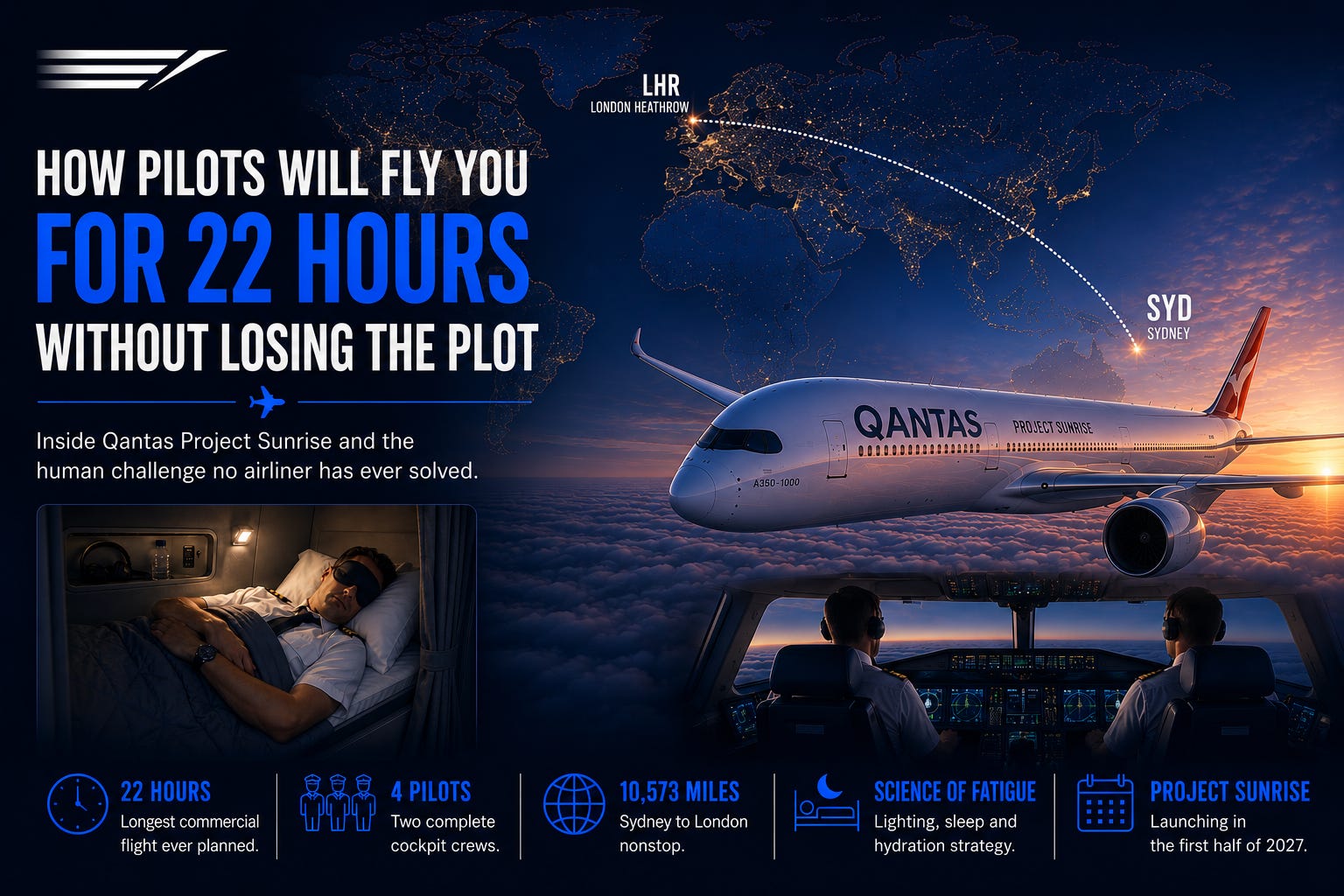
Qantas has ordered 12 of them. The first won’t be delivered until April 2027 (the original end-2026 timeline slipped due to supply chain issues). But the airplane that will fly Sydney to London Heathrow nonstop — 10,573 miles, the longest commercial route in history is now flying, and Qantas expects to launch commercial service in the first half of 2027.
For context: today’s longest commercial flight in the world is Singapore Airlines’ SQ23/SQ24 between Singapore Changi and Newark Liberty — roughly 9,537 miles, 18 to 19 hours in the air, flown by the A350-900ULR (the previous generation of the same family). That’s the route the industry already considers the edge of the operational envelope.
Project Sunrise adds roughly four more hours and another 1,000 miles on top of it.
That much you can read in the press release. Here’s the part the press release doesn’t tell you.
The airplane is the easy part of Project Sunrise. The humans are the hard part.
What 22 hours actually feels like up front
I’ve flown 8-hour transatlantic legs, 12-hour Asia–Europe legs, 14-hour Asia –US legs. I have never flown 22 hours nonstop, because no commercial pilot ever has. Even Singapore Airlines SQ23 — today’s longest commercial sector — tops out at 18 to 19 hours.
Project Sunrise is asking the industry to push that envelope by another four hours. Which, in flight-deck terms, is enormous.
Here’s why.
In the cockpit, the metabolic cost of flying isn’t the actual stick-and-rudder work — the autopilot does most of that. The metabolic cost is the constant vigilance. You’re monitoring six fuel tanks, four engine indicators, weather radar, traffic radar, ATC frequencies in three regions, oceanic crossing procedures, alternate airport availability over the next 1,500 miles, and the dozen subtle ways the airplane talks to you when something is starting to drift. You’re doing that at 41,000 feet in a 12% humidity, 800 mb pressure environment that is steadily dehydrating you, regardless of how much water the cabin crew brings up.
For 8 hours, this is manageable.
For 18, it requires choreographed sleep.
For 22, it requires choreographed everything.
The 5 things Project Sunrise had to solve before a single commercial passenger could board
The aircraft modification is one of five solvable problems. Here are the other four and how the system answers each one.
1. The range problem (solved by the engineers)
An A350-1000, off the showroom floor, cannot do Sydney to London nonstop. It’s roughly 800 nautical miles short, depending on payload and winds.
So Airbus took the most fuel-efficient widebody on the market and added a 20,000-litre rear-centre tank. The fuel system now has to manage a larger, more complex weight distribution which is why this week’s flight tests are 80 hours, two months, and focused almost entirely on the fuel system. The certification is not about whether the engines run. It’s about whether the new fuel architecture is safe in every fuel-loading scenario, including the one where you suddenly need to divert with 80% of your fuel still on board.
In real life: when the press release says “the airplane has tons of new range,” the work hiding behind that sentence is two months of test flying just to prove the new tank doesn’t surprise anyone.
2. The duty-time problem (solved by the regulators)
The standard regulatory duty-time limit for two pilots is in the order of 13 to 14 hours from sign-on to engines off. A 22-hour flight, by definition, blows through that limit before you’re halfway across the Indian Ocean.
The fix is a 4-pilot crew. Two captains, two first officers effectively two complete cockpit teams. All four are in the cockpit for takeoff and landing — standard procedure at every ULR carrier, because the highest-workload phases of the flight deserve the highest level of human redundancy. The rotation happens during cruise: each pilot gets one long rest break (~4 hours) and one short break (~2.5 hours) in a dedicated crew bunk above the main cabin, choreographed so the pair flying the approach is the most rested one.
In real life: when you board a Project Sunrise flight, there are four pilots on your manifest, and all four are up front when you push back from the gate. The system is older than you think — Singapore, Qantas, Emirates, and Cathay have been running variants of this for over 20 years on slightly shorter ULR routes.
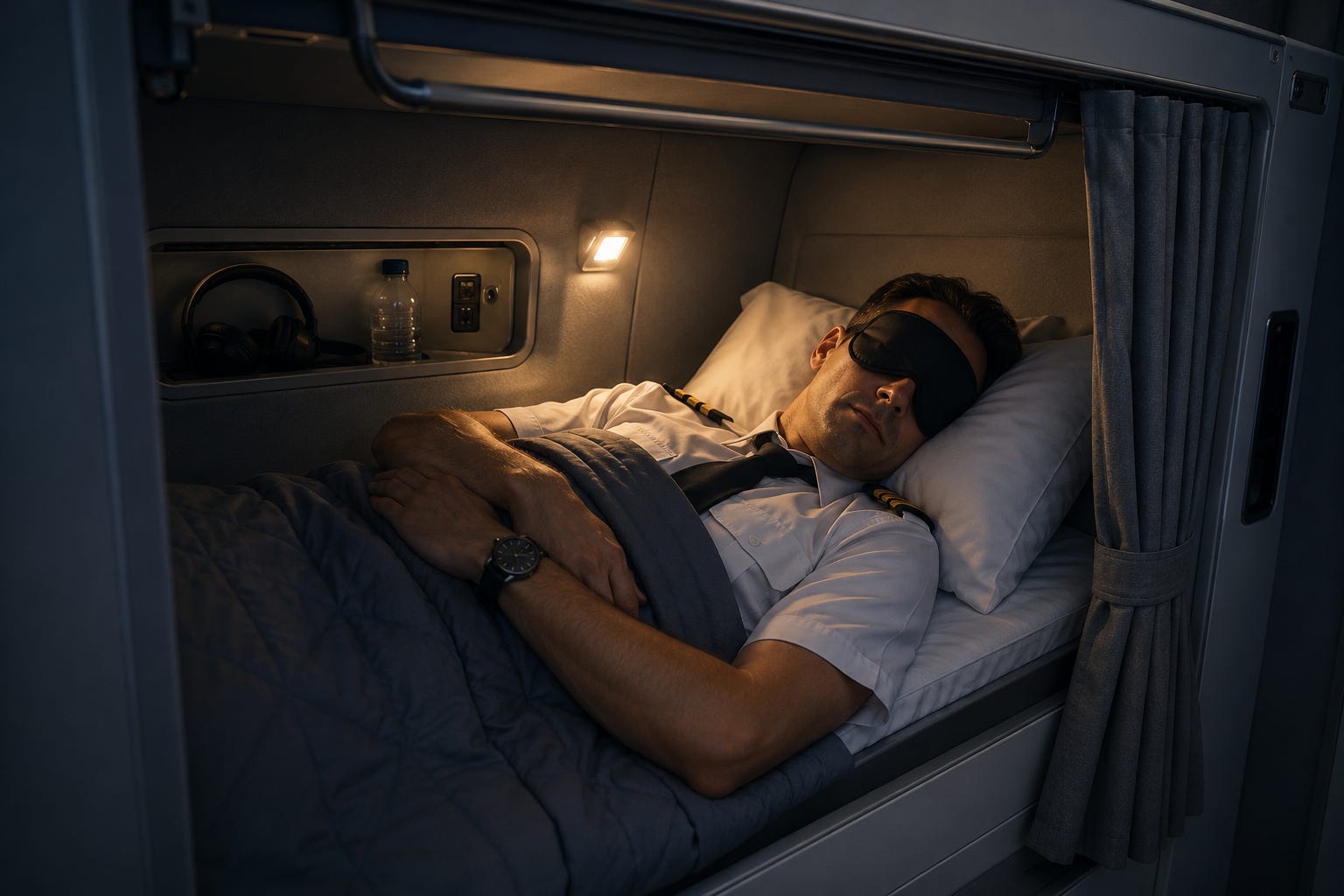
In real life: when you board a Project Sunrise flight, there are four pilots on your manifest. Two will land the airplane. Two will fly the middle of the route while the first pair sleeps. The system that makes this work is older than you think — Singapore, Qantas, Emirates, and Cathay have been running variants of this for over 20 years on slightly shorter ULR routes.
3. The biology problem (managed by science, not engineering)
The human circadian rhythm does not know what year it is, what time zone you crossed, or what your boarding pass says. It runs on a roughly 24-hour clock anchored to light.
On a 22-hour flight, you will cross every time zone on Earth. Your body will not know what time it is, even after you land. This isn’t a passenger problem — it’s a pilot problem, because the pilots flying your approach are the same pilots whose circadian rhythm has been shoved through a blender.
This is why Qantas has spent years on circadian research. The cabin lighting is engineered to push passengers (and crew) onto destination time within the first few hours. Meals are timed deliberately. The pilots’ rest cycles are choreographed against their personal sleep timing, not just the clock.
In real life: the lighting and meal service you’ll experience on a Sunrise flight aren’t comfort features. They’re medical countermeasures dressed up as hospitality.
4. The “fresh for the approach” problem (the hardest one)
This is the one keeping the safety analysts up at night.
The approach and landing phase of any flight is the most safety-critical part. It’s also, in a normal flight, the part the pilots are freshest for, because they’re at the start of their duty period.
On a 22-hour flight, the approach happens at the end of the duty period. The pilots flying you into Heathrow have, in theory, been awake or rested-poorly for most of the last day. The system mitigates this — the pilots who land the airplane take the long mid-flight rest break specifically so they’re as fresh as possible for descent — but it cannot eliminate the basic biological cost of being on duty for 22 straight hours.
In real life: the reason the regulators take ULR ops so seriously is that the final 90 minutes of a 22-hour flight are flying the riskiest phase of the operation with the most fatigued version of the pilots. Project Sunrise’s entire operational philosophy is built around making those final 90 minutes flown by the freshest available bodies.
5. The unknown-unknowns problem (still being tested right now)
This is what the next 80 flight-test hours are for.
Every ultra-long-range aircraft brings a category of failure modes that didn’t exist on shorter flights: fuel pump behavior during a 22-hour cycle, hydraulic system aging on a single sortie, crew rest area performance over long durations, cabin pressurization stability over 22-hour cycles, even avionics cooling behavior when the systems have been running uninterrupted for a day.
None of these are likely to fail. All of them have to be proven.
In real life: when you read that “the aircraft is undergoing flight tests,” what’s actually happening is that test pilots are flying the airplane through every possible failure scenario at the long end of the duration envelope. They’re not trying to prove the airplane works. They’re trying to prove it keeps working.
The framework above is the system. But the most useful thing for a passenger isn’t understanding the engineering — it’s understanding what your actual experience will be in three real scenarios most ULR passengers worry about.
Below the line, I walk through three real questions that come up before every ultra-long-haul flight: what happens if we need to divert?
what happens if a pilot is incapacitated at the 14-hour mark?
and what is hour 18 actually going to feel like?
Plus the printable Project Sunrise Passenger Checklist I’d want every first-time ULR flyer to read before they board.
