
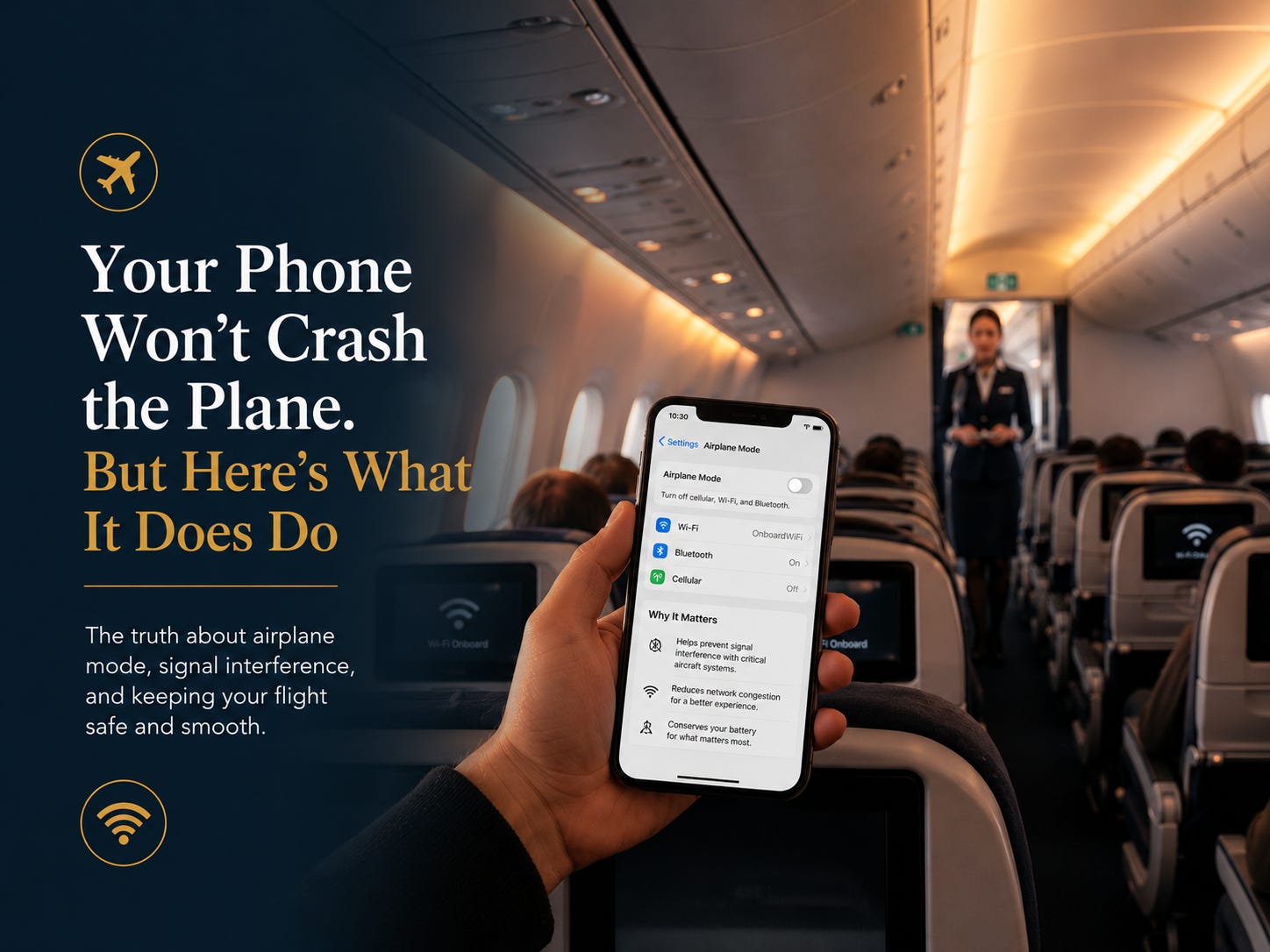
Your Phone Won’t Crash the Plane. But Here’s What It Does Do
A cockpit insider’s guide to the buzzing, clicking, and behind-the-scenes comms you never hear.
You’re settling into your seat, the flight attendant gives that familiar “please switch your devices to airplane mode”announcement, and you glance down at your phone.
You know you should turn it on airplane mode…
But what actually happens if you don’t?
I get this question constantly from passengers, family, friends, even other pilots’ kids. And I get why it’s confusing. The rules have changed over the years, the explanations are vague, and let’s be honest… we’ve all seen someone forget to switch it over without the airplane suddenly nosediving.
So let me give you the real answer pilot to passenger.
The Technical Reality (Without the Tech Overload)
Modern airliners are flying tanks of shielding and redundancy. The systems that run your flight are tested to survive lightning strikes, severe interference, and environmental extremes. The tiny radio signal from your phone isn’t going to overpower anything critical.
But here’s the part most passengers never hear about…
🎧 What We Actually Hear Up Front
When phones search for cell towers, they make a very distinct buzzing or clicking that comes right through our headsets.
If you’re old enough to remember the noise a phone made when it rang near computer speakers…
Yep. That exact sound.
It’s not dangerous — but it is distracting, especially when we’re communicating with air traffic control during takeoff or landing. Those moments are nonstop, rapid-fire instructions, and clarity matters.
One buzzing phone? Not a big deal.
Two hundred buzzing phones? A whole different soundtrack.
❌ MYTH: “One phone will interfere with navigation systems and cause the plane to crash.”
✅ REALITY: One phone isn’t the issue. Two hundred phones all transmitting at the same time can create cumulative interference mostly on the radios pilots use to communicate.
It’s less “life-threatening danger” and more “please stop making my headset crackle while I’m trying to understand ATC in crosswinds.”
Why the Rule Actually Exist
Aviation safety works through what we call defense in depth — multiple layers of small precautions that combine to create one of the safest transportation systems on Earth.
Airplane mode helps in three ways:
1. Clear Radio Comms
During takeoff and landing, we need every instruction from ATC crystal clear. No static, no buzzing, no guessing.
2. Cell Network Issues
At 35,000 feet, your phone tries to connect to every cell tower it can “see,” which is a nightmare for the ground network.
3. Simple, Standardized Procedure
Regulators need rules that are easy to follow and easy to enforce. “Airplane mode, please” works worldwide.
Okay, But What Happens If You Forget?
Here’s the part no one says out loud:
Absolutely nothing dramatic.
After 10,000+ hours in the cockpit, I’ve never had to call maintenance, divert a flight, or sound an alarm because of someone’s phone.
What I have had is that occasional obnoxious buzzing in my headset — usually right when I’m trying to catch a fast runway instruction. Annoying? Yes. Dangerous? No.
The honest pilot truth:
Your forgotten phone won’t put the aircraft at risk.
It will make our radios sound like a 1990s Nokia on caffeine.
But here’s the thing: just because individual violations don’t cause problems doesn’t mean the rule is pointless. If everyone decided “my phone won’t make a difference,” we’d have 200 phones all creating interference simultaneously. That’s when minor annoyances could potentially become more significant issues.
The Evolution of the Rules
Remember when all devices had to be completely off for takeoff?
Or when you couldn’t read a Kindle until reaching 10,000 feet?
As aircraft shielding improved and we collected more data, the restrictions relaxed. Now you can use:
Wi-Fi
Bluetooth
Tablets
Laptops
All at altitude.
The only thing we still ask you to turn off?
The cellular radio.
And that’s exactly what airplane mode does.
💡 Pro Tip: Why Wi-Fi Is Allowed But Cell Signals Aren’t
Airplane Wi-Fi uses completely different frequencies and power levels — designed not to interfere with aircraft radios.
Your cell radio… isn’t.
Easy fix: airplane mode + Wi-Fi ON = happy pilots, stress-free passengers.
The Bottom Line
Airplane mode is one of those tiny safety habits that keeps the system clean and predictable. Is it the most important safety measure onboard? No — your seatbelt, the aircraft’s maintenance, and pilot training outrank it by a mile.
But it’s also:
Easy
Fast
Helpful
Part of the aviation safety culture that keeps you safe
Small layers matter. This is one of them.
What I Tell Nervous Flyers
If you forget to put your phone in airplane mode, don’t panic. You haven’t put the flight at risk. But do switch it over when you remember, because these small protocols are part of what makes your flight as safe as it is.
The real miracle of modern aviation isn’t any single safety rule—it’s the entire system working together, from the way the aircraft is designed to the procedures we follow in the cockpit to yes, even the small protocols like airplane mode.
Have Questions About Something Else on the Plane?
That’s exactly why I created this newsletter — to make flying less mysterious and more empowering.
Drop your questions in the comments and I’ll answer them in future posts. The more you understand, the more relaxed (and even fascinated) you’ll feel on your next flight.
PIlot Nick ✈️
✈️ Ready to Beat Flight Anxiety for Good?
My Fear-Free Flying Masterclass is now live everything I’ve learned from 27 years of flying, distilled into practical tools you can use on your next trip.
✔ Understand exactly what’s happening during turbulence
✔ Stop the spiral of “what if” thinking
✔ Learn the same calm-under-pressure habits pilots use
✔ Feel prepared, confident, and in control
👉 Join the Masterclass here:
📘 Want Something Instant?
Download my bestselling ebooks:
Fly Calm
Calm Before You Board
Mind Tricks for Takeoff
👉 Get the bundle here:


Thank you!
Thanks for the explanation. It sure would be helpful if more travelers understood the reason.