



Pilot Nick - 6 min read
It’s 11:47 PM. Your flight is in nine hours.
You’re not sleeping. You’re on your phone, and you’re on Turbli.
You’ve typed in your route three times tonight. The little colored bars haven’t changed. Yellow over the Rockies. A patch of orange somewhere near Denver. You’ve zoomed in. You’ve zoomed out. You’ve checked the “light, moderate, severe” key twice, even though you have it memorized.
You’re not crazy. You’re trying to feel in control.
I want to talk to you about that app gently, because I know it feels like a lifeline. But there are some things it isn’t telling you, and I think once you understand them, you’ll sleep a little better tonight.
First, Credit Where It’s Due
Let me say this clearly, because I respect the people who built it: Turbli is a genuinely well-engineered tool.
It’s not pulling random weather data. It uses NOAA’s Graphical Turbulence Guidance the same underlying turbulence forecast data pilots use for flight planning. It even adjusts for your specific aircraft’s wing loading, which affects how it handles bumps. The team behind it clearly knows aviation.
So the problem isn’t the data. The problem is the packaging and what gets lost between the cockpit and your phone.
What Turbli Actually Misses
1. The forecast updates every 6 hours. The atmosphere doesn’t.
Turbli’s turbulence forecast refreshes four times a day. That’s standard for global weather models. But the air you’ll fly through changes much faster than that. Jet streams shift. Storms develop. Pilot reports come in every few minutes. By the time you read a Turbli forecast, the data underneath it is already hours old and your flight is still hours away.
We don’t fly on six-hour-old forecasts. We fly on continuously updated turbulence layers, refreshed in near real-time and cross-referenced with what aircraft ahead of us are reporting right now.
2. The forecast doesn’t see what other pilots just reported.
Turbli has a PIREP map, pilot reports of actual turbulence and it’s a useful feature. But here’s the catch most users miss: the PIREP map is separate from your flight forecast. Your flight’s turbulence prediction is built from forecast models alone. The real-time pilot reports aren’t blended into the colored bars you’re staring at.
In the cockpit, PIREPs are integrated. We don’t toggle between maps. The latest pilot report from the aircraft 80 miles ahead of us shows up on the same screen as the forecast and it overrides the forecast every time. That’s the difference between “what the model predicted at 6 AM” and “what’s actually happening at 35,000 feet right now.”
3. Clear Air Turbulence is the hardest kind to forecast for anyone.
This isn’t a Turbli flaw. It’s physics.
Clear Air Turbulence (CAT): the bumps in clear blue sky, no clouds, no storms happens at the edges of jet streams in wind shears thousands of feet thick but only a few miles wide. Forecast models smooth those edges out. Even the best aviation weather systems list CAT as a probability, not a certainty.
The honest answer about turbulence forecasting is this: everyone is making educated guesses. Pilots make better guesses because we have real-time data and the ability to react. Turbli makes a reasonable guess based on a 6-hour-old model. Your phone screen doesn’t show you that distinction.
And here's the part no forecast can show you: even when turbulence does happen, it's far less dangerous than it feels. I explain why your body exaggerates every bump here 👇
Is Turbulence Dangerous? A Captain Explains Why You Are Safe

Feeling jolted mid-flight can make you fear flying. But, turbulence isn't a danger to flight safety. Learning about it can turn fear into calm.
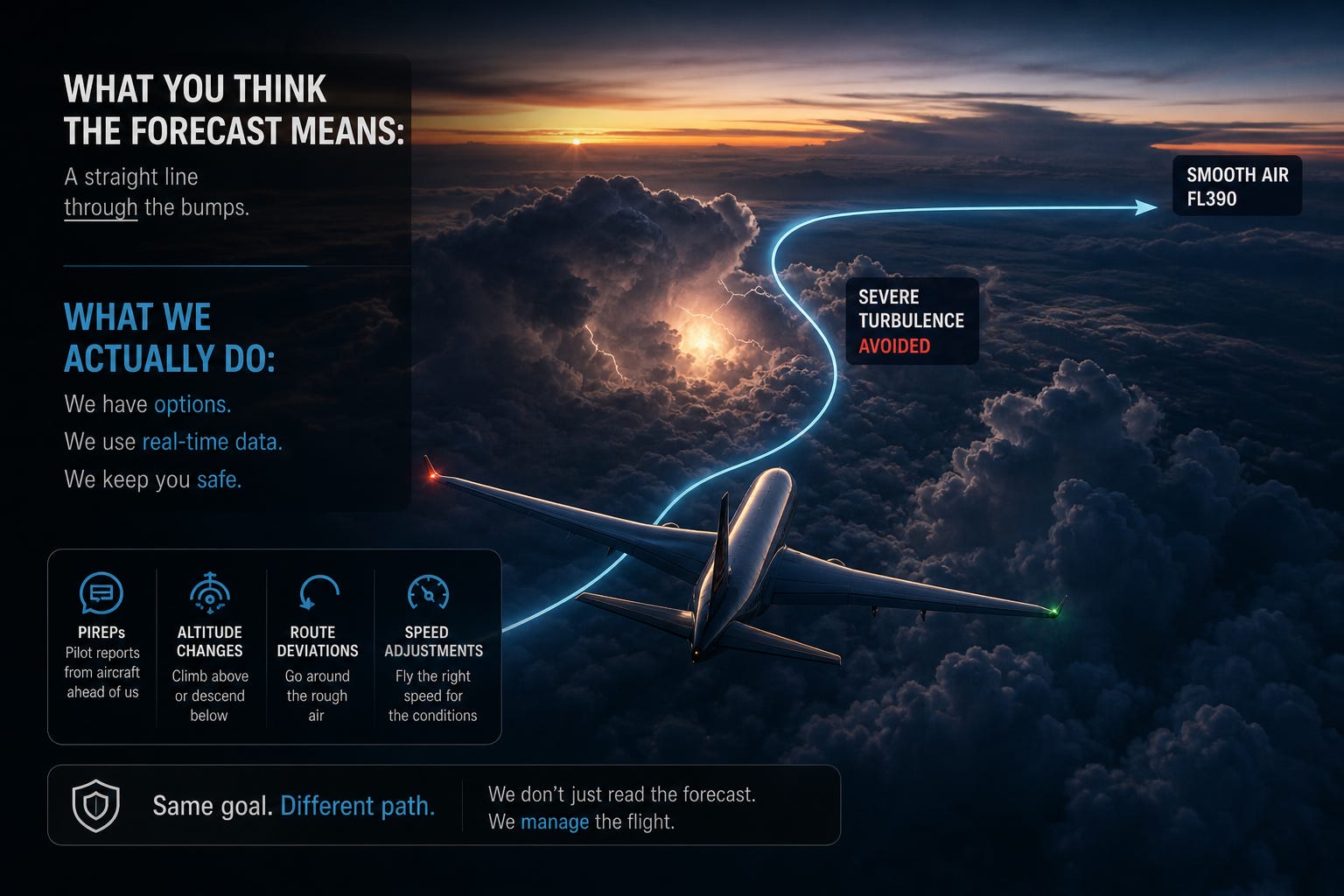
4. The forecast assumes we’ll fly straight through whatever it predicted. We almost never do.
This is the one Turbli openly admits buried in their FAQ. When their forecast shows severe turbulence, they note that “your pilot might find an alternative route.” That’s a polite way of saying: the forecast you’re looking at doesn’t account for the most important variable, which is the captain.
If we hit a bump, we ask ATC for a different altitude. Or we deviate around it. Or we slow to “turbulence penetration speed” a specific airspeed engineered to keep the aircraft stable. Sometimes we change altitude before hitting the bump, because the PIREP from the aircraft ahead of us told us to.
The forecast assumes a plane flying in a straight line at one altitude. Real flights don’t work that way. The captain and his or her First Officer are part of the system. Turbli, by definition, can’t forecast what I’ll choose to do.
The Bigger Problem (This Is The One That Matters)
Here’s the part I really want you to hear.
Even if Turbli were 100% accurate and no app can be checking it the night before your flight isn’t preparing you.
It’s priming you.
When you stare at those orange and red bars at midnight, your brain isn’t filing the information away calmly. It’s rehearsing fear. By the time you board, every small bump becomes a confirmation of what the app warned you about. A normal pocket of light chop, the kind that doesn’t even register for me in the cockpit, feels like the beginning of something worse.
You’re not flying through more turbulence than other passengers. You’re flying through the same air, with a brain that’s already decided what every bump means.
The air is the same for everyone, but where you sit changes how much of it you feel. Here's the seat I'd pick if I wanted the smoothest ride 👇
Pilot’s Secret for a Smooth Flight: Sit Here. Most Passengers Never Think of It

If turbulence stresses you out, here's the seat I'd choose as a passenger. Most never think of it.
That’s not Turbli’s fault. That’s just how anxiety works when you give it a forecast to obsess over.
So if the app isn’t the answer… what should you actually trust?
What Pilots Actually Use, And What You Can Access Right Now
Here’s the truth most articles about turbulence don’t tell you:
Turbli isn’t the top of the food chain. It’s the consumer-friendly version of tools that already exist. Some of those tools are free. Some require a subscription. One or two are reserved for professional aviation. But all of them give you a more complete picture than what you’ve been using and once you know how to read them, you’ll never doom-scroll a turbulence app the night before a flight again.
A quick note for fairness, before we go further: Turbli’s interactive map does let you select altitudes, and their separate PIREP feed is genuinely useful. If you’re going to keep using Turbli, those two features are far better than the default route forecast most people land on. But there’s still a better way to do this and once you see it, you’ll understand why.
Let me walk you through the tools, in the order I’d recommend you try them.
Tier 1: Free, And Better Than Turbli
🌐 Aviation Weather Center (aviationweather.gov)
This is the official source. The U.S. National Weather Service’s aviation division publishes the same SIGMETs and AIRMETs that I read before every flight. It’s plain, ugly, and not designed for passengers — which is exactly why it’s better. No marketing. No color-coded fear bars. Just the real advisories pilots use.
What to look for: Go to the “G-AIRMET” or “SIGMET” section and check whether your route has an active turbulence advisory. If it doesn’t, the worst-case forecast you saw on Turbli is statistically very unlikely to materialize. That alone is worth more than a week of doom-scrolling.
🗺️ SkyVector (skyvector.com)
A free, web-based aeronautical chart used by general aviation pilots worldwide. It overlays SIGMETs, AIRMETs, and PIREPs directly on your route. You can literally see what other pilots are reporting in near real-time.
What to look for: Pull up your route, toggle on the weather layers, and look at recent PIREPs along your path. Smooth reports from earlier flights at your altitude? That’s the most reassuring data on the internet and you won’t find it integrated into any consumer turbulence forecast.
Tier 2: Worth Paying For (If You Fly Often)
💨 Windy.com (with aviation layers)
Windy is what Turbli wishes it were. It uses multiple forecast models (ECMWF, GFS, ICON) instead of just one and you can compare them. It also has dedicated aviation layers for turbulence, icing, and jet streams at every altitude band.
What to look for: Set the altitude slider to where your flight will cruise (most long-haul flights cruise between FL340 and FL400 you can find your flight’s expected altitude on Flightradar24). Check the turbulence layer at that specific altitude not the route average. This alone solves one of the biggest weaknesses of consumer turbulence apps.
✈️ ForeFlight
This is the gold standard for general aviation pilots in the U.S. and the same app many airline pilots use personally. It’s a paid subscription, but it gives you turbulence forecasts cross-referenced with real PIREPs, layered by altitude, updated continuously.
Honest take: You probably don’t need ForeFlight unless you’re a serious aviation enthusiast or you fly multiple times a month. But if you’re someone who’s been spending nothing on Turbli and a fortune on therapy because of flight anxiety, ForeFlight is a much better investment in your mental health.
Tier 3: What We Use In The Cockpit (For Your Awareness)
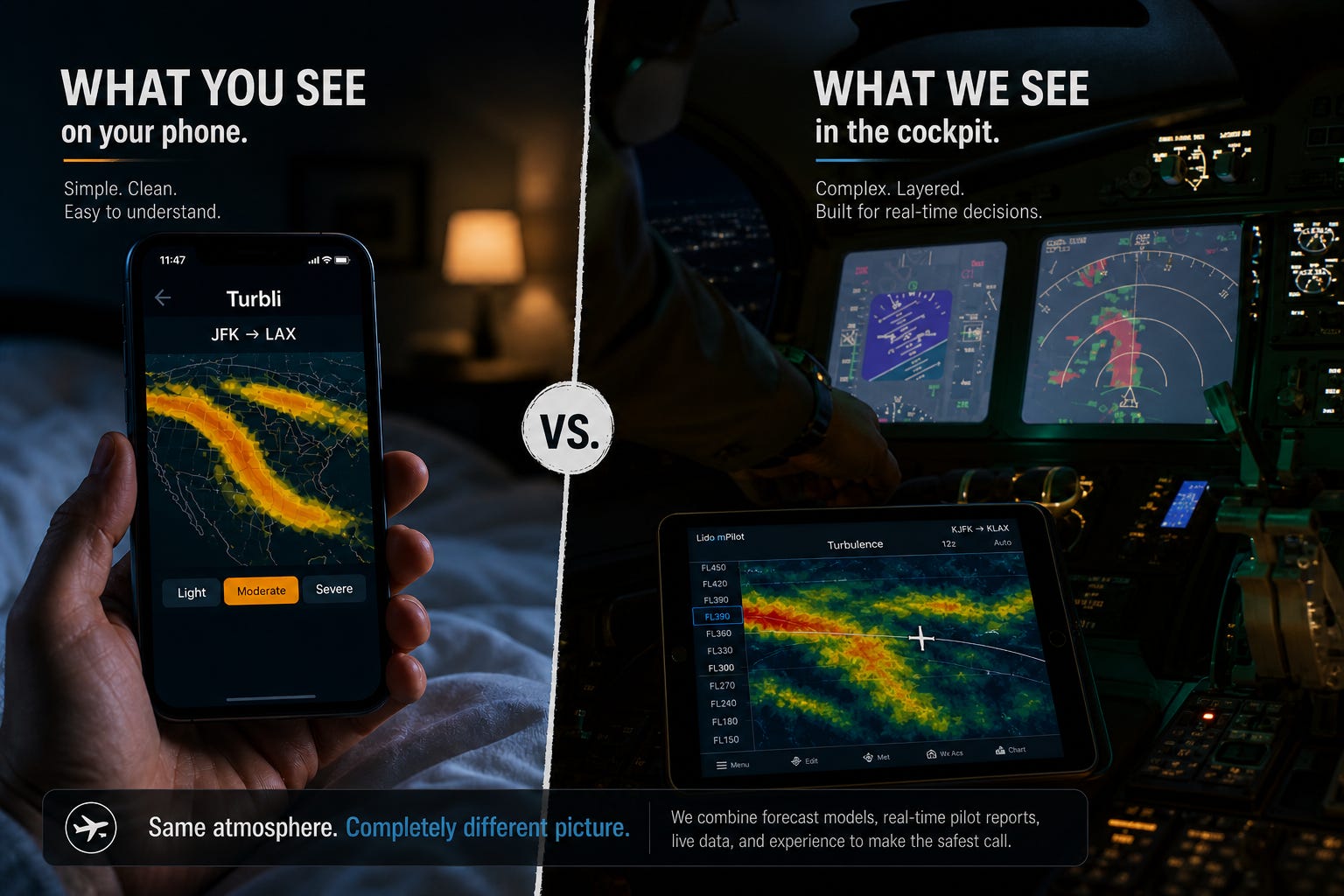
📡 Lido
Lido is the flight planning system used by many major airlines. It integrates real-time weather, turbulence forecasts, PIREPs, and aircraft-specific performance data into a single picture. It tells me not just where the turbulence is, but what my specific aircraft, at my specific weight, at my specific altitude will experience.
You can’t access Lido. But knowing it exists matters, because this is the data your captain is flying on. Not Turbli. Not Windy. A system specifically engineered to keep your flight smooth and safe with information orders of magnitude richer than anything on the consumer market.
When I tell you “the pilots aren’t worried” this is what we’re looking at. And it’s almost always reassuring.
Now you know what to look at. But a pilot's tool in nervous hands can make things worse. Below, I'll show you exactly how I read these screens, the three signals I trust over any forecast, and the 3-step routine I give every nervous flyer who emails me. It's the closest I can get to handing you the jumpseat.
