


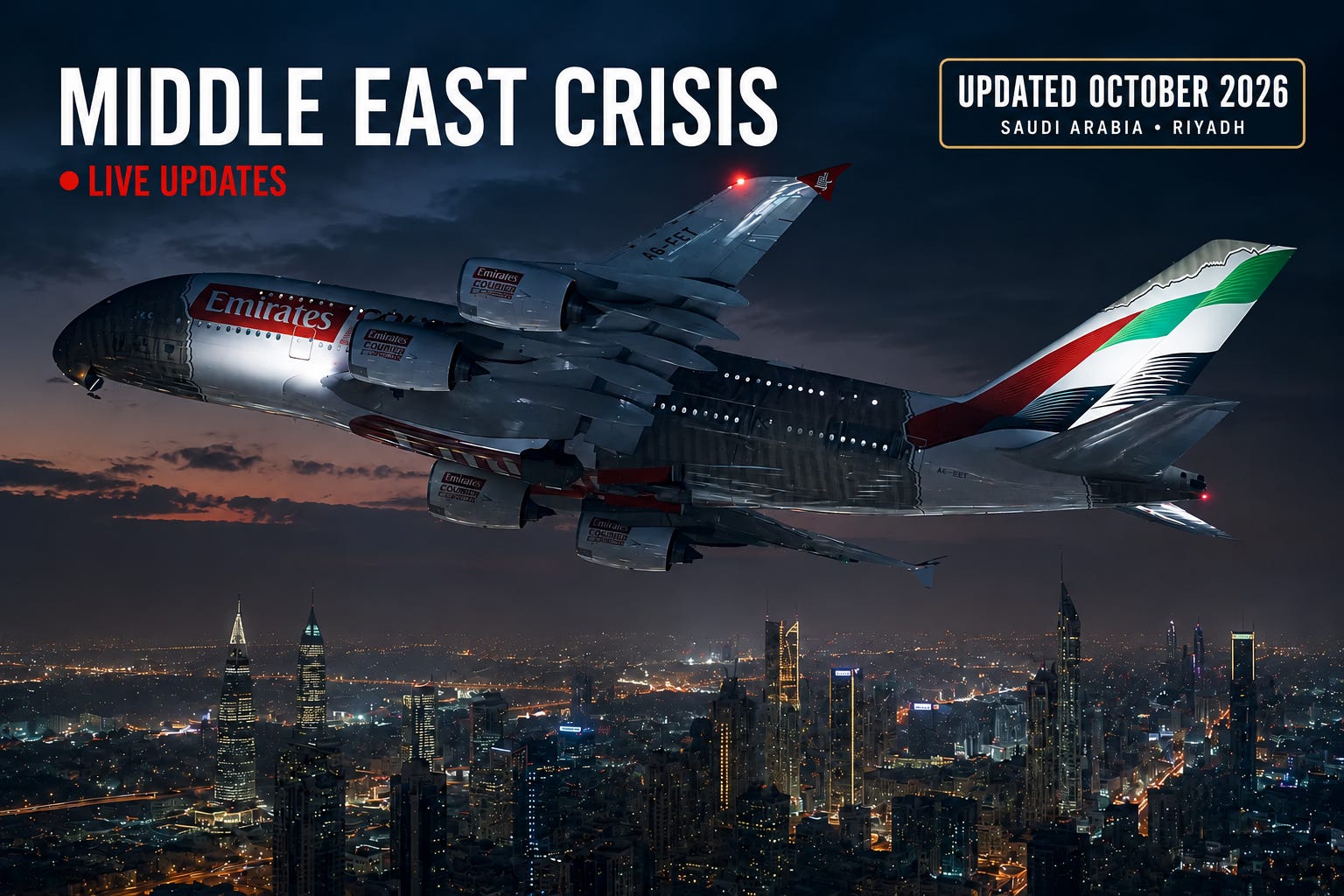
🔴 UPDATE, October 13, 2026: Riyadh is closed, and Saudi Arabia is now the issue
In May I told you the hole in the sky over the Gulf was starting to close. For Dubai and Doha, that mostly held. This past week the problem moved west, onto the country most Europe to Asia flights had been leaning on: Saudi Arabia.
In the first days of October, Yemen’s Houthis began hitting Saudi airports with drones and missiles: Riyadh, plus Abha, Jizan and Najran in the south. On October 8, a strike at Riyadh’s King Khalid International hit a parked Saudia aircraft. There were no passengers on board, but three people were killed, among them a Saudia captain, Hamoud Ali Alkalthami. On October 10, a ballistic missile hit the terminal complex that holds Terminals 3 and 4. Thirteen people died, including a 28-year-old flynas flight attendant, and more than 300 were hurt. On October 11, Terminal 4 was hit again and Dammam’s airport was also targeted. Across the week, at least 19 people have been killed and more than 350 injured.
Captain Alkalthami and that flight attendant were at work, doing the same job my colleagues and I do every day. My thoughts are with their families, and with the Saudia and flynas crews who are still turning up for work this week.
Where things stand this morning:
Riyadh (RUH) is closed by NOTAM until midnight local time at the end of Saturday, October 17, and that date can move. Saudi Arabia’s civil aviation authority says the airport stays shut while it completes safety and readiness checks, and it hasn’t promised a reopening date. On October 11, Cirium counted 353 of 354 Riyadh departures cancelled.
Jeddah, Dammam and Madinah are open, with heavy delays and cancellations. Dammam is taking some diverted Riyadh traffic. In the south, Jizan and Najran are closed by NOTAM until 6 p.m. local time on October 15, and Abha is open only in daylight until then.
Airlines have pulled back from Riyadh. Lufthansa Group has suspended flights until October 16, Gulf Air until October 17, SriLankan until October 18, Etihad until October 19, and Air France and KLM until the end of October. Delta has moved its first Atlanta to Riyadh flight, planned for October 23, to March 2027.
The regulators have moved too. EASA revised its Saudi bulletin on October 9 (valid until November 16): European airlines should avoid two defined parts of the Jeddah flight information region at all altitudes and use caution in the rest of it. France and Germany have warned their own operators, Canada has told its airlines not to enter Saudi airspace at all, and the FAA has a caution notice in force until December 10.
Dubai and Doha are open. Emirates and Qatar Airways are flying, though Riyadh is off and other Saudi flights are being trimmed day to day. Lufthansa is scheduled back in Dubai on October 25 and 26, Swiss on October 27 and British Airways on November 3, but treat those dates as provisional.
If you’re flying from the US
The FAA has told American airlines that threats in Saudi airspace “could pose a potential risk to aircraft at all altitudes.” It’s a caution notice, in force until December 10. It doesn’t ban US airlines from Saudi airspace, but it means every US carrier’s security team is now reviewing its routes over the country. Very few US flights go to Saudi Arabia in the first place, and the one that was about to start, Delta’s first Atlanta to Riyadh service on October 23, has been pushed back to March 2027. The US Embassy in Riyadh has warned Americans to expect cancellations and airspace closures.
For most of you the effect is indirect. If you’re connecting to Asia, India or Africa through Dubai, Doha or a European hub, your onward flight may be scheduled longer, and Saudi connections are the ones to avoid this month. If you’re flying American Airlines through Doha, it has a travel alert covering trips through January 6, 2027, so you can change your booking without a fee.
Why your flight to Asia may be longer, even if you’re nowhere near Riyadh
Most airlines have avoided Iran and Iraq since the end of February. That funnelled a huge share of the flights between Europe and South or Southeast Asia over Saudi Arabia this year. If you’ve flown London to Singapore or Paris to Mumbai since March, there’s a good chance you crossed it.
Every one of those flights carries a list on the captain’s flight plan that passengers never see: the en-route alternates. These are the airports we’d divert to if a passenger had a heart attack, an engine needed shutting down, or we lost cabin pressure over the desert. Riyadh, Dammam and Jeddah have been sitting on a lot of those lists.
When Riyadh drops off that list, our planners swap in another suitable airport, and the region has several. The bigger effect on the map comes from the warnings around it. EASA has drawn areas to avoid, Jeddah control is slowing the flow, and every airline’s security team is adding its own buffer. Put those together and some flights take tracks that keep well clear of the southern areas near Yemen, some go north through the Caucasus and Central Asia, and some add a fuel stop. If your flight to Asia is scheduled longer than it was last month, that’s usually why.
If you’re a nervous flyer, the question underneath all of this is whether a plane in the air over Saudi Arabia is at risk. The strikes this week hit airports on the ground, but the sky above matters too. The Houthis have publicly warned airlines away from Saudi airspace, and the FAA’s notice says the threat could reach aircraft at any altitude. The risk for an airliner is being near missiles, drones and air defences while they’re active.
That is what the people making these decisions guard against. They are the regulators, who publish exactly which areas and altitudes to avoid, and each airline’s own security department, which reads those bulletins alongside government briefings and private intelligence the public never sees. Those security teams often draw their line further out than the regulator does. Since MH17 was shot down over Ukraine in 2014, that process has become far more conservative, and a route through an area an airline has been told to avoid simply doesn’t get filed.
From my seat, that’s the reassuring part. No airline is sending aircraft over Saudi Arabia this week on hope. They’re paying the fuel bill to stay behind those lines, and a longer flight is the price of that margin.
What I’d do this week
If you’re booked into or out of Riyadh before October 20, assume it won’t operate and contact your airline now, through its app or website first and by phone if you must, about rebooking or a refund. If you’re connecting through Jeddah or Dammam, build in a spare day. If you’re flying Europe to Asia on any airline, expect a longer block time and don’t book a tight onward connection at the far end. And if you’re flying through Dubai or Doha, you’re in a much better position than anyone routing through Saudi Arabia right now, but check your flight the morning you leave.
One correction to what I wrote in May: I suggested Jeddah and Dammam as backup hubs if Dubai or Bahrain fell over. Please don’t count on them right now. The backup hubs I’d use instead are below the line.
If someone you know is flying to Asia or the Gulf this month and has been watching the news with a knot in their stomach, please forward this to them.
Earlier update, May 9, 2026 (Day 70): After the April 8 US–Iran ceasefire, UAE airspace fully reopened and Qatar Airways rebuilt to around 140 daily departures. Dubai and Doha came back as working hubs, though most European carriers stayed away until later in the year. The airline dates and flex policies in that update have since expired. See the October 13 update above for where things stand now.
🔒 The rest of this article is for paid subscribers.
The October routing picture: why traffic is still crossing Saudi Arabia, and how crews cross Afghanistan, where there’s no normal air traffic control
ESCAT, the emergency procedure that can change your route after you’ve boarded, and why it’s one more layer of protection
GPS jamming across the Gulf: what it looks like from the flight deck and how crews keep flying through it
My updated backup hubs, now that Jeddah and Dammam are off the list
The insurance trap in the weekend’s government warnings, and your refund rights if your flight is cancelled
The full Smart Pilot’s Booking Strategy: the Flightradar24 ground-truth check, why booking direct beats the online agencies when things go sideways, the first-flight-of-the-day rule, the seat tactic for downgauged aircraft, and what to do in the first hour if you’re stranded
Already a paid subscriber? Keep reading below.👇🏻
