
Pilot Nick - 10 min read
BLACK BOX · Incident file: Learjet 60 N722BD, Palm Beach County
The short version
On Sunday, a Learjet 60 flying from Austin to the Bahamas went into a steep, high-speed dive over South Florida and crashed near Greenacres, killing all nine people on board.
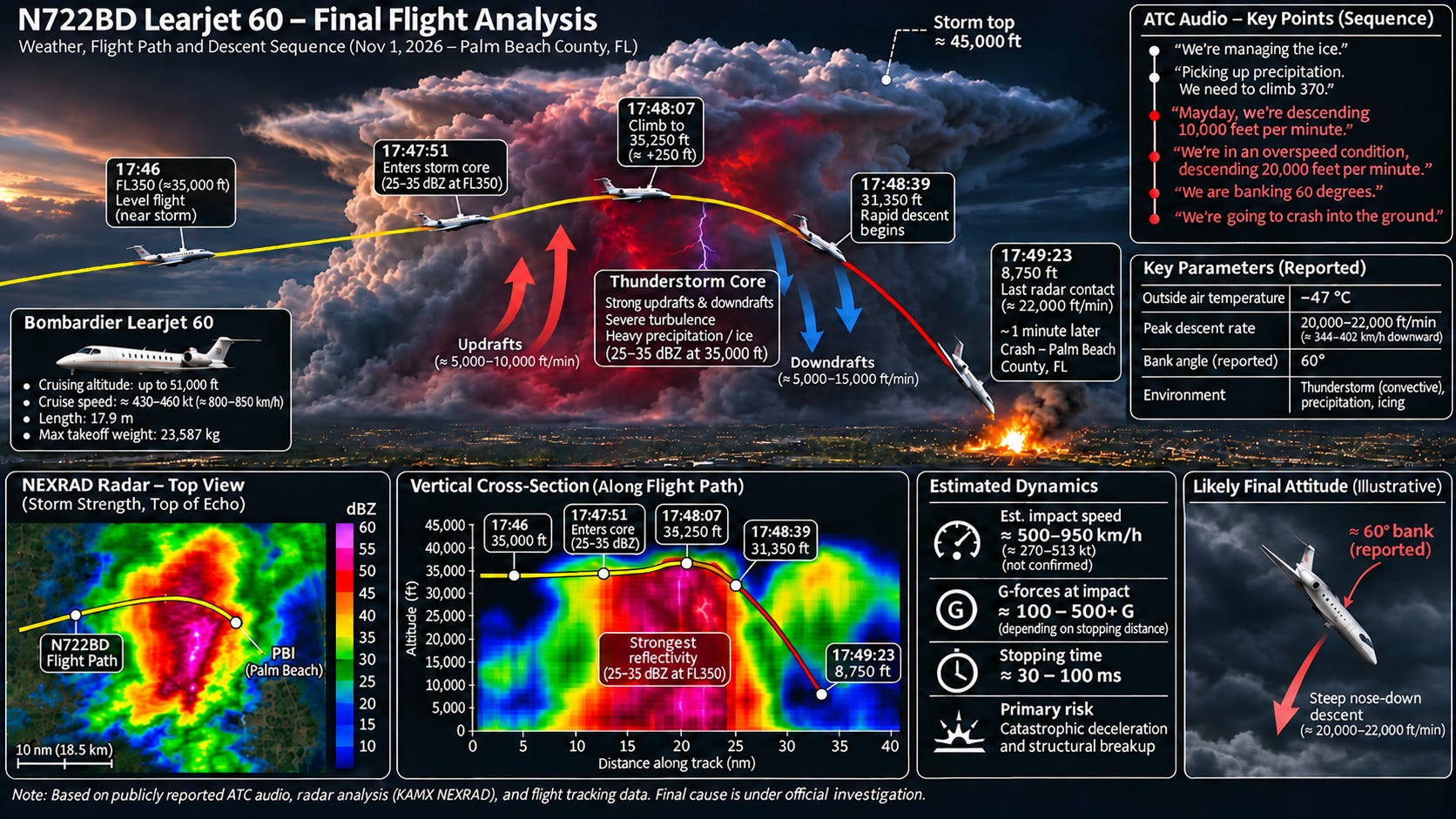
Before the dive, the pilot reported light clear ice, moderate turbulence and an outside temperature of minus 47°C, and the flight was cleared to climb from 35,000 to 37,000 feet. A Flightradar24 radar overlay, reported by the AP, appears to show the jet flying into a building storm cell.
The NTSB says there is “some indication” the jet was breaking up before impact. No cause has been established.
One detail in the radio calls raises a question, and it is where the pilot's analysis starts. Every theory, including storm damage, is still open.
A preliminary NTSB report usually follows within about 30 days. I will come back to this file when it does.
At 12:48 on Sunday afternoon, a Learjet 60 over South Florida had just been cleared from 35,000 to 37,000 feet. Flightradar24 shows it climbing briefly, then rolling into a steep descending turn to the right. The crew called mayday and reported an overspeed, descending at 20,000 feet per minute. According to the FAA, the jet went from 35,250 feet to 8,750 feet in a little over a minute. It hit the ground around 12:50, near Military Trail in the Greenacres area. All nine people on board were killed.
My thoughts are with their families. This file sticks to what is confirmed, and to the questions a pilot asks first.
Black Box is my recurring series on aviation incidents in the news, and older ones still worth learning from. Every file follows the same rules: the confirmed facts first, a pilot’s reading of the data, the theories kept in a “not yet” box, and no guessing ahead of the investigation.

The flight file: what is established
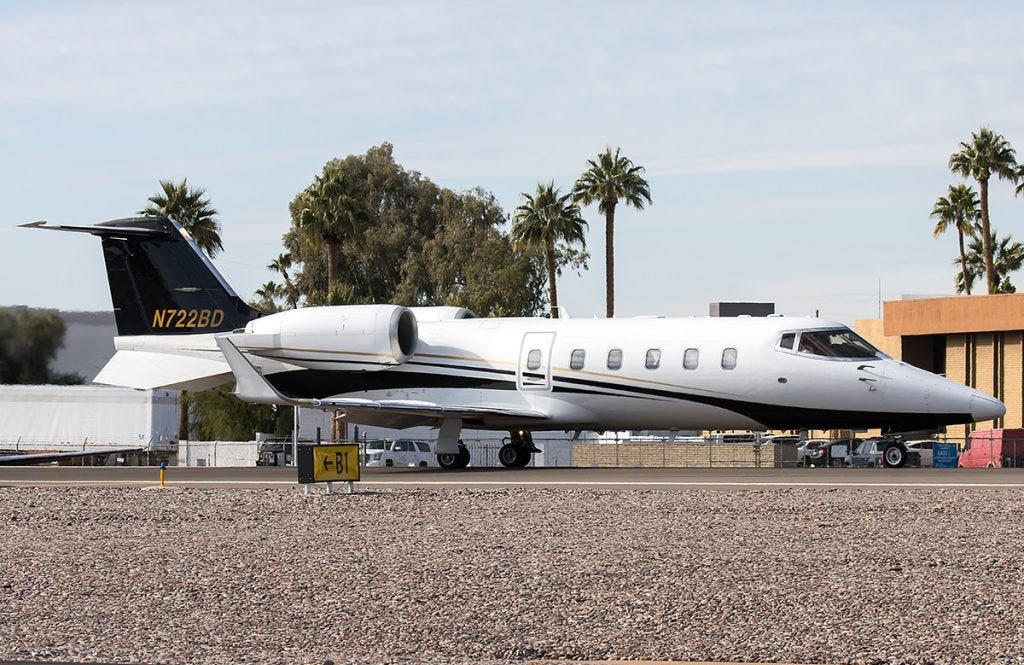
The airplane was N722BD, a Learjet 60 built in 2004 and registered to a Delaware company, LR60271 LLC. The operator has not been identified. It left Austin-Bergstrom on Sunday morning for North Eleuthera in the Bahamas and cruised east at around 41,000 feet. Near Naples, at 12:35 local time, it started down to 35,000 feet.
Thunderstorms were scattered across South Florida. A National Weather Service observation about 15 minutes before the accident recorded thunderstorms, 3 miles of visibility and gusts to 19 knots near the crash site. Weather radar images that Flightradar24 combined with the flight path appear to show the jet flying directly into a storm cell that was rapidly building upward, the Associated Press reported. That overlay is not an NTSB analysis. Ground radar images can lag the real weather by several minutes, so the jet's exact position relative to the cell is for the investigators to establish, and Chapman said weather will be a major focus of the investigation.
On the Miami Center frequency, recorded by LiveATC.net, the pilot reported light clear ice that he called manageable, moderate turbulence moving the airplane up and down by as much as 700 feet, precipitation, and an outside air temperature of minus 47°C. CNN reports that he asked to climb, and the controller cleared the flight to 37,000 feet. Tracking data showed a descent rate above 32,000 feet per minute before the signal was lost.
At a briefing on Monday afternoon, NTSB Member Tom Chapman said there is "some indication that the aircraft was breaking up before impact," and that parts may be found some distance from the main site. Investigators describe a debris field roughly half a mile by four-tenths of a mile and have not identified the parts yet. According to CBS12, NTSB officials also confirmed that the crew reported light clear ice and moderate turbulence shortly before the overspeed. Chapman said water in the crater is complicating access to the wreckage. Records show a cockpit voice recorder was installed, but the NTSB does not yet know whether it was still on board. One man on the ground suffered a leg injury, and about 600 residents of a nearby mobile home park were evacuated. Chapman declined to speculate on a cause.
If this makes you uneasy about your next flight, hold on to this: pilots treat thunderstorms as something to go around, and the whole system is built to keep you away from them.
One number in that radio call does not sit well with the words “clear ice”, and the breakup evidence leaves investigators with a harder question, which is whether the airplane came apart first or came apart because of the dive.
Reading the data like a pilot
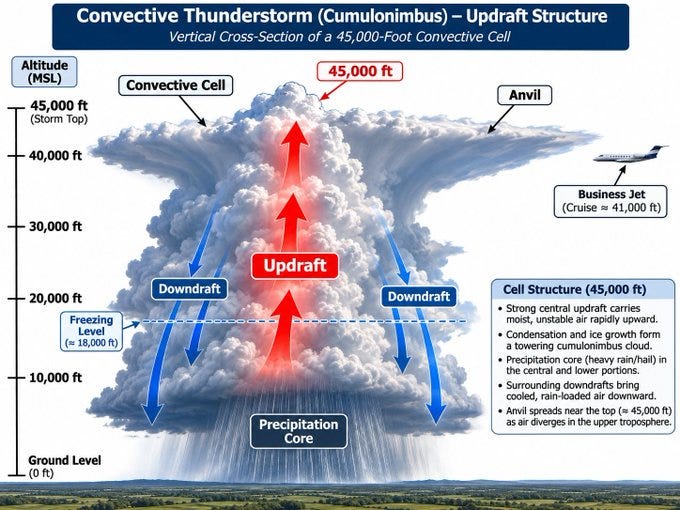
Start with the storm. The FAA's thunderstorm guidance, Advisory Circular 00-24C, tells pilots to "avoid by at least 20 miles any thunderstorm identified as severe or giving an intense radar echo." The radar overlay suggests this jet entered a building cell, but as I noted above, those images run behind the real weather, and a fast-growing cell can move or build a long way in a few minutes. How that cell looked on the crew's own radar is not yet known. Heavy rain can hide a stronger cell behind it on an airborne display, and a cell can grow into a flight path faster than a crew can turn away. Whether the crew asked the controller for a deviation is another open question. The recorders, the ATC tapes and the radar archives should help answer all of it.