


Pilot Nick (8mn read)
Ten minutes.
That’s how long it took for a fully loaded widebody, with an engine coming apart and fire trailing behind it, to get safely back on the ground.
No injuries. No panic. No chaos.
Just ten minutes.
Here’s exactly what happened on Delta 104 and why, from the cockpit, the outcome was never really in doubt.
THE MOMENT
Now step into the cabin for a second.
You’ve just settled into your seat on a long-haul flight from São Paulo to Atlanta — eight-plus hours ahead of you. Dinner service is coming. You’ve got your movie picked out. It’s close to midnight.
Then, seconds after the wheels leave the runway—
You hear it.
A loud bang. Then another.
And when you look out the window… you see fire.
Let me walk you through it. Not the headline version. The real version.
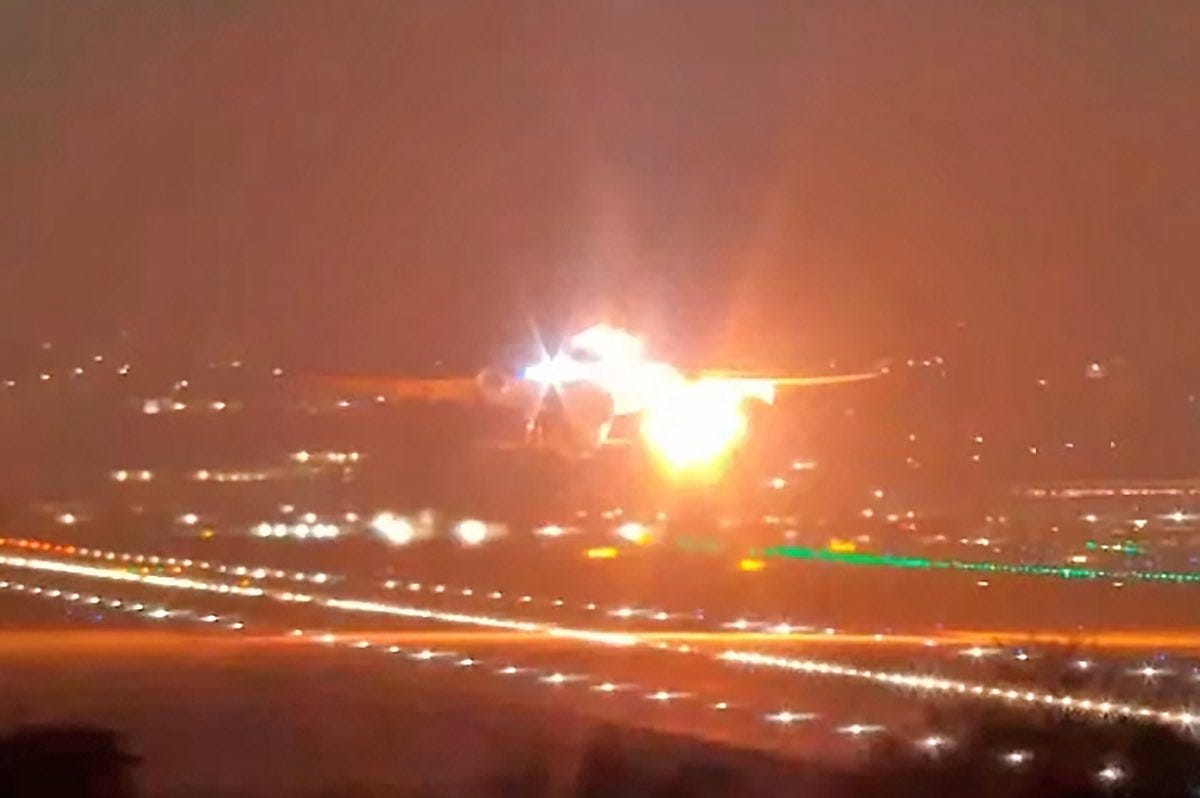
Here is a cabin view of the failure just after take-off from São Paulo yesterday:
WHAT ACTUALLY HAPPENED
The aircraft was a 19-year-old Airbus A330-300 registered as N813NW — a workhorse originally built for Northwest Airlines, later absorbed into the Delta fleet after their 2009 merger. It’s powered by two Pratt & Whitney PW4168A engines, each producing around 68,000 pounds of thrust.
Seconds after rotation — that’s the moment the nose lifts off the runway — the left engine suffered what aviation investigators call an uncontained engine failure. That’s the technical term for what happened when the engine didn’t just malfunction quietly. It came apart. Incandescent debris was ejected from the engine, fell onto the grass beside the runway, and ignited a brush fire inside the airport perimeter. Metallic fragments were later found scattered on the runway surface itself.
Witnesses on the ground reported multiple explosions followed by sustained flames trailing behind the aircraft as it climbed away. Air traffic control, watching from the tower, immediately got on the radio.
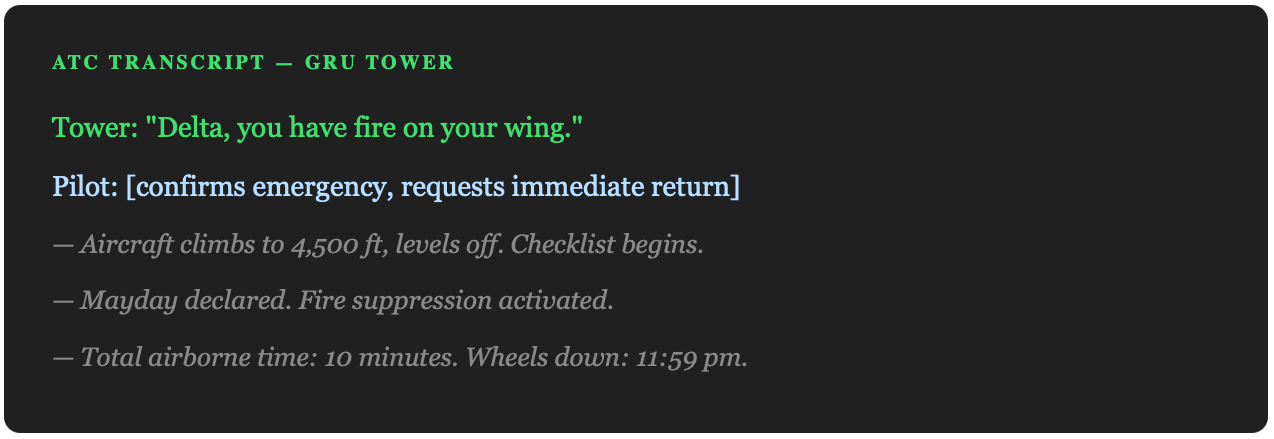
Ten minutes. From explosion to safe landing. That’s the number I want you to hold onto.
MY PERSONAL READ — WHAT I THINK HAPPENED
The official investigation is only just beginning, and I’ll be clear: we don’t know the root cause yet. But after 28+ years in the cockpit, when I look at the sequence, the loud bang at rotation, the immediate flames, the debris trail my gut says :
Compressor Stall.
PILOT NICK’S TAKE
A compressor stall happens when the smooth, high-speed airflow through the engine’s compression stages suddenly breaks down, the engine momentarily “chokes,” and unburned fuel and hot gases backfire forward out of the engine instead of flowing through cleanly. That backfire is what produces the dramatic flash of fire from the front or sides of the engine, and the cannon-shot bang that passengers hear and feel in their chest.
What causes it? That part I honestly can’t tell you yet and neither can anyone else right now. It could be FOD, foreign object debris, something ingested into the fan at the worst possible moment. It could be a bird strike. It could be an internal mechanical issue in the compressor stages themselves. The investigators will work through that methodically. But whatever triggered it, the result was unmistakable and from the cabin, I can only imagine how impressive that looked.
Here’s what I want you to know, though: this is precisely the scenario we train for in the simulator, regularly, every six months without exception. The sounds, the warnings, the fire handle, the checklist — none of it was new to that crew. When it happened for real over São Paulo, they’d already “seen” it dozens of times.
The bang, the fire, the ten-minute return — you now understand what happened over São Paulo better than most passengers ever will.
But here’s the part almost no one outside the cockpit ever sees:
What actually happens in those first seconds up front.
How the crew decides whether to continue or come back.
And the one detail about that runway that made this situation far more complex than it looked.
On the other side, I’ll walk you through the exact cockpit sequence — step by step — and show you three things to watch on your very next flight that will instantly tell you everything is under control.
→ “If you’ve ever felt uneasy during takeoff, this next part will change the way you experience it.”
