

I’ve heard it hundreds of times.
A passenger in first class, half-joking as they sip their drink, leans toward a flight attendant and says: “So… are the pilots actually up there, or did the computer take over?”
Everyone laughs. But the question is serious and the assumption behind it is one of the most common misconceptions in all of aviation.
People genuinely believe that once autopilot is on, the cockpit goes quiet. That we kick back, read a magazine, maybe catch a nap.
I want to set the record straight. Not just to defend my profession but because understanding what’s really happening up front might be the single most reassuring thing you’ll ever learn about flying.
WHAT YOU PICTURE
Here’s what most passengers imagine:
Climb to cruise altitude. Press a button. Put the plane on autopilot. Coffee. Crossword puzzle. Maybe a quick nap. Wake up 8 hours later for descent.
“The computer’s flying. The pilots are just there in case something goes wrong.”
I understand where this comes from. Aviation movies. News reports. A general sense that modern aircraft are so sophisticated they practically fly themselves.

And on the surface? It looks that way. Cruising at 37,000 feet, the aircraft is smooth, stable, and seemingly serene.
But here’s what you don’t see.
WHAT’S ACTUALLY HAPPENING
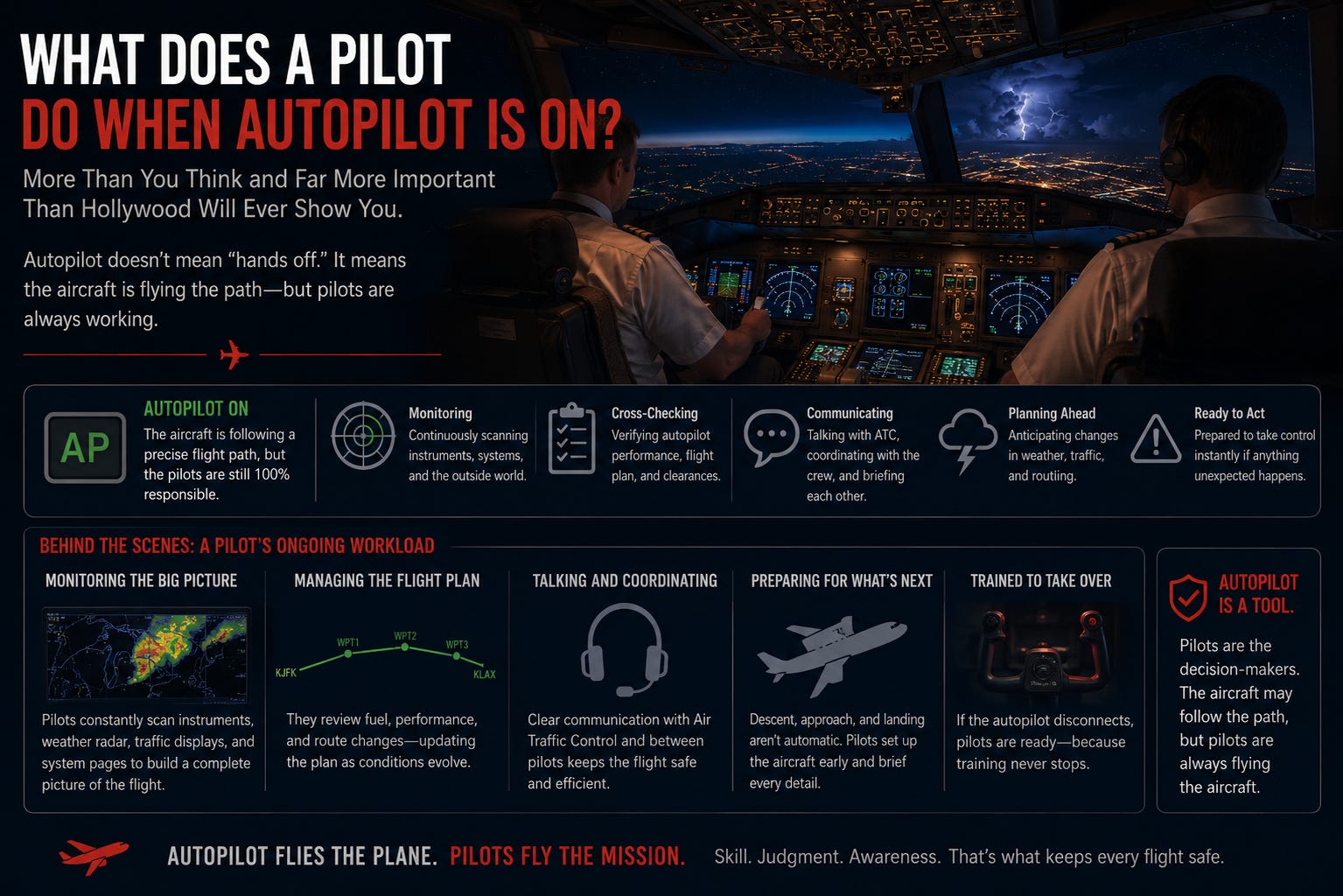
The moment autopilot engages — typically a few minutes after takeoff — it doesn’t mean we stop flying the aircraft. It means we change how we’re flying it.
Think of autopilot like cruise control in a car. You’ve set your speed, but you’re still steering, watching the road, anticipating the curve ahead, ready to brake if something unexpected happens. You haven’t handed the wheel to the car and gone to sleep.
Now multiply that by a hundred. Add weather systems across three time zones. Air traffic control instructions every few minutes. Fuel calculations updating in real time. Contingency planning for airports you might never visit.
That’s closer to what we’re doing.
On a long-haul flight, my co-pilot and I will monitor dozens of systems, receive multiple re-routes, cross-check fuel burns against our flight plan, and brief for alternate procedures — all while the autopilot holds our altitude to within 10 feet.
But here’s where it gets genuinely interesting — and this is the part most passengers never hear about.
The autopilot isn’t making decisions. We are. Every input it follows comes from us. Every constraint it works within, we set. Every change in route, altitude, or speed — that’s the pilots talking to the aircraft through a system called the Flight Management Computer.
And managing that system, while simultaneously monitoring engine performance, weather radar, hydraulic pressures, fuel balance, cabin altitude, and a hundred other parameters…
That’s a full-time job. That’s our full-time job.
What I’m about to share inside the paid section is something most people never get to see: a real breakdown of what a typical cruise phase looks like from the left seat — the decisions being made, the systems being watched, and the one thing that happens on almost every long-haul flight that would surprise even the most frequent flyer.