



You’re in 14A. Window seat. Somewhere over the Carolinas in July.
Outside, the cloud has been building for twenty minutes — first cottony, then bruised, then black. The cabin lights flicker once. Twice. There’s a flash, white and total, then a crack that doesn’t sound like anything you’ve heard before.
A kid two rows back yells. Your hand finds the armrest. The man across the aisle whispers “oh god” under his breath, and you realize you said it too.
You want someone, a calm voice, an adult voice to come over the PA and tell you everything is okay.
Up at 37,000 feet, we know that feeling. We just don’t have it.
Here’s what most people get wrong about lightning.
They think the bolt is the danger.
It isn’t. The bolt is a discharge. A photograph of something that already happened. By the time you see the flash through your window, the physics are finished — the airplane took the strike, the current ran around the aluminum skin to the trailing edge, and it left the airframe somewhere out behind us, probably without leaving so much as a scorch mark.
The danger isn’t the lightning. The danger is the cloud that produced it.
And the cloud that produced it is something we worked out how to handle forty miles ago, on the ground, before any of this started.
That’s the part no one tells passengers. They imagine pilots squinting through the windshield, white-knuckled, “trying to make it through the storm.” We’re not. We’re managing distance. We’re managing geometry. We’re managing the small set of decisions that turn lightning from a problem into a non-event.
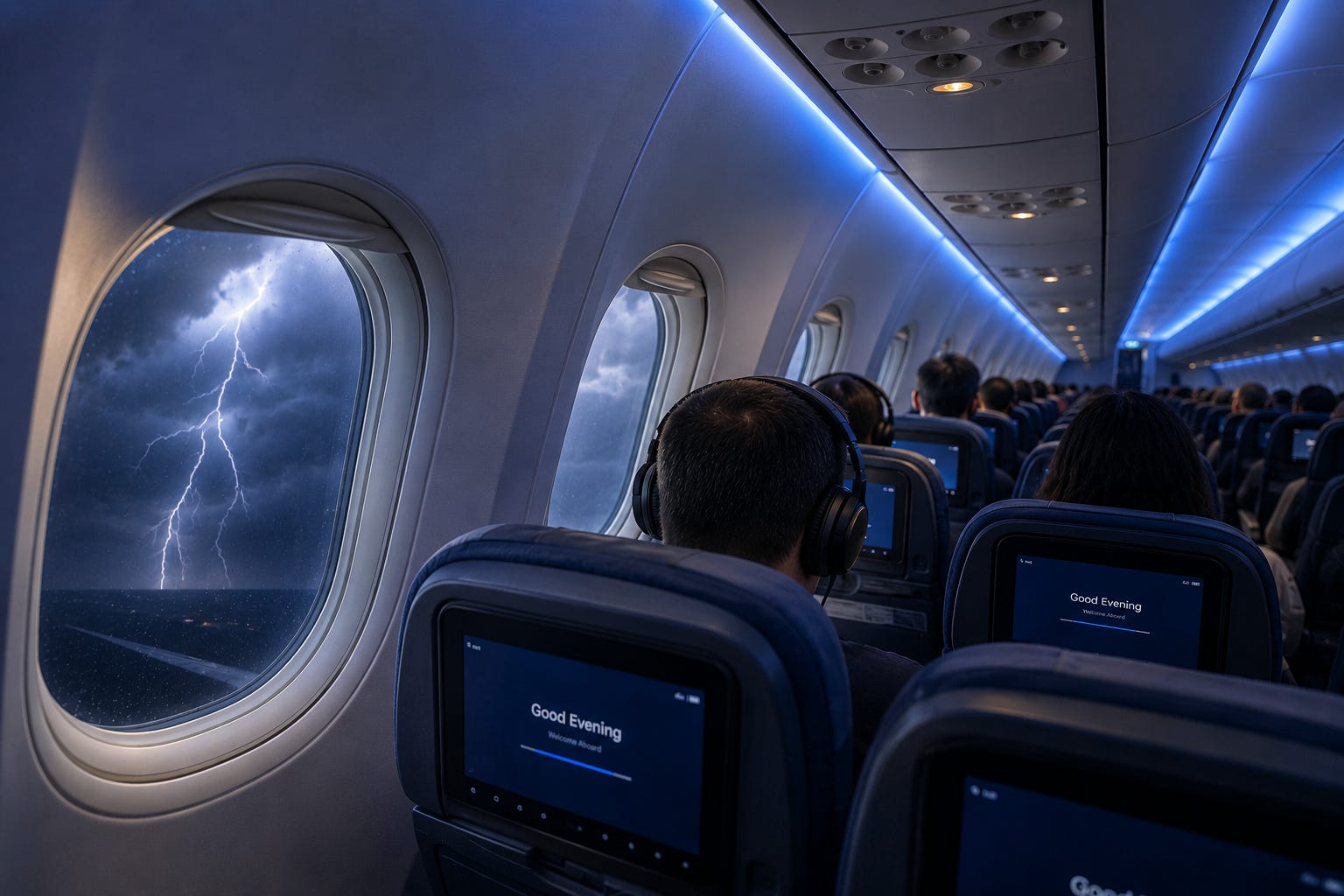
Let me tell you about an actual one.
Atlanta to Newark. Evening flight. A line of thunderstorms had been forming all afternoon along the spine of the Appalachians — the kind of line you can see on the weather radar from 200 miles away, painted in cells of yellow, red, and the magenta we call the bad ones.
My first officer and I briefed the line on the ground, before we even started engines. We knew where the gaps were. We knew which cell we’d deviate around first. We had a fuel number for the diversion and a fuel number for the divert-to-Charlotte-instead.
We launched. Climbed through 18,000 feet. At cruise, we were 40 miles out from the first cell when ATC cleared us to deviate left of course. We did. We threaded the line.
And then, between two cells we had already decided were safe to fly between — crack.
A flash so bright it lit the cockpit like a stage light. A sound that doesn’t have a real name. The autopilot stayed engaged. The instruments stayed green. My first officer looked at me. I looked at him. He said, “Well, that was a strike.” I said, “Yep.”
We finished the flight. Ground crew looked the airplane over in Newark. They found a tiny exit burn near the right horizontal stabilizer. Nothing structural. Nothing the airplane wasn’t built to take.
The strike was a non-event. The decision that prevented it from being an event was made on the ground, 90 minutes earlier, with a coffee in our hands and a flight plan on the table.
That’s the principle. The flash isn’t the moment. The moment was always earlier.
A small confession before we get into the framework.
When we know the line ahead has lightning and we know we’re at our 20-mile distance, we don’t dread it. Most pilots love it.
At night, if the storms ahead are really firing, we’ll turn the cockpit lights all the way up. Counter-intuitive, you’d think dim is better but bright lights keep our eyes adapted to brightness, so when the next bolt lights up the sky, we don’t go temporarily blind from the flash.
Then we watch.
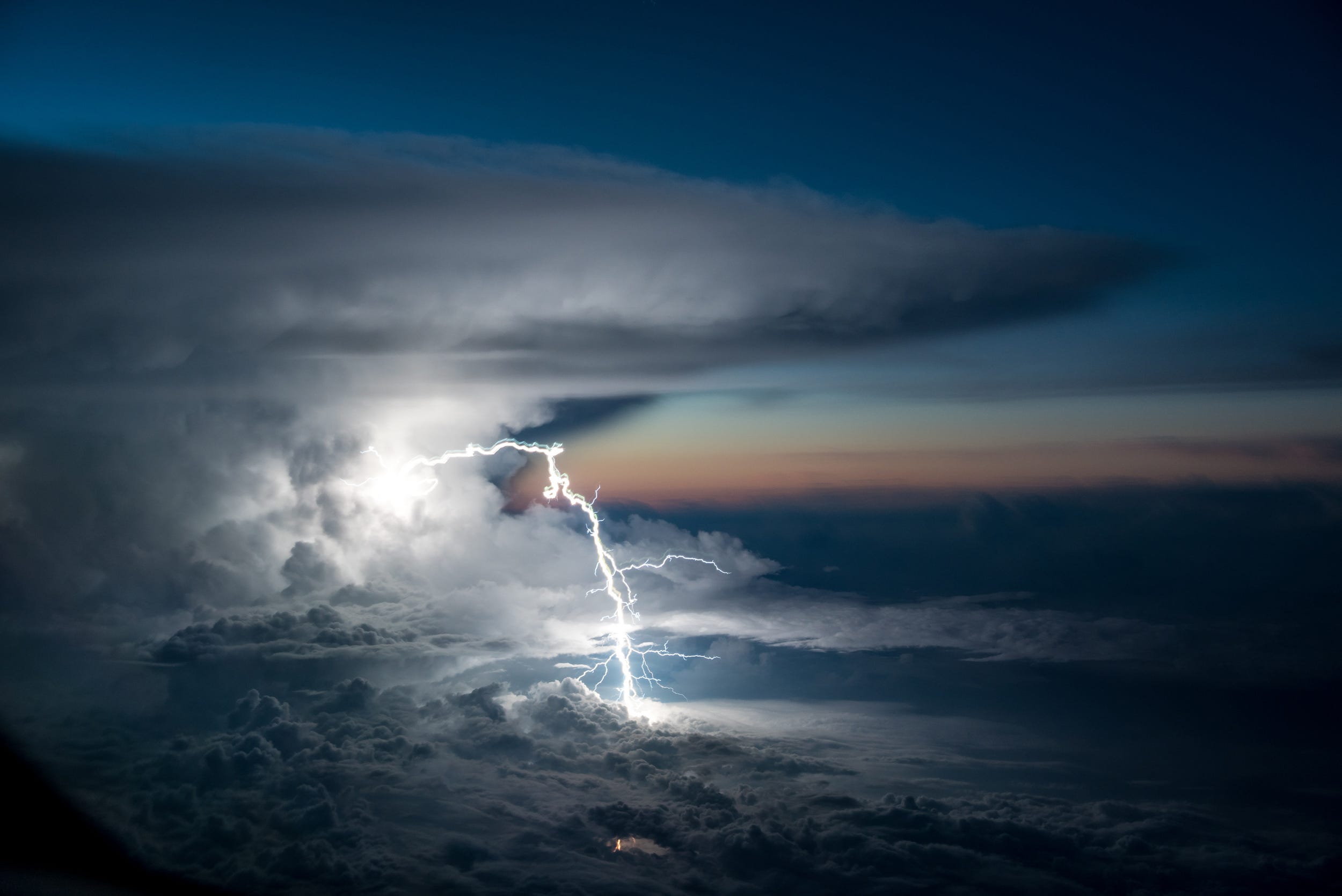
A thunderstorm at night, from the flight deck, with the right distance between us and it, is one of the most beautiful sights in this job. Cells lighting up from inside like paper lanterns. The whole horizon flashing white, then black, then white again.
We’re not white-knuckled up there. We’re often quietly grinning.
Here’s the framework — five steps. They map to the cockpit, but I’ve written each with a version you can use from 14A.
Step 1: Decide on the ground, not in the air
In the cockpit, we don’t make storm decisions while we’re flying through them. We make them on the ground, with charts and forecasts, hours before takeoff. By the time we’re airborne, the decision is already made — we’re just executing it.
You can use this immediately. If you’re a nervous flyer and you know you’re flying in summer, the moment you’re in the air with a flash outside your window is the worst possible time to start managing fear. Do that work the night before. Read the route forecast. Look at the radar from your hotel room. Decide, before the gate, that you’ve already accepted what you might see.
One practical move while you're still on the ground: if you don't love thunderstorms, book the early flight. Convective weather builds with the heat of the day — most thunderstorms in the US form between 2 and 6 p.m. local. A 7 a.m. departure usually beats the system entirely. It's the single cheapest fix in this article, and most passengers never use it.
Step 2: Read the radar, not the flash
Check the actual radar trend the night before, Windy is the simplest version of what we look at up front. Don't rely on the icon on your phone weather app. Storms in the southeastern US tend to form mid-afternoon and dissipate after sunset. A 9 a.m. departure into a 4 p.m. arrival window is a different conversation than a 4 p.m. departure into the same window.
In real life: if you’re at the window and you see a flash, your instinct will be to focus on the flash. Don’t. Look for the cloud that made it. Notice that it’s behind us now. Notice that the next cloud, the one we’re flying near, is not flashing. We left the flashing one already.
Step 3: the 20-mile rule
The standard separation in commercial flying is 20 nautical miles upwind of a thunderstorm cell. Most carriers train to it. Some require more. The number isn’t arbitrary — it’s far enough out that we’re clear of the hail, the wind shear, and the strongest vertical currents.
Your version: distance is the answer to most fear. When you don’t know what’s happening, the right move is almost never to lean in closer. It’s to step back. To breathe out longer than you breathed in. To watch instead of grip.
Step 4: Trust the aluminum cage
Every commercial airliner is certified for lightning. The skin of the aircraft is a “Faraday cage” the current travels around the outside and exits at a trailing edge, usually through a wick designed exactly for that purpose.
Here’s the math passengers never see:
Every commercial airliner is struck by lightning, on average, once a year.
That works out to roughly “one strike per 1,000 flight hours.”
Across the global commercial fleet, that’s “tens of thousands of strikes a year” almost none of which make the news, because almost none of them do anything.
The last passenger jet brought down by lightning in the United States was “Pan Am Flight 214 in December 1963”.
After it, the FAA rewrote the lightning protection standards. Every airliner certified since has been built to those rules. No commercial jet designed under them has ever been brought down by a strike.
Here’s what a strike actually looks like from seat 14A:
A flash. The cabin lights might flicker, they might not. If you’re at the window, you’ll see white for a half-second, like a camera flash close to your face.
Then a crack. Loud. Sometimes a deep boom, sometimes a sharp snap. It depends on where you’re sitting and where the strike exited the airframe.
Sometimes not always, a faint smell of ozone in the cabin a few minutes later. Same smell as after a thunderstorm on the ground.
That’s it.
The autopilot stays engaged. The screens stay green. The flight attendants keep walking down the aisle with the cart. The captain might come on the PA and say “you may have noticed we just took a lightning strike, everything’s normal.” Some captains don’t even mention it.
After landing, the ground crew walks the airplane with a checklist. They find an entry mark and an exit mark usually pinhead-sized, sometimes the size of a quarter. The airplane is back in service in 30 minutes.
That’s the entire event.
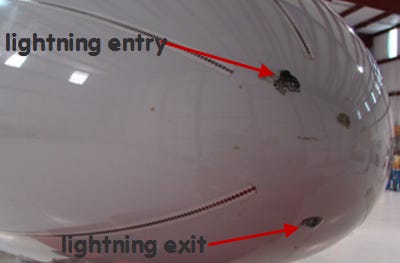
I have been struck. My colleagues have been struck. The airplanes were fine every time.
You can use this immediately. When the flash happens and at some point in your flying life it might — your body will tell you the airplane is broken. Your eyes will tell you the airplane is fine. The airplane is fine. Believe your eyes.
Step 5: Aviate—Navigate—Communicate
This is the oldest piece of pilot wisdom there is. When something happens in the cockpit, the order is non-negotiable. First we keep flying the airplane. Then we figure out where you’re going. Then and only then do you talk about it. But I’ll tell you we plan ahead, way ahead…
In real life: when the cabin goes white and you feel the panic spike, do not look at other passengers’ faces. Don’t reach for your phone. Don’t try to remember what your therapist said. Just fly your own seat. Hands on your knees. Feet flat. One breath in, two breaths out. That’s aviate. Once your hands stop shaking, you can decide whether to look out the window again. That’s navigate. Talking about it, to the flight attendant, to your seatmate, to anyone comes last. Maybe much later.
Pilots aren’t calmer than passengers because we’re braver. We’re calmer because we’ve already decided what we’re going to do, long before there’s anything to do.
The framework above is the whole system. But knowing the steps and using them when 100,000 volts crack against the wing are two different things.
Below, I walk through three real scenarios most of us face, the cancel-or-fly call before a storm front, the in-flight strike when you’re sitting next to anxious family, and the frequent-flyer summer routing through storm country and show you exactly how a pilot would work each. Plus the printable Storm-Day Checklist you can keep in your bag and the one-line phrase I’ve taught more nervous flyers than I can count.
