


Update, October 9, 2026: the investigators’ interim report is out
On September 28, Germany’s accident investigators (the BFU) published their interim report on VN34. The key findings, as reported by Reuters, Bloomberg and the German aviation press:
The flight recorder logged both brake pedals at the left seat, where the pilot flying sat, moving three seconds into the takeoff roll, with more brake inputs later. Braking peaked at 27% on the left and 17% on the right, two seconds before the nose came up.
The airspeed hovered around 168 knots for about 18 seconds. V1, the decision speed, was 169. The aircraft only reached it 11 feet in the air.
The nose came up at 163 knots, about level with the end of the runway. The aircraft lifted off from the grass beyond it and hit 20 approach lights.
The BFU has not determined why the pedals moved and is testing the brake control units. The cockpit voice recording of the takeoff was overwritten, as I feared in August. The final report is expected in about a year.
Correction:
Three corrections to what follows, which relied on the early account from Vietnam’s aviation authority.
The crew did not rotate with 300 feet of runway left.
The aircraft never reached V1 on the ground. All four damaged tyres were on the left main gear.
My read, from the left seat. The number that matters to me is 168 knots for 18 seconds. Pilots are trained to treat V1 as a line on the speed tape: below it you can stop, above it you go. That only works if you reach V1 where the calculation said you would. The 787 has no system that tells the crew the aircraft is accelerating more slowly than planned. Airbus fits one on the A350 and A380, and nothing like it has made it onto a Boeing. In my experience, simulator training above 80 knots is built around engine failures, fires and windshear, and a slow, unexplained loss of acceleration is something we barely practise. So the crew sat just under their decision speed near the end of the runway, judged there was no longer enough runway to stop, and had nothing on the flight deck telling them they were behind. At that point going was the right call, and I’d have done the same.
What happened at second three is for the investigators. Pedal positions come from sensors, and a faulty sensor looks exactly like a foot on the recorder. I now put an unintended pilot input slightly ahead of a system fault, and the bench tests could flip that. None of it is blame. The crew got a dragging aircraft into the air and brought all 287 people home. The line I’m adding to my own takeoff briefing is a rough acceleration check, something the pilot monitoring can call early, while stopping is still an option.
The original file, published in August, follows below 👇🏻
Pilot Nick - 7 min read
The short version
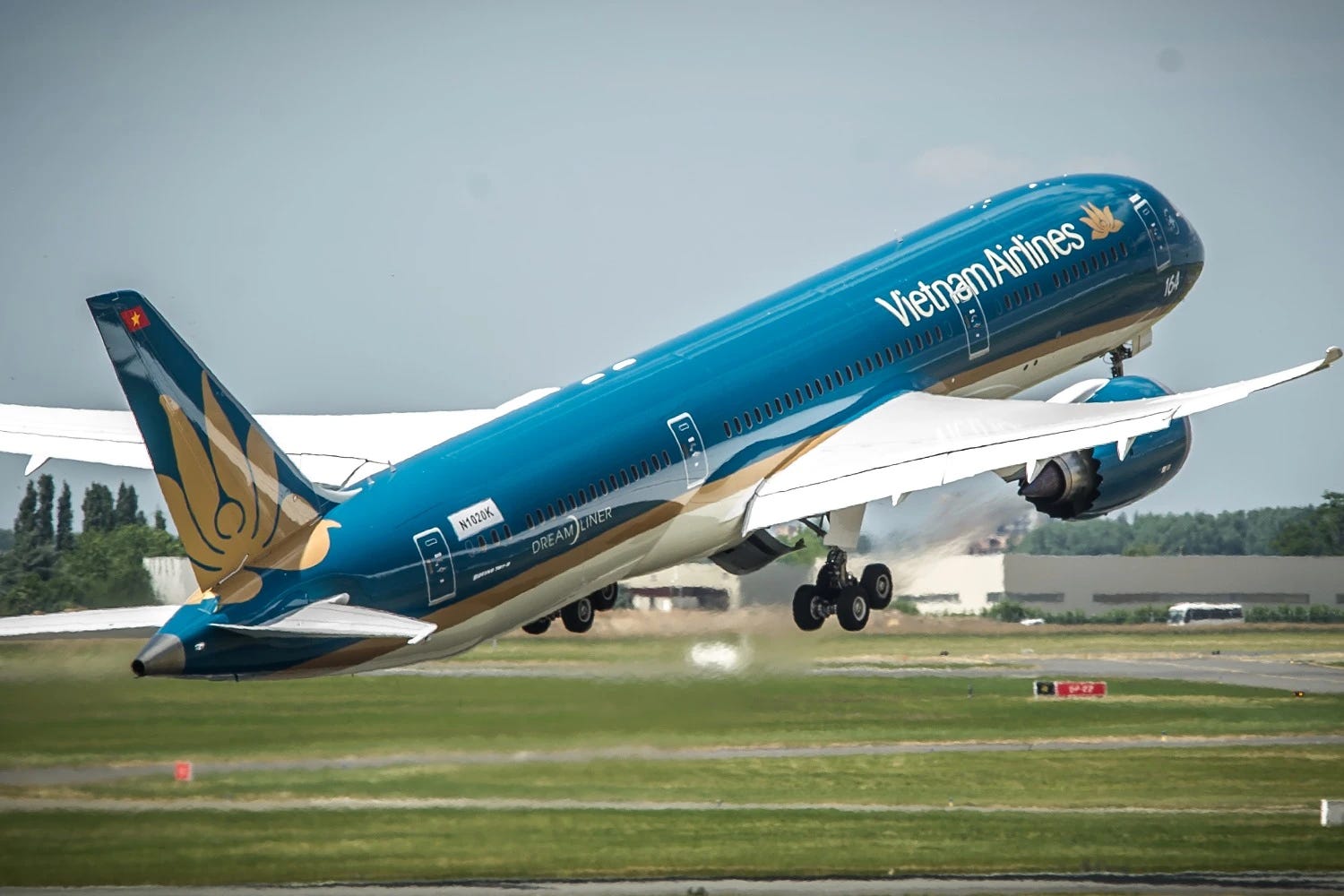
On 15 August, Vietnam Airlines VN34, a Boeing 787-9 bound for Hanoi, used almost all of Munich’s 4,000-metre runway 26L, struck its tail on rotation, ran past the paved surface and got airborne with roughly 300 feet left.
The crew watched the speed stop increasing twice during the roll. Four main gear tyres burst, three of them on the left.
Skid marks from both main gears, and a left gear that came back trailing smoke, point at the brakes rather than at the engines or the paperwork.
All 287 people on board were unhurt. The German BFU’s preliminary report is due within weeks.
Below, what the tracking data already rules out, what the drag cost in kilonewtons, and the three explanations still standing.
Seat 24A, Munich, Saturday afternoon, 15 August.
The engines spool up, the seat presses into your back, the runway lights start to smear past the window. Then it keeps going, longer than you remember, and the far end of the runway stops being an idea and starts being a thing you can see.
The nose finally comes up. There is a thud somewhere behind you. The aeroplane climbs away, and a few minutes later the captain tells you that you are going back to Munich.
That was Vietnam Airlines flight VN34, a Boeing 787-9 bound for Hanoi with 271 passengers and 16 crew. Everybody walked off it. Ten days later, the part I keep coming back to is the two hours after the tail hit the ground.
What we actually know
Confirmed by the German BFU, which is leading the investigation: the aircraft rotated late on runway 26L, a runway 4,000 metres long. Its tail contacted the ground during the rotation, leaving longitudinal scrape marks along the underside of the rear fuselage. It went past the paved surface before it was properly flying, damaging lights at the runway end. Four of the eight main gear tyres burst, and the breakdown matters: numbers 1, 3 and 5 on the left main gear, and number 3 on the right.
The crew’s account is worth reading slowly. Around halfway down the runway, the speed stopped increasing for about two seconds. It picked up again. Then, at V1, they saw it decrease a second time. They judged there was no longer enough runway to stop on, pushed the thrust levers to maximum, and rotated with roughly 300 feet of concrete left. The warnings arrived once they were airborne: a tail strike, and tyre pressure problems.
They told air traffic control they were coming back, dumped fuel down to landing weight, and flew two low circuits so controllers on the ground could look at the gear with their own eyes. They landed on runway 26R at 15:57 local, about two hours after they had left. No injuries.
The evidence on the concrete
Photographs of the departure end of 26L show two long dark skid tracks running off the paved surface and into the grass, one from each main gear, getting heavier towards the end. That is the signature of wheels that have stopped rolling freely and started dragging. Video review puts the right main gear braking from roughly 210 metres before the runway end, with those wheels locked at and past it, and aerial photographs the following day indicate both brakes were active before the end.
Both sides show marks, so this was not one seized wheel. But three of the four burst tyres are on the left, and the left gear is the one that came back trailing smoke and left the aeroplane disabled on the runway. Whatever was happening was heavier on the left, and that asymmetry has a consequence the crew would have felt. Drag on one side pulls the nose towards it, and holding the centreline against it takes rudder and takes attention, at exactly the speed where a pilot has least of both to spare.

Why the brakes are the question
The 787 has electric brakes, the first airliner in service built that way, using a system from Safran Landing Systems. On every other big jet, pressing the pedals sends hydraulic pressure down a brake line to squeeze the carbon discs. On the 787 there is no brake line and no hydraulic fluid at the wheel. Pedal movement becomes an electrical signal, controllers interpret it, and electric motors on each brake unit clamp the discs directly.
That changes the shape of this investigation. A hydraulic brake drags when a valve sticks or a seal fails, and you find that with a spanner. An electric brake drags when an actuator, a controller or the logic behind them holds clamping force nobody asked for, and you find that in data and software.
One more thing before the theories, because it decided how this flight ended. V1 is the last speed at which we can stop on the runway that remains. One knot after it, the runway behind us is too short to stop in, so we take the problem into the air. The second speed decrease came after V1, so there was no decision left to make. The crew’s job became getting the aeroplane airborne, which they did at the cost of a tail strike and four tyres.
Metal is cheap. That trade is one we brief out loud before every departure.
Nobody knows yet why that aeroplane would not accelerate, and only a small number of explanations fit all of the evidence at once.
Below the line, what the tracking data already rules out, what the drag actually cost in kilonewtons, the three explanations that survive, and the recorder problem nobody is talking about.
