


It’s back.
Each week: real questions from nervous flyers.
Real answers from the cockpit.
Because knowledge beats fear every time.
And yes… we’ll go a little deeper for the avgeeks too.
👇 This Week’s Questions:
💬 Question #1: “Why is it so hot on the plane when I’m boarding? It’s unbearable for the first few minutes.”
✈️ You step through the door, find your row, wrestle your bag into the overhead bin — and you’re already sweating. The cabin feels like a greenhouse. Nobody seems to be doing anything about it. What’s going on?
It comes down to where the cold air actually comes from.
On the ground, aircraft have two ways to cool the cabin:
The APU — Auxiliary Power Unit: A small jet engine in the tail that powers the aircraft's electrical systems and air conditioning while the main engines are off. But here's what most passengers don't know: at many airports particularly in Europe, noise regulations prohibit us from running it until a set time before engine start. So during boarding, the cabin may be running on limited ground power, or simply absorbing heat with no active cooling at all. Add 200 warm bodies and doors opening and closing, and the temperature has nowhere to go but up.
Ground air conditioning carts Some gates pipe external air conditioning directly into the aircraft, giving the APU a hand. But not every gate has them, and even when they do, the cooling capacity has limits especially with doors constantly opening during boarding.
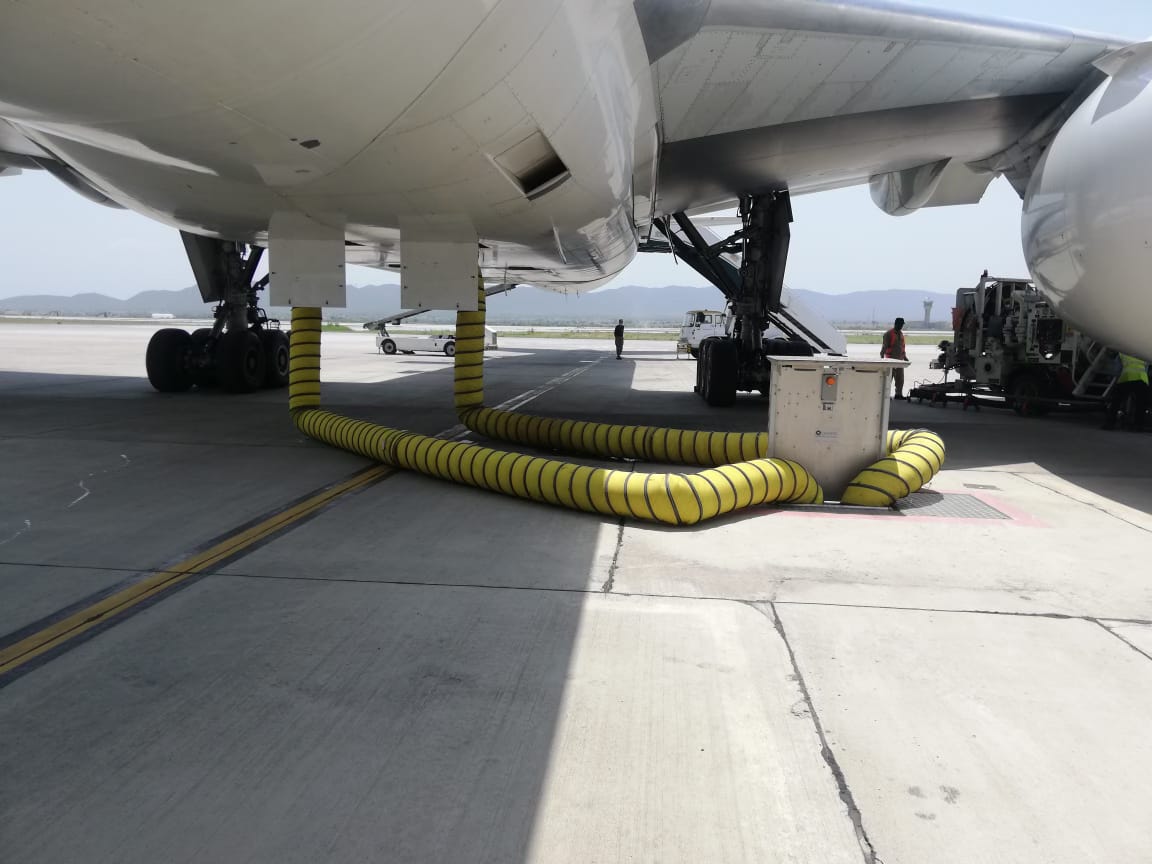
The real problem: physics.
A modern jet cabin is essentially a metal tube that’s been sitting on a hot tarmac, absorbing heat through windows, walls, and floor. Cooling that volume of air — while counteracting the body heat of 150-300 boarding passengers — takes time. The system is doing its best, but it’s fighting an uphill battle until the main engines start and the full air conditioning comes online.
The pilot truth: We feel it too up front. The cockpit can get brutally hot during boarding, especially on summer turnarounds with the sun baking through the windshield. Main engine start is a relief for everyone.
🤓 Fun Fact: The air inside a commercial cabin is completely replaced every 2 to 3 minutes far more frequently than the air in your office or home. On most flights, you're breathing some of the freshest, most filtered air you'll encounter all day. The low humidity is what makes it feel stuffy, not the air quality itself.
The bottom line: Hot during boarding is normal, temporary, and purely a physics problem. Give it five minutes after pushback and you’ll be reaching for your blanket.
✈️ Pilot Hint : If heat bothers you, try boarding later than sooner, the cabin is usually much cooler by then
💬 Question #2: “I noticed fuel streaming off the wingtip during flight — are we leaking fuel?”
✈️ Cruising along, you glance out the window and notice what looks like a thin stream trailing from the wingtip. Your stomach drops.
It’s not a leak. Here’s what’s actually going on and there are three possibilities, each worth knowing.
1. Vortex condensation
As the wing generates lift, high-pressure air beneath rolls around the tip to meet low-pressure air above, creating a powerful spinning vortex essentially a tiny horizontal tornado. The pressure drop inside causes moisture to condense instantly into a visible white wisp. Pure physics, no fuel involved.
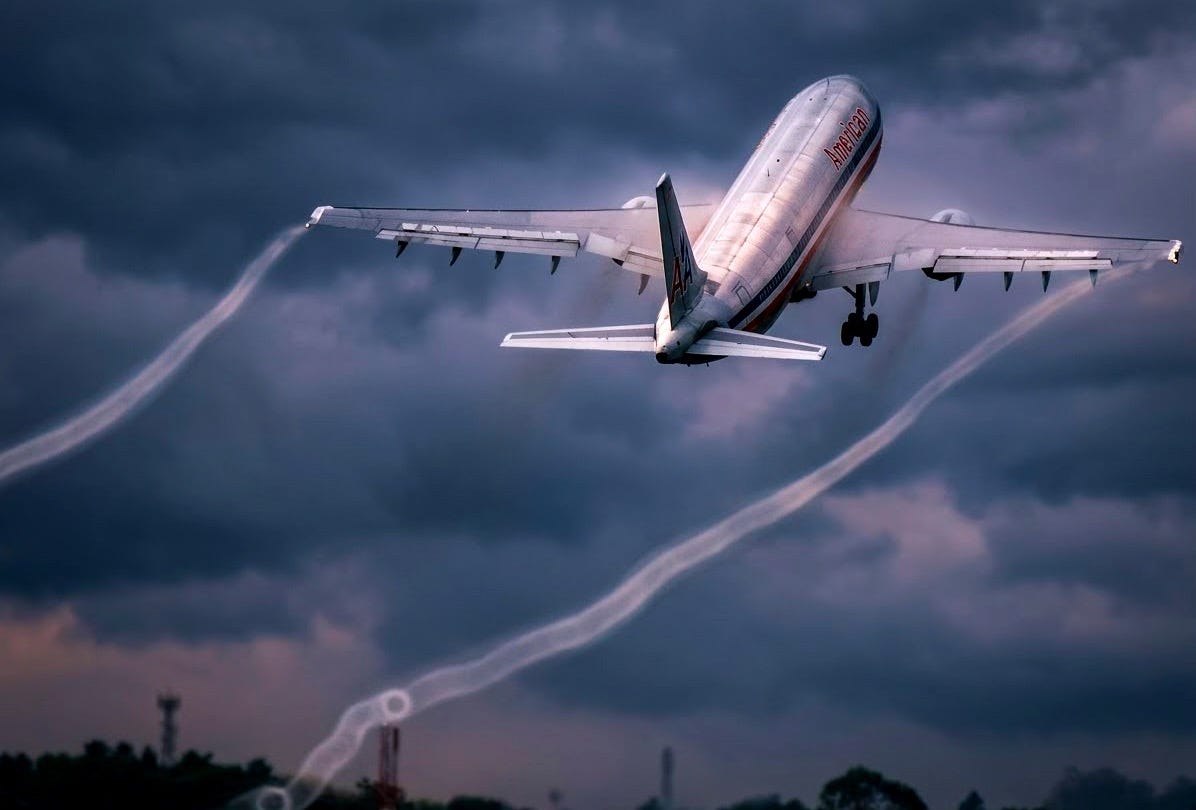
Intentional wingtip venting
Fuel expands as temperature changes during climb and descent. Vent surge tanks at the wingtips accommodate that expansion, and any overflow exits through a small vent tube — a tiny, managed amount, most noticeable during descent. You might catch a slight rainbow tint in direct sunlight.
🤓 Fun Fact: Wingtip vortices are so powerful on large aircraft like the Boeing 747 or Airbus A380 that smaller planes must wait several minutes after them on approach to avoid being flipped by the swirling wake. It's called wake turbulence, and it's one of the invisible forces air traffic controllers manage constantly purely from the physics of lift being generated at that wingtip you were just watching.
Fuel jettison — a completely different situation
This one is rare, dramatic, and worth understanding properly.
Aircraft have a maximum landing weight that is lower than their maximum takeoff weight — the airframe is stressed differently on touchdown. On a long flight this isn’t an issue; you burn fuel naturally en route. But if something requires an immediate return shortly after departure, you may be too heavy to land safely.
The options: an overweight landing (possible, but requires a full structural inspection and takes the aircraft out of service), or fuel jettison — rapidly dumping fuel through dedicated nozzles further along the wing to get down to landing weight quickly.
A few important nuances:
The 737 and A320 family have no jettison system — they either do an overweight landing or hold and burn fuel down
Widebodies like the 777, 747, and A380 typically do have jettison capability, they carry so much fuel that burning it off in a hold could take hours
It’s coordinated with ATC and done over designated areas away from populated zones where possible
From the ground it looks like a fine mist trailing the wings nothing like the gentle wingtip venting above
The pilot truth: Actual unplanned fuel loss triggers cockpit alerts immediately. We track fuel quantity constantly. If there were a real leak, we’d know long before you spotted it out the window.
The bottom line: The wisp off the wingtip is almost certainly condensation or routine venting — physics and engineering doing their quiet work. Fuel jettison is a different beast entirely: deliberate, rare, and a sign the crew is methodically solving a problem, not losing control of one.
💬 Question #3: “Why does the crew make everyone put their window shades up for landing?”
✈️ You’re dozing through descent and a flight attendant firmly asks you to open your shade. What does a window shade possibly have to do with landing?
Quite a lot, in an emergency.
It’s not about the pilots. It’s entirely about you.
If something goes wrong during landing and the cabin fills with smoke or loses lighting, passengers need to already know what’s outside. Fire on the left? Evacuate right. Wing in water? Use the other side. Flight attendants make these calls in seconds and passengers who can already see outside react faster and more correctly.
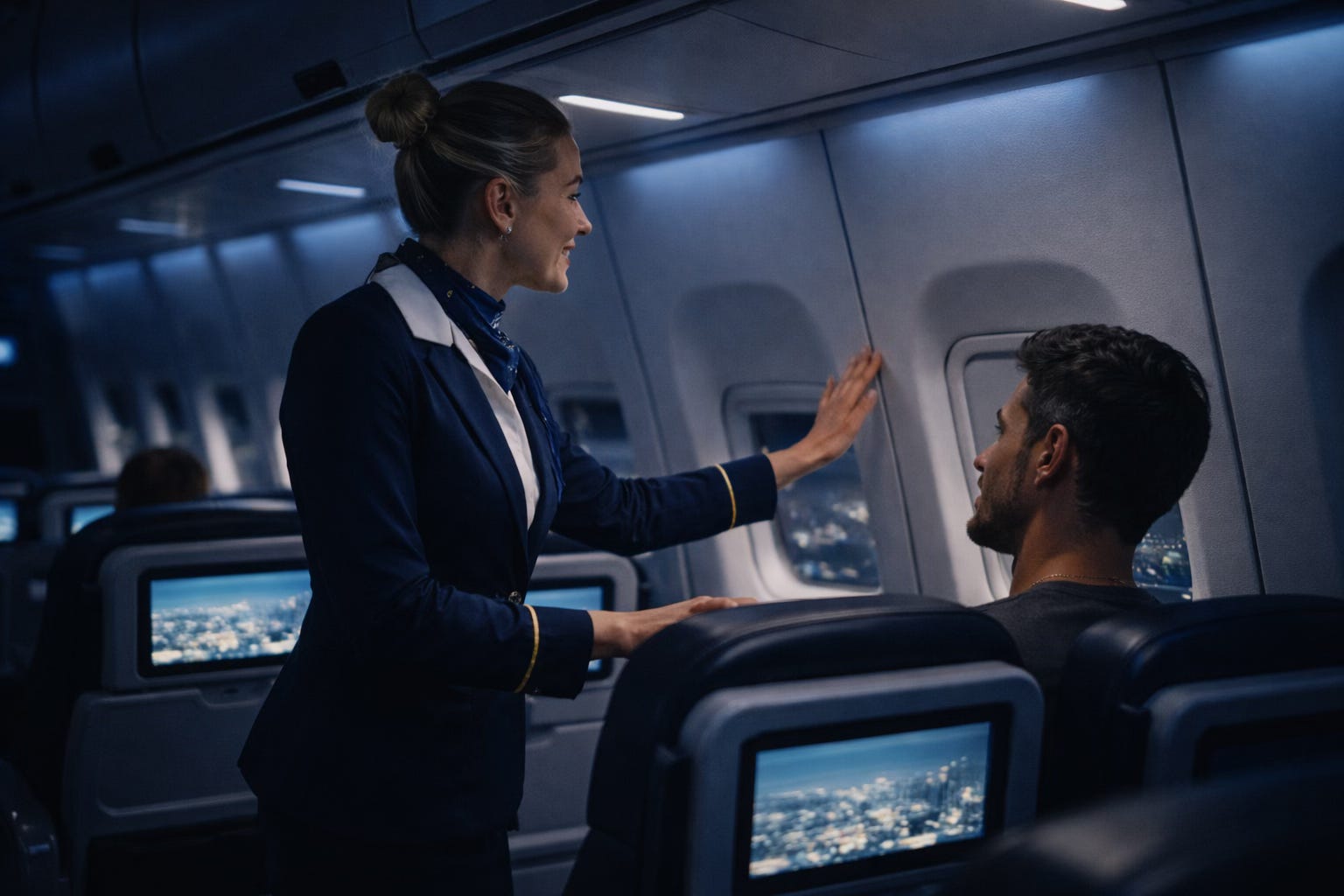
There’s a subtler reason too, one most people don’t know: your eyes need time to adjust. Going from a dark cabin to a bright emergency scene outside causes temporary blindness. In an evacuation you have seconds, not minutes. Shades up means your eyes are already adapted.
And from outside, rescue crews use windows to rapidly read the cabin — where smoke is concentrated, whether passengers are mobile, which exits are clear. Closed shades are opaque walls to them. Open shades are real-time intelligence.
The bottom line: It takes two seconds and it genuinely matters. The crew isn’t being fussy — every detail during those final minutes is optimized for your safety.
👨🏻✈️✈️ Pilot Hint: If the crew asks for shades up, it’s always for a safety reason even small things like this are part of a bigger plan.
💬 Question #4: “How do pilots actually know where they’re going — do they just follow GPS like the rest of us?”
✈️ Yes, GPS is involved — but what’s happening in that cockpit makes your Google Maps look like a paper napkin.
Pilots don’t navigate. The FMS does.
The Flight Management System is a specialized onboard computer holding a complete database of every airway, waypoint, airport, and approach procedure on the planet — updated every 28 days. It calculates the optimal route, altitude, and speed profile for the entire flight and feeds continuous guidance to the autopilot. The pilot’s job is to manage the FMS, stay ahead of it, and be ready to take over if anything degrades.
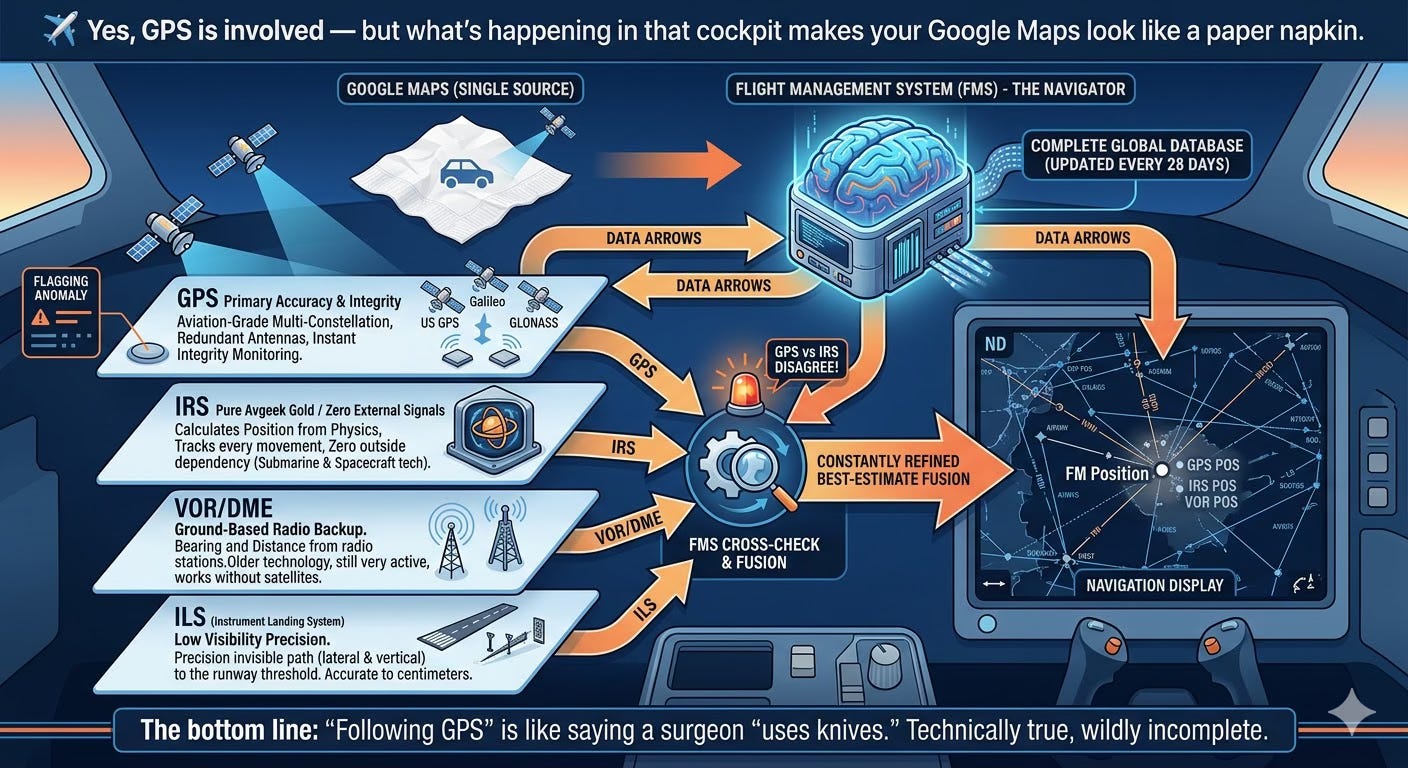
The navigation layers underneath:
GPS — Aviation-grade receivers pull simultaneously from multiple satellite constellations (American GPS, European Galileo, Russian GLONASS), with redundant antennas and integrity monitoring that flags anomalies instantly.
IRS — Inertial Reference System — Pure avgeek gold. Accelerometers and gyroscopes track every movement with zero dependency on external signals — calculating position purely from physics. No satellites needed. The same technology used to navigate submarines and spacecraft.
VOR/DME — Ground-based radio stations providing bearing and distance. Older technology, still very much active, and crucially works when satellites don’t.
ILS — For low visibility approaches, ground transmitters send two radio beams to guide the aircraft down a precise invisible path to the runway threshold. Accurate to centimeters.
🤓 Fun Fact: The IRS (Inertial Reference System) needs to know exactly where it is before departure so it can start tracking from a known point — a process called alignment. It takes about 10 minutes of sitting perfectly still on the ground. That's partly why pilots arrive early and why the aircraft can't just be moved around the apron while it's aligning. It's literally calibrating itself to the rotation of the Earth.
The FMS cross-checks all of these continuously. If GPS and IRS disagree, the system flags it. What you see on the cockpit display is a constantly refined best-estimate fusion of every available source.
The bottom line: “Following GPS” is like saying a surgeon “uses knives.” Technically true, wildly incomplete.
💬 Question #5: “How do you communicate with ATC over multiple countries and oceans?”
A flight from New York to Singapore passes through a dozen countries’ airspace and hours of open ocean — yet remains in a coordinated global system throughout. How?
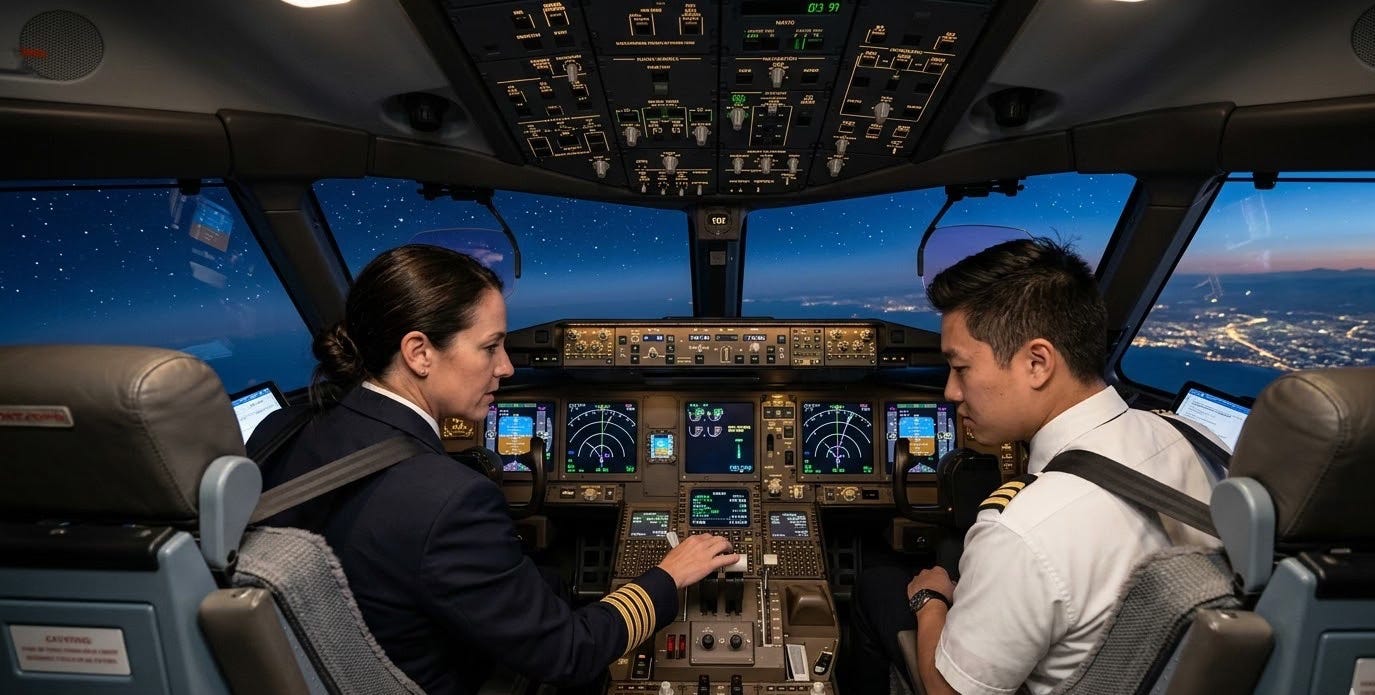
Over land: Standard VHF radio — clear, reliable, line-of-sight. As you cross from one country’s airspace to the next, you’re handed off between control centers. Radar tracks you continuously.
Over the ocean: VHF doesn’t reach — no ground stations for thousands of miles. So the system layers up.
HF Radio bounces off the ionosphere to reach across oceans with no infrastructure. It works, but it sounds like a tin can full of static and solar activity can make it temperamental.
SELCAL solves the noise problem — each aircraft has a unique 4-letter code. ATC broadcasts it when they need you, a chime sounds in the cockpit, and you respond. Aviation’s version of a pager.
ACARS is the text messaging system of aviation — short digital messages via VHF over land and satellite over ocean. Weather updates, route changes, technical reports. Automatic, no voice needed.
CPDLC — Controller-Pilot Data Link Communications is the modern upgrade most passengers have never heard of — and the easiest way to understand it is this: imagine ATC sending the pilots a text message.
Instead of a voice call through crackling HF static, a controller simply types a clearance and sends it to the cockpit. It pops up on screen: “Climb to FL380. Proceed direct BEDAX.” The pilots read it, tap accept, and it’s done — logged automatically, no miscommunication, no misheard altitudes. The pilots can even reply or request changes, just like a text thread. It’s now standard across the North Atlantic and Pacific, and quietly replacing HF voice across oceanic airspace. Simple, clean, and frankly long overdue.
ADS-B and ADS-C complete the picture. ADS-B has the aircraft continuously broadcasting its position, altitude, and speed — visible to any receiver, largely replacing radar over land. ADS-C sends automatic satellite position reports to ATC at set intervals over oceans — every 14 minutes over the Pacific. ATC doesn’t ask. The aircraft just tells them, continuously.
✈️ 👨🏻✈️Pilot Hint: Crossing an ocean today is remarkably quiet compared to how it used to be. You make your SELCAL check at oceanic entry to confirm the system can reach you if needed, and from there it's mostly the datalink doing the work — position reports going out automatically, clearances and updates coming in as text messages on ACARS. No one's sitting there with a headset pressed to their ear listening to HF static anymore. It's efficient, precise, and honestly a little surreal — you're over the middle of the Atlantic with 300 people behind you, and the "radio" is basically a text thread.
The avgeek bonus — North Atlantic Tracks:
Every day, based on the jet stream and traffic volume, a fresh set of parallel “tracks” are published across the North Atlantic — temporary airways connecting North America to Europe. Airlines bid for preferred tracks, departures are sequenced for precise separation, and position reports keep everyone honest. Most passengers crossing the Atlantic have no idea this daily choreography is happening 35,000 feet below their Netflix show.
The bottom line: At no point are you truly out of contact. VHF, HF, CPDLC, satellite datalinks, automatic position reporting — layered, redundant, and global. Genuinely extraordinary when you stop to think about it.
🛬 Final Thought:
The theme running through every question this month is the same one that runs through every edition: what feels mysterious or alarming almost always has a rational, engineered, well-tested explanation behind it.
The too hot cabin, the stream off the wingtip, the window shade request, the invisible navigation web, the silent datalink humming over the Atlantic — none of it is accidental. All of it is designed, monitored, and understood by the people up front.
Your job as a passenger? Sit back, stay curious, and trust that the more you understand this world, the less frightening it becomes.
📬 Enjoyed this edition?
If this helped you understand what’s really happening up there share it with someone who needs it. You probably know at least one person who white-knuckles every flight. Forward this to them. It might just change how they feel about their next trip.
And if you’re not subscribed yet, join thousands of nervous flyers and avgeeks who get these answers delivered every month — free.
Got a question you’ve always wanted answered? Hit reply or drop it in the comments below — your question could be featured in the next edition.
Pilot Nick ✈️ Lessons from the Flight Deck

📬 Get more cockpit insights and travel tips, subscribe free to Lessons From the Flight Deck for weekly updates that help you fly calm and confident or visit:
I imagine you’ve answered this before. I experience terrible ear pain on descent SOMETIMES. I’ve not been able to detect a pattern (aircraft, weather conditions, destination?) If I could at least anticipate the issue, it would be helpful. Thoughts?
Wow - interesting. Our SINS was a R2-D2 kinda look'n thing. I hope your is smaller and lighter.
That did raise a question, though. I know that aircraft aluminum isn't ferrous, but do you have components of the aircraft that need to be degaussed from time to time?