



Pilot Nick — 4 min read
Each edition: real questions from real passengers. Real answers from the cockpit.
Because knowledge beats fear every time.
And yes… we’ll go a little deeper for the avgeeks too.
Lessons From The Flight Deck ✈ is a reader-supported publication. To receive new posts and support my work, consider becoming a free or paid subscriber.
👇 This Edition’s Questions:
This month’s three questions share something in common — they’re all about the invisible layer of every flight you take. The conversations you can’t hear. The river of air you can’t see. The decisions being made before you’ve even buckled your seatbelt.
Let’s go.
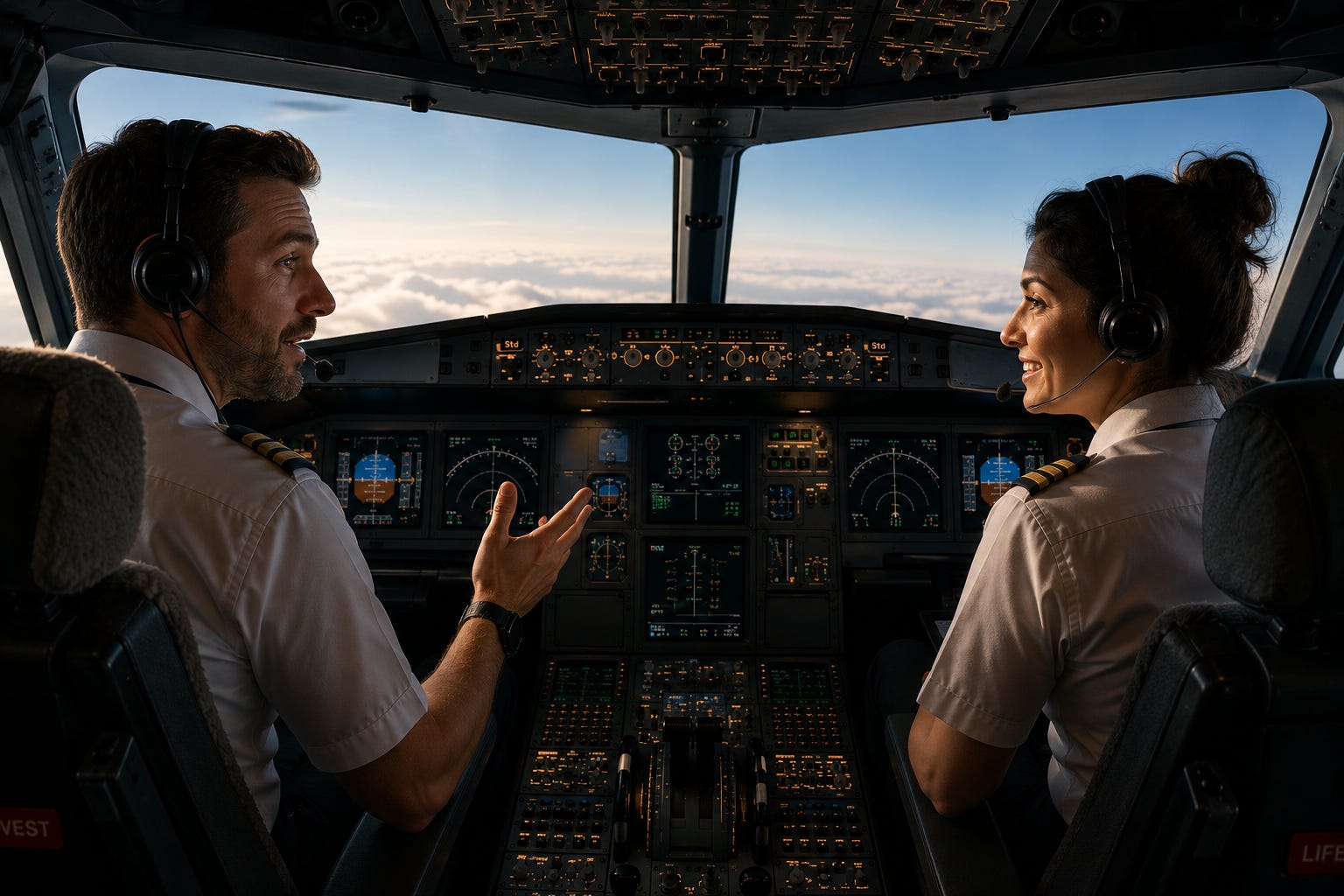
💬 Question #1: “What do pilots actually talk about up there? Is it boring during cruise?”
✈️ You picture us up front, hours into a flight, watching the autopilot do its thing. So what’s actually happening behind that locked door?
The short answer: it depends entirely on the altitude.
Below 10,000 feet — the “sterile cockpit”
There’s a rule in aviation called the sterile cockpit rule. Below 10,000 feet — climb out and descent — no conversation is allowed that isn’t directly related to operating the aircraft. No chat about the weekend. No coffee orders. No “did you see the game last night.”
Why? Because those phases of flight are where 80% of incidents historically occur. Takeoff, climb, descent, approach, landing — that’s when we’re configuring the aircraft, talking to multiple ATC controllers, scanning for traffic, briefing approaches, and managing the highest workload of the entire flight.
A casual remark at the wrong moment can pull attention away from a critical task. So we don’t make them.
Inside the cockpit during those phases, you’d hear something close to a surgical theatre: checklists, callouts, instrument scans, ATC readbacks. Precise, calm, deliberate.
Above 10,000 feet — different rhythm
Once we’re established in cruise, the workload drops dramatically. The autopilot is flying, the FMS is navigating, the systems are monitoring themselves and reporting any issue instantly.
But “boring” isn’t the right word. It’s more like active monitoring.
We’re cross-checking fuel burn against the flight plan. Watching weather radar 100 miles ahead. Listening to ATC for traffic in our area. Reviewing the arrival and approach for our destination, often hours before we get there. Checking alternate airports in case something changes.
And yes — we also talk.
About the flight, about flying in general, about the industry, about our families, about whatever interesting thing one of us read last week. Cockpits are small spaces, and over the course of a 10-hour flight you learn a lot about the person beside you. Some of my best conversations in 25 years have happened at 38,000 feet over the Atlantic at 3 AM.
🤓 Fun Fact:
Most airlines pair pilots randomly through their scheduling systems. You often don’t know who you’re flying with until you arrive at the briefing room an hour before departure. You introduce yourself, brief the flight, and a few hours later you’re together at the top of the world. By the end of a multi-day rotation, you’ve shared meals, hotels, and thousands of miles and you may never fly with that person again. It’s one of the strangest social rhythms of any profession.
The pilot truth:
The locked cockpit door creates this idea that something mysterious is happening up front. It isn’t. It’s two highly trained professionals doing a job that alternates between intense concentration and quiet vigilance with the occasional good conversation in between.
The bottom line:
Below 10,000 feet, we’re surgeons. Above it, we’re navigators with a view. Either way, we’re never just “sitting there.”
💬 Question #2: “Why does the same flight take longer in one direction than the other?”
✈️ You fly New York to London in 6 hours. The return takes 7.5. Same aircraft, same route, same distance. What gives?
You’re flying through a river of air and which way it’s flowing changes everything.
Meet the jet stream
At cruise altitudes — roughly 30,000 to 40,000 feet — there are massive ribbons of fast-moving air circling the planet. The most famous is the North Atlantic jet stream, which generally flows from west to east at speeds that can exceed 250 mph.
That’s not wind in the way you experience it on the ground. That’s a moving conveyor belt of air the size of a small country.
Fly with it (eastbound) and your ground speed gets a huge boost. Fly against it (westbound) and you’re effectively swimming upstream.
A Boeing 777 cruising at Mach 0.84 might be doing 560 mph through the air — but with a 150 mph tailwind, it’s covering ground at 710 mph. Turn around and fly home, and that same aircraft is now making 410 mph over the ground. Same aircraft. Same engines. Same fuel burn. Two completely different flight times.
Here's where it gets really interesting — pilots don't just ride the jet stream, we hunt it. Which is why your flight to Europe goes over Greenland and your flight home loops south near the Azores. Inside the paid section: how we choose the route, plus the full breakdown of how runway selection actually works on every flight you take.
