


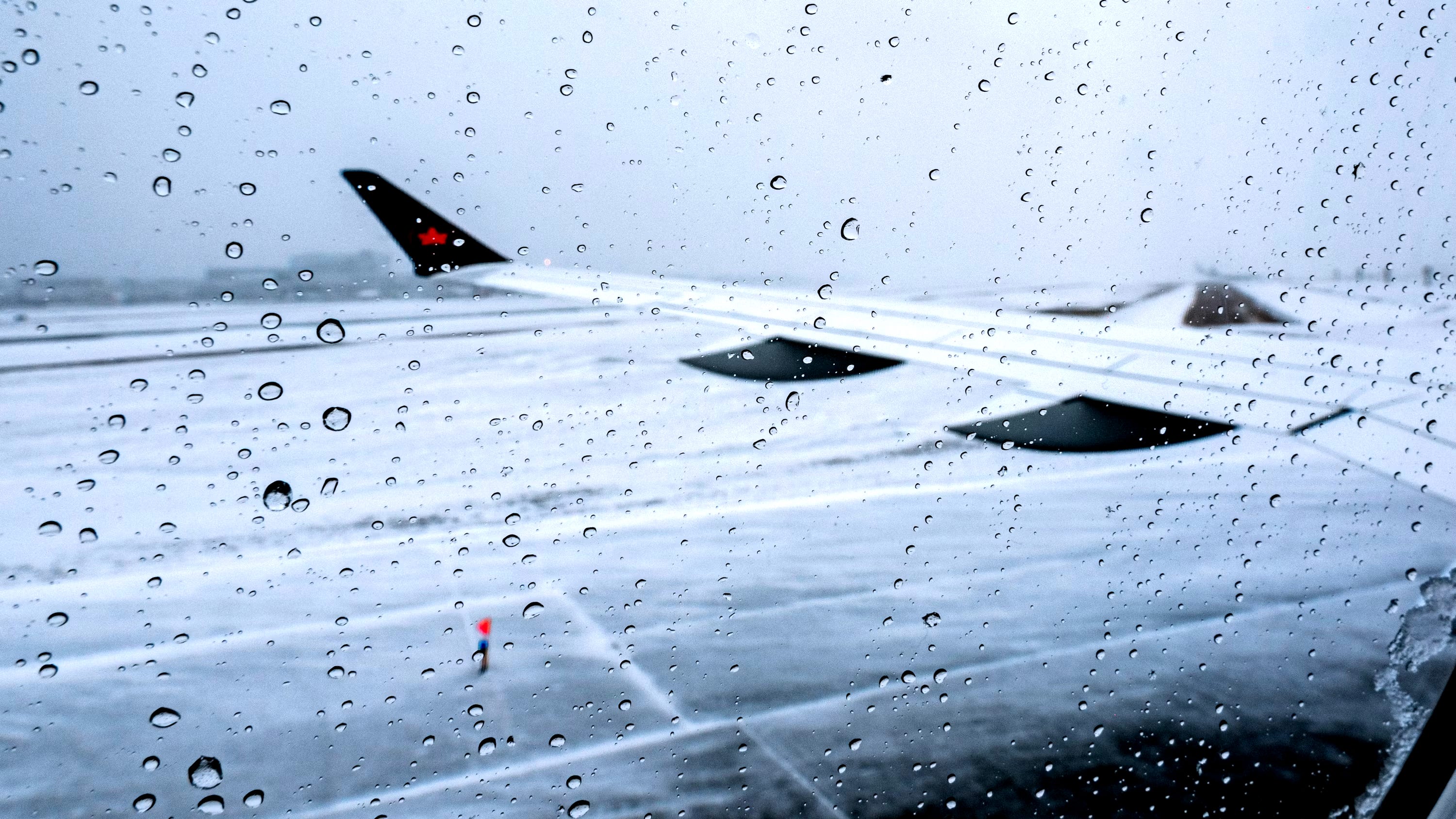
You feel it the moment the wheels touch. That jarring thud, the sudden deceleration, the overhead bins rattling. You grip the armrest and think:
Did something go wrong?
I’ve had passengers turn to me after a wet-weather landing and ask, half-joking: “Is the pilot okay up there?” I always smile. Because the answer is yes — and so are you. In fact, that hard landing you just experienced might have been one of the safest things that happened to you all day.
Let me explain what’s actually going on.
First, Let’s Talk About Water and Rubber
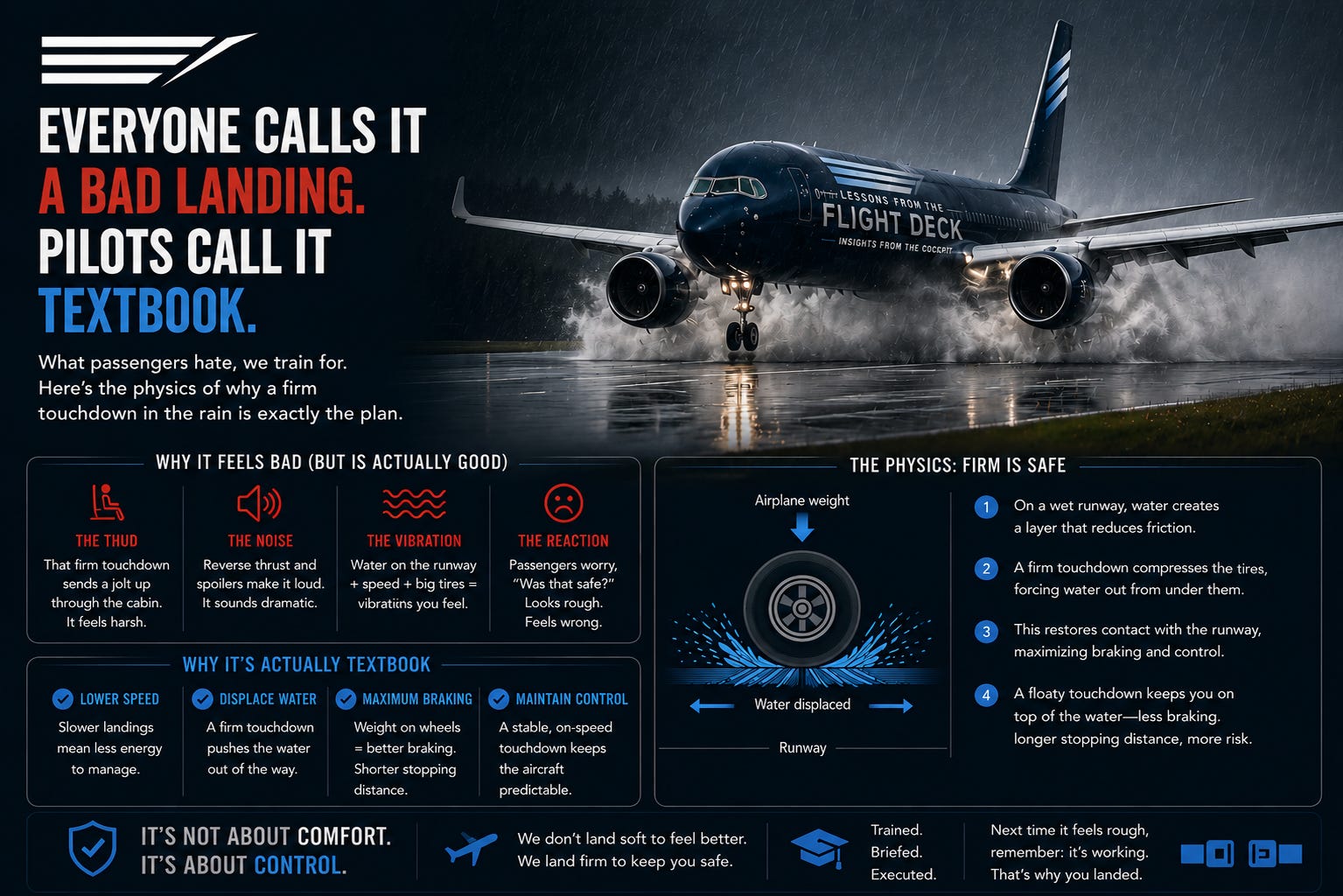
When a runway is wet, a thin film of water builds up between the tire and the pavement just like it does under your car on the highway. The technical term is hydroplaning, and it’s exactly as dangerous as it sounds.
A commercial aircraft lands at around 150–180 mph. At that speed, with water on the runway, tires can lose contact with the surface entirely. When that happens, braking becomes almost useless. We’re essentially sliding on a cushion of water with 80 tons of metal behind us.
To cut through that water film and get rubber actually touching tarmac, we need to do one thing: get the weight of the aircraft onto the wheels as fast as possible.
And the way you do that? You land firmly.
The “Grease” Landing Is Not Always the Goal
Here’s something pilot training teaches early: a perfectly smooth, “greaser” landing is a great feeling but it’s not the universal gold standard people think it is.
On a dry runway, a smooth landing is lovely. On a wet or contaminated runway, a pilot who floats the aircraft trying to achieve that perfect touchdown is actually creating a hazard. Every second spent floating above the runway in a flare is a second your brakes, spoilers, and thrust reversers aren’t working. That’s runway disappearing behind you.
We are trained explicitly to put the plane down firmly when conditions call for it. It’s not a mistake. It’s the plan.
What Happens in the Cockpit When It’s Raining
Before we even begin the approach, there’s a whole checklist running through our heads (and literally, on paper). We consult the Runway Condition Assessment Matrix the RCAM which gives us a standardized runway condition code based on surface contamination. We get braking action reports: Good, Medium, Poor, or Nil.
“Nil” braking action, by the way, means the runway is essentially ice. That’s when we divert.
For anything in between, we calculate our landing distance with a wet runway factor applied. This gives us a number: the minimum runway length we need to stop safely. We compare that to what’s available. If there’s enough margin, we continue. If not, we go somewhere else simple as that.
Then, on final approach, we aim for the threshold with more precision than you might imagine. Our target zone is a specific 1,000-foot stripe of paint at the start of the runway and we want to be on it, not floating past it.
The Three Weapons We Use to Stop
Once we’re down, stopping a heavy jet on a wet runway is a coordinated attack on physics. We have three tools, and we deploy all of them simultaneously:
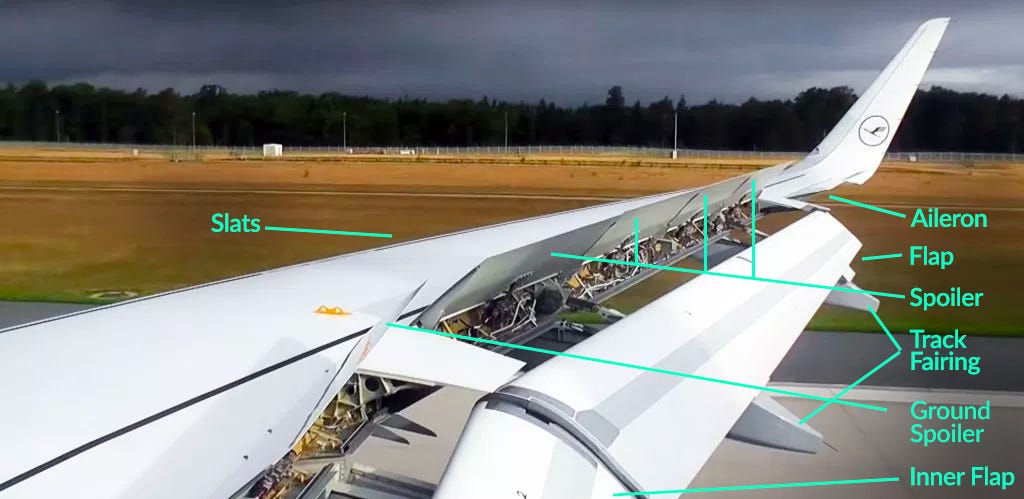
1. Spoilers. Those panels that pop up from the wings the moment we touch down. They “spoil” the lift the wings are still generating, which pushes the aircraft weight down onto the wheels faster — again, better braking contact.
2. Thrust reversers. The engine nacelles open and redirect thrust forward. You’ll hear that loud roaring sound and feel the deceleration. This is normal. This is good.
3. Autobrakes. Set before landing, these apply a preset level of braking automatically and consistently — often more effectively than a human foot can manage. On wet runways, we typically select a higher autobrake setting.
All three engage within the first two seconds of touchdown. The aircraft does a lot of the work itself. Our job is to make sure it can.
Side Note: It’s Not Just Rain — Short Runways Too
A firm touchdown is not only about rain. On short runways, every meter counts — floating even a few seconds too long can burn through hundreds of feet you simply do not have. A few airports where a firm, purposeful landing is always the plan:
London City (EGLC): Only 1,508m of runway, a steep 5.5-degree approach, and buildings at both ends. No room for a gentle float.
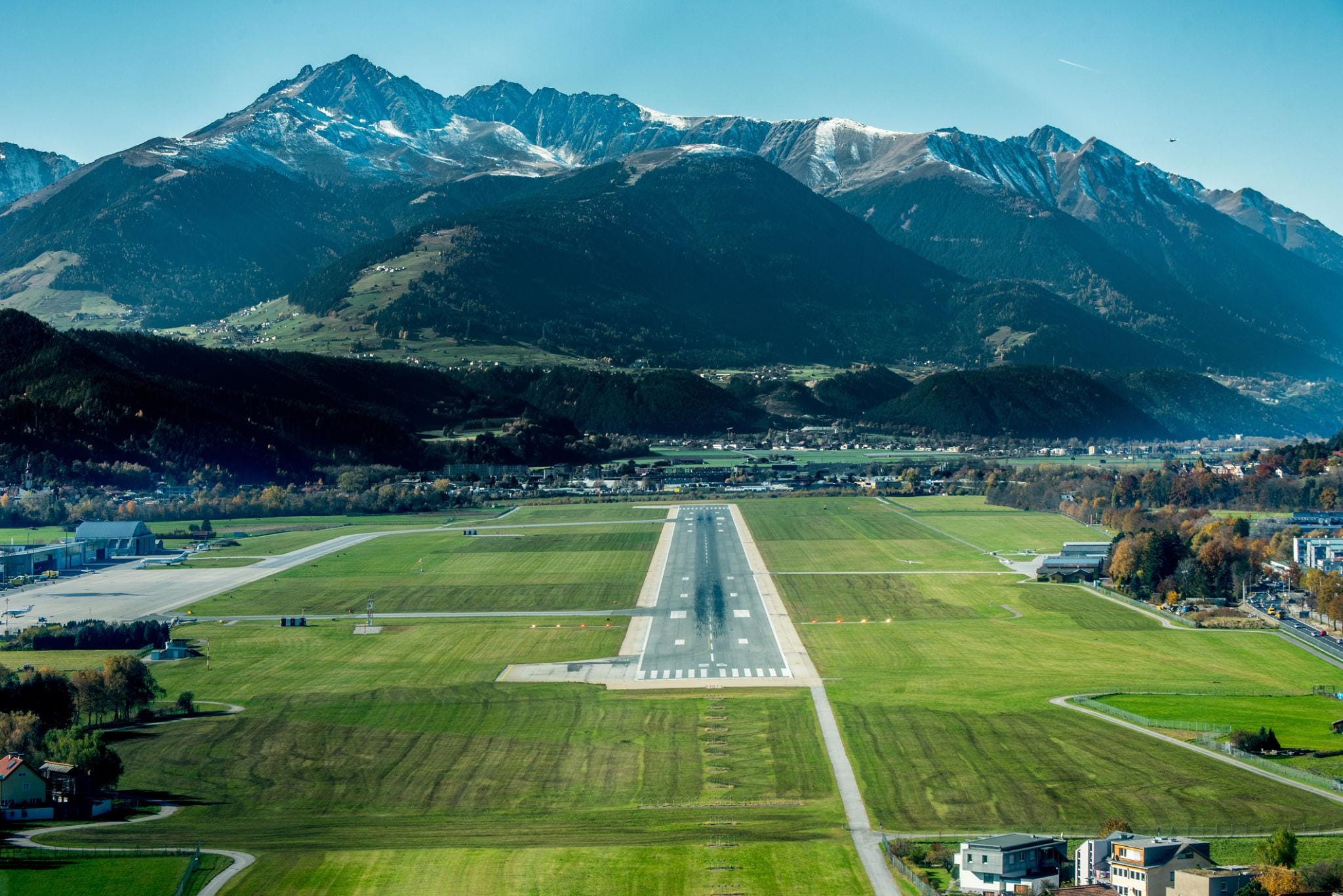
Innsbruck (LOWI): 2,000m nestled in the Alps. Terrain on all sides means you fly a precise, stabilised approach and plant it.
Queenstown, New Zealand (NZQN): 1,800m between mountains and a lake. Firm, on-speed, on-target every time.
If you have ever landed at one of these and felt that confident thud — now you know exactly why.
So What Does a Dangerous Landing Actually Look Like?
Not what you think.
A dangerous landing in the rain looks like this: a long float above the runway while the pilot hunts for smoothness, touching down too far past the threshold with not enough runway remaining to stop. That’s the scenario training is designed to prevent.
The hard, assertive touchdown? That’s us being precise. That’s the training working exactly as intended.
You’ll notice that after a firm rain landing, the plane stops with runway to spare. That’s not coincidence.
Next Time It Rains...
When you feel that firm touchdown on a rainy day, resist the urge to wince. Instead, take a breath and notice what happens in the next 20 seconds: the roar of the reversers, the press of the brakes against your body, the aircraft slowing confidently and controllably.
That sequence — all of it, including the firm initial contact — is exactly what’s supposed to happen. It was briefed, calculated, and executed on purpose.
You’re not in the hands of a pilot who botched the landing.
You’re in the hands of one who knew exactly what they were doing.
One more thing. I get a lot of replies from nervous flyers after posts like this one. The landing is fine, they say but it’s the turbulence that still gets them. That’s actually why I put together a full guide on it.
Start Understanding It a pilot’s masterclass breaking down exactly what turbulence is, why the plane handles it the way it does, and why you’re safe. Dozens of flyers have told me it changed the way they think about flying entirely. I’ll leave the link below if that sounds like you.
Fly safe,
Pilot Nick
Lessons from the Flight Deck

Thank you so much for the precise details. So helpful. I used to rate landings in my head from 1-5. This changes my criteria dramatically. 😁
Beautiful explanation.