



Few things focus the mind quite like the words “ENGINE FIRE.”
It’s one of the most critical emergencies we train for in the cockpit and one where the procedural discipline we build over years of training has to work flawlessly in a matter of seconds.
Today I want to walk you through exactly how we handle an engine fire on board: how we know it’s happening, how we make sure it’s real, and how we put it out.
If you’ve ever wondered what happens behind the cockpit door when things go wrong, this is it.
🚨 The Alert
Modern jet engines are incredibly reliable, but they’re also spinning at tens of thousands of RPM, managing fuel, oil, and bleed air at extreme temperatures. When something goes wrong, the aircraft tells us loudly.
An engine fire is typically annunciated by a combination of a master warning light, an aural warning (a bell or chime, depending on aircraft type), and the engine fire handle illuminating. Behind the scenes, fire detection loops heat-sensitive wires that run through the engine nacelle have sensed a rapid temperature rise that exceeds normal parameters. On most modern aircraft, there are two detection loops per engine. This redundancy matters, and we’ll come back to it.
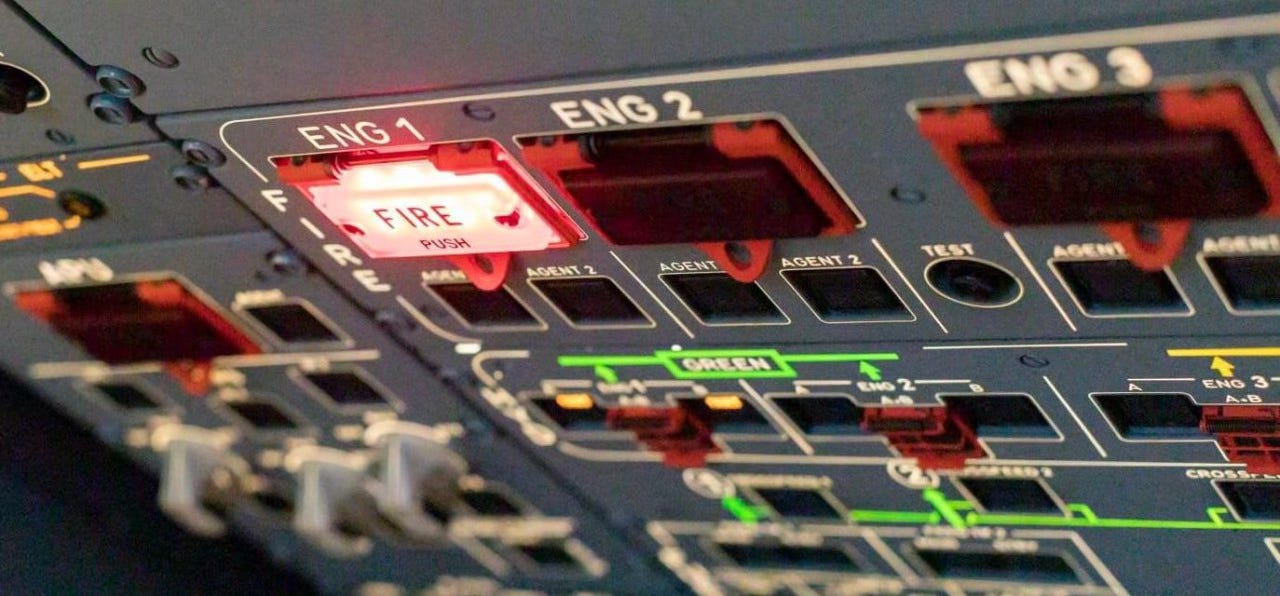
The moment that warning triggers, the flight deck changes. Everything else takes a back seat. Aviate, navigate, communicate — in that order. But before we reach for anything, we do something that might surprise people outside aviation.
We confirm.
The Confirmation
Here’s the thing about emergencies: acting fast on a false indication can be just as dangerous as acting slow on a real one. Shutting down a perfectly good engine especially on a twin-engine aircraft is not something you can easily undo. So before we pull any handles, we verify.
Confirmation typically involves cross-checking multiple sources of information. We’re looking at engine instruments: is there an abnormal EGT (Exhaust Gas Temperature) rise? Oil pressure dropping? N1 or N2 fluctuations? We check if the fire warning corresponds to what we’re seeing on the engine indications. On many aircraft types, the dual-loop detection system helps here: if both loops detect fire, our confidence is high. A single-loop detection may still be a genuine fire, but it’s also where we apply extra scrutiny.
We also use the “touch drill” or “identify” step physically touching (but not pulling) the fire handle of the affected engine. This is a deliberate, crew-coordinated action.
The Pilot Monitoring points to the correct engine fire handle and confirms, verbally: “Number [X] engine.” The Pilot Flying confirms.
This verbal crosscheck exists because in the stress of the moment. History has shown us what happens when the wrong engine gets shut down. We’ve learned those lessons the hard way, and they’re baked into every procedure now.

🧠 Does knowing what happens in the cockpit during an emergency make you feel calmer about flying or does it make it worse?
Reply in the comments — I read every one.
That’s why we don’t rely on instinct.
We rely on structure.
And here’s the part most people never see.
What actually happens when the fire handle is pulled.
Not in movies.
Not in headlines.
In a real cockpit procedure.
🔒 Paid subscribers continue below where we walk step-by-step through the exact shutdown and extinguishing sequence, plus a simulator video showing how a Boeing 737 MAX crew handles it in real time.
