


Pilot Nick - 7 min read
The short version
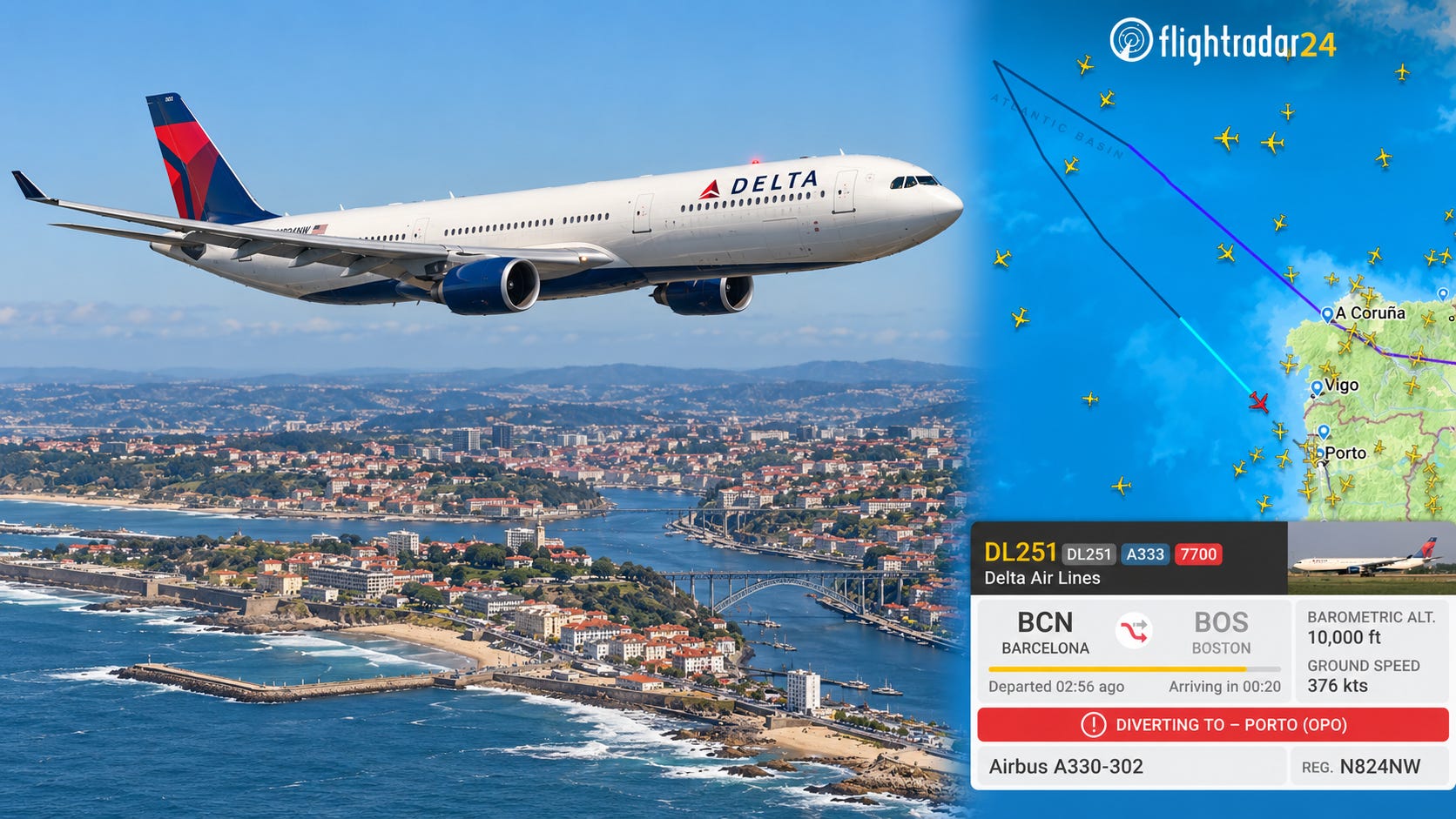
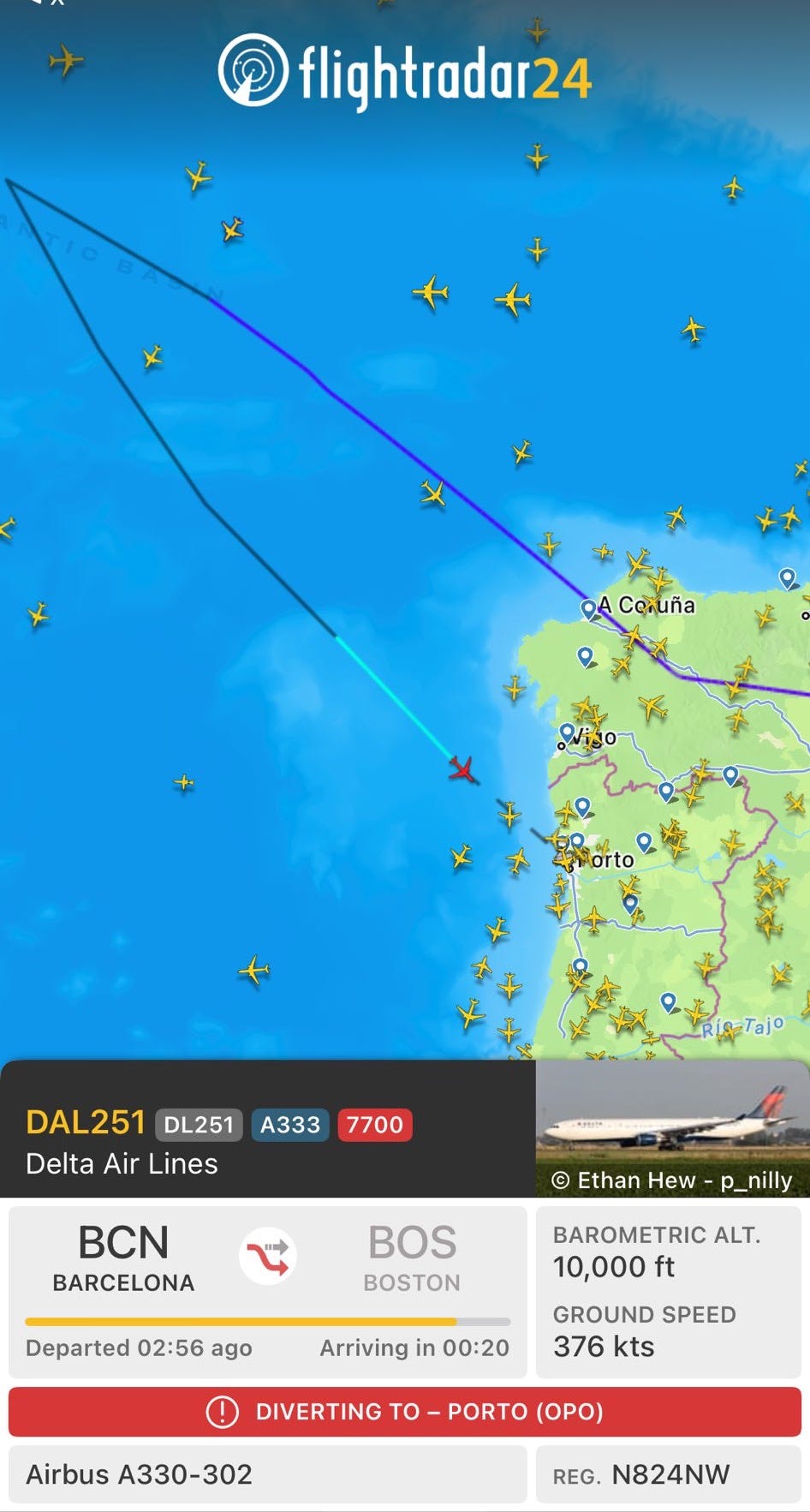
On Sunday 27 September, Delta flight DL251, an 11-year-old Airbus A330-300 (N824NW) flying Barcelona to Boston with 296 passengers, reported smoke in the cabin roughly two hours after takeoff.
The crew declared an emergency (squawk 7700) about 500 miles off the Portuguese coast, turned around and landed in Porto at 17:45 local time, three and a half hours after leaving Barcelona.
About a dozen people got oxygen during the flight. Three or four were taken to hospital with mild smoke inhalation, and seven flight attendants were checked on the ground for nausea and headaches. According to the Portuguese press, nobody was kept in hospital overnight.
Delta has said only that there was “a reported mechanical issue.” Nobody knows yet what was burning, or whether anything was burning at all.
Below: what the pilots did in the first two minutes, why they went to Porto, and why the oxygen masks above your seat probably never came down.
You’re two hours out of Barcelona. Lunch is cleared away, the window shades are half down, and the moving map shows the little airplane well past Portugal with nothing ahead but blue.
Then you smell it. It’s faint at first, then it isn’t, and a thin haze is hanging under the reading lights a few rows up. A flight attendant walks past a little faster than flight attendants usually walk.
Nobody makes an announcement for a while. It feels like a very long while.
That was the cabin of DL251 on Sunday afternoon. Up front, those same minutes were some of the busiest two people can have in a cockpit, and almost everything they did was decided years before either of them sat down.
The decision that looked like nothing
Most of the coverage focuses on the smoke, the hospital and the cancelled flights. What I noticed was the turn.
Two hours into an eight-and-a-half-hour flight, a widebody full of fuel and 296 people changed direction and flew about an hour back to Europe. To the passengers it must have looked like the airplane was just banking. That turn was the most important thing anyone did on Sunday, and it probably came within a couple of minutes of the first report from the cabin.
In airline flying, smoke is the abnormal event where you don’t wait to see what happens. With an engine failure you have time to think. Smoke gives you less time than any other problem, and every pilot is trained to treat it that way.
Why diverting now comes first
Our smoke procedures used to run the other way round: find the source, then decide whether to divert. The industry learned the hard way that a fire hidden behind a panel doesn’t wait for your checklist.
After 1998 the industry flipped the order. On the Airbus today, landing as soon as possible is one of the first items in the smoke procedure, right at the top of the page. You start heading for the ground before you know what’s burning. If it turns out to be a burnt croissant in a galley oven, you’ve lost an hour and some fuel. If it’s something worse, you’re already on your way down.
Every smoke checklist written since 1998 carries the lessons of Swissair 111. I wrote about that flight here👇🏻

The first two minutes, step by step
Delta hasn’t released the crew’s account, and nobody outside that cockpit knows exactly what was said. What I can tell you is the sequence every widebody crew is trained to fly when the cabin calls with the word “smoke.”
Step 1: Oxygen masks on, pilots first. The pilots put on their own masks before doing anything else. On the A330 these are full-face masks with built-in goggles, and in an emergency they deliver 100% oxygen under slight pressure so smoke can’t leak in around the seal. It takes a few seconds. A pilot who is coughing can’t fly, and a pilot whose eyes are streaming can’t read the checklist.
In your seat: if you ever see your pilots come on the PA sounding muffled, like they’re talking through a snorkel, that’s the mask. They’re following procedure.
Step 2: Point the airplane at land. One pilot flies and handles the radio. The other starts the diversion. On Sunday, “land” was behind them, so they turned around. Porto was close to the reversed track and has a runway more than 3 km long, a fire service equipped for widebody aircraft, and hospitals nearby. Pilots call that the nearest suitable airport. The word “suitable” matters: the nearest airport on the map might be a strip that can’t take an A330.
In your seat: the turn you feel in the first few minutes of any problem is usually the decision already made. The explanation over the PA comes later, once the crew has time for it.
Step 3: Find it and cut it off. In the cabin, flight attendants go looking for the source, sometimes wearing a smoke hood (PBE, protective breathing equipment) with its own oxygen supply. They check galley ovens, lavatories, overhead bins, in-seat power. In the cockpit, the checklist takes the pilots through shutting off electrical systems that could be feeding it, and on the Airbus that includes the fans that recirculate cabin air. Much of the time, once the power to the source is cut, the smoke begins to clear.
In your seat: if a crew member asks what you smelled and where, answer precisely. “Burning plastic, near the left galley, five minutes ago” is exactly what the pilots need.
Step 4: Tell everyone. Squawk 7700 is the emergency code the pilots dial into the transponder. It lights up the airplane on every radar screen that can see it, and controllers clear the airspace ahead. On the ground in Porto, that call set off a Level 2 alert: around 60 responders and 22 vehicles waiting by the runway before the wheels touched. In the cabin, the purser is briefed on how bad it is, how long until landing, and whether to prepare for an evacuation.
In your seat: the fire trucks chasing you down the runway are part of the plan. Porto rolled out for DL251 the same way it rolls out for every aircraft that declares.
Step 5: Land heavy. Two hours into a transatlantic flight, an A330 still has most of its fuel in the tanks, and that probably put it above its normal maximum landing weight. Not every A330 can dump fuel, and Delta hasn’t said what this crew did. For exactly this situation, Airbus allows an overweight landing: a careful touchdown followed by a maintenance inspection. In a real emergency, getting on the ground is worth more than getting down to a lighter weight.
In your seat: the landing may feel firmer than usual. The crew does that deliberately, and the airplane is built for it.
That’s the sequence in the first few minutes. You won’t find it in the news reports, which mostly read smoke, emergency, landed. There’s more worth understanding, though, including what the smell tells the crew and why nobody on DL251 went down the slides.
That’s the sequence in the first few minutes. You won’t find it in the news reports, which mostly read smoke, emergency, landed. There’s more worth understanding, though.
Below the paywall: what the smell tells the crew, why the yellow masks stayed up, why 296 people walked down stairs instead of sliding onto the runway, the one-minute checklist I’d want every reader to have in their head at 35,000 feet and the question I know a lot of you are asking this week: would I get back on that airplane?
This is what paid readers get every week. $80 a year about $6.67 a month, less than a checked bag. Sunday’s DL251 is exactly the kind of story I turn around fast for the Flight Deck Club.
