


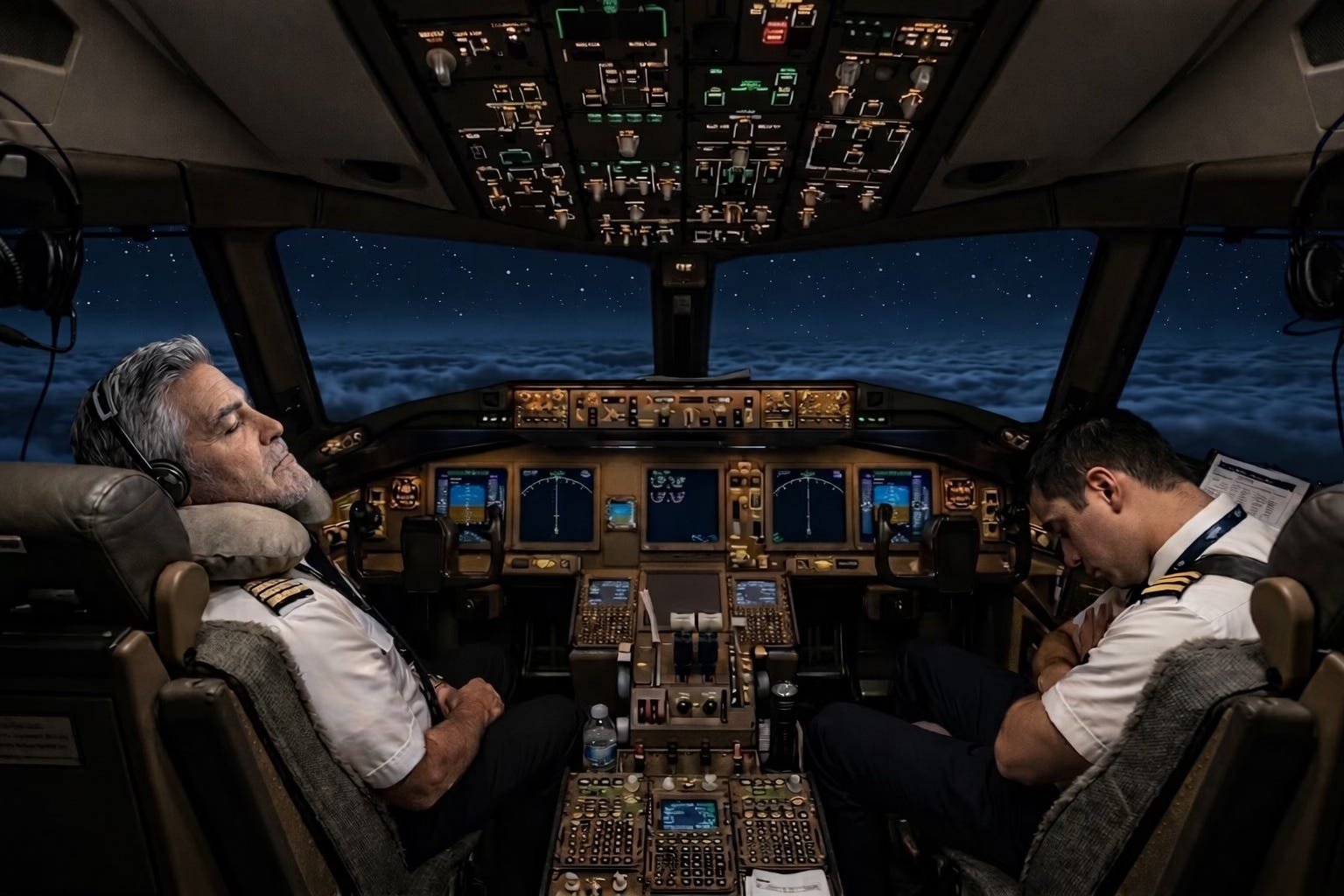
It’s 2:00 a.m. over the Atlantic. The cabin lights are dimmed. Three hundred passengers are tucked under thin blankets, headphones still in, movies long since abandoned. The engines hum at a steady, almost hypnotic rhythm. Everything is quiet.
And somewhere in the back of your mind, a thought creeps in:
What about the pilots? What if they’re asleep too?
I get it.
After 28 years and more than 10,000 hours in the cockpit, I can tell you you’re not the first person to wonder.
In fact, I’ve been asked this question more times than I can count. Usually with a half-smile… but also with a bit of genuine concern behind it.
And if you’ve ever thought about it mid-flight — especially on a long, quiet night crossing — you’re definitely not alone.
It’s a perfectly reasonable question.
And it deserves an honest answer.
Let’s Start with the Truth

Fatigue is real in aviation.
Pilots are human beings. We fly across time zones, through the middle of the night, in an environment that can genuinely make you drowsy.
Warm cockpit. Low lighting. Steady vibration.
The gentle hiss of pressurized air, the soft glow of instruments — it’s calm, controlled… and yes, sometimes a little sleep-inducing.
I’d be lying if I told you none of that ever tugs at your eyelids.
And here’s something most people don’t expect me to say:
There are moments especially at 3 a.m. over the ocean — where you do feel that natural dip in energy. The kind everyone feels at that hour, whether you’re in a cockpit, an office, or your living room.
But here’s the difference.
Aviation doesn’t ignore that reality.
It plans for it.
Every layer of how we operate — from scheduling to cockpit procedures to regulations — is built around the fact that humans get tired.
The system doesn’t rely on willpower.
It relies on design.
✈️ Pilot Hint: On long-haul flights, airlines carry extra pilots so crew members can take supervised rest breaks in a dedicated bunk behind the cockpit. It’s not hidden — it’s part of the safety system (picture below in the article)
It has happened and will happen (again)…
In 2022, a long-haul flight from New York to Rome made headlines for an unusual reason.
During the cruise phase, while the aircraft was flying at around 38,000 feet over France, both pilots became unresponsive to air traffic control for several minutes.
One of the pilots was on an authorized “controlled rest” break — a normal fatigue-management procedure used on long flights. But the captain, who was supposed to be awake and monitoring the flight, also appears to have fallen asleep.
For about 10 minutes, controllers could not establish contact with the aircraft. Concern quickly escalated, and military authorities were even put on alert, preparing fighter jets to investigate.
Eventually, the pilots responded, and the flight continued normally before landing safely in Rome.
An internal investigation later found inconsistencies in the captain’s explanation, and he was dismissed by the airline.
Important perspective
While this incident sounds alarming at first, it’s important to understand the context.
This happened during the cruise phase, when the aircraft is stable and largely managed by automation systems. The airplane continued flying normally throughout the event.
And this is not an isolated case.
Over the years, there have been a handful of similar incidents worldwide where pilots unintentionally fell asleep or missed communications often linked to fatigue on long or irregular schedules
Six Layers Between You and a Sleeping Cockpit
So what actually stands between a tired crew and a sleeping cockpit?
The answer isn’t just one thing.
It’s a system — built layer by layer — designed specifically for moments like this.
Below, I’ll walk you through exactly what protects every flight, even in the unlikely scenario where both pilots are momentarily out of the loop.
If you’ve ever wondered “but what really keeps us safe?” — this is the part that changes how you see flying.
