


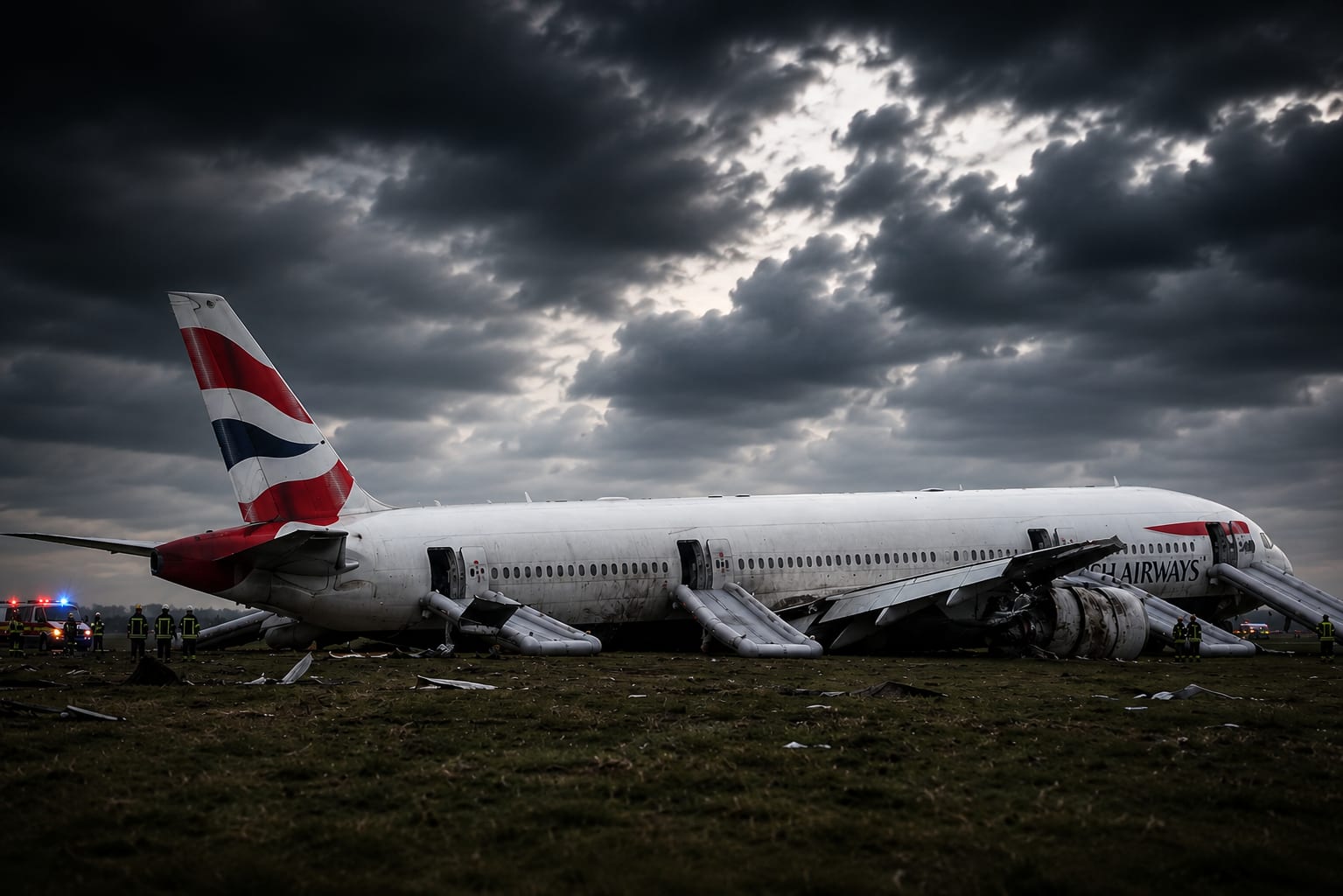
Pilot Nick — 8 min read — Black Box Series
You've almost certainly heard of the Miracle on the Hudson — the airliner that glided onto a river in New York with both engines gone. You've probably never heard of the one that pulled off something just as remarkable a year earlier, two miles from London Heathrow, with even less time to react.
On the 17th of January 2008, British Airways Flight 38 was seconds from an ordinary landing.
A Boeing 777 with 152 people aboard was on final approach to Heathrow — two miles out, 720 feet above the rooftops of west London closing out a routine ten-and-a-half-hour flight from Beijing.
Then both engines quietly stopped making power. No fire. No bang. No warning horn for what was happening. The autothrottle called for more thrust and got almost nothing back, and in the space of a few seconds a 150-tonne airliner became a glider — too low, too slow, sinking toward houses, a busy road, and the airport fence.
The crew had less than a minute to solve a problem that appeared in no checklist on the aircraft.
This is what actually happened, why it happened, what changed because of it, and the system the pilots used when the book ran out.
What everyone gets wrong about how pilots survive
Here’s the assumption most people carry: pilots stay alive in emergencies because there’s a checklist for everything.
Engine fire? There’s a page. Depressurization? There’s a page. Flip to the tab, run the drill, breathe. Most of the time, that’s exactly right. The checklist is one of the quiet miracles of aviation — it turns panic into a to-do list.
But a checklist can only cover the problems someone has already survived and written down. It’s a memory of other people’s disasters.
Flight 38 hit the one nobody had written down. And that’s the moment training actually earns its keep.
Below the line: the forty seconds that followed, the cause nobody believed at first, and the five steps that kept 152 people alive when no checklist existed.
