


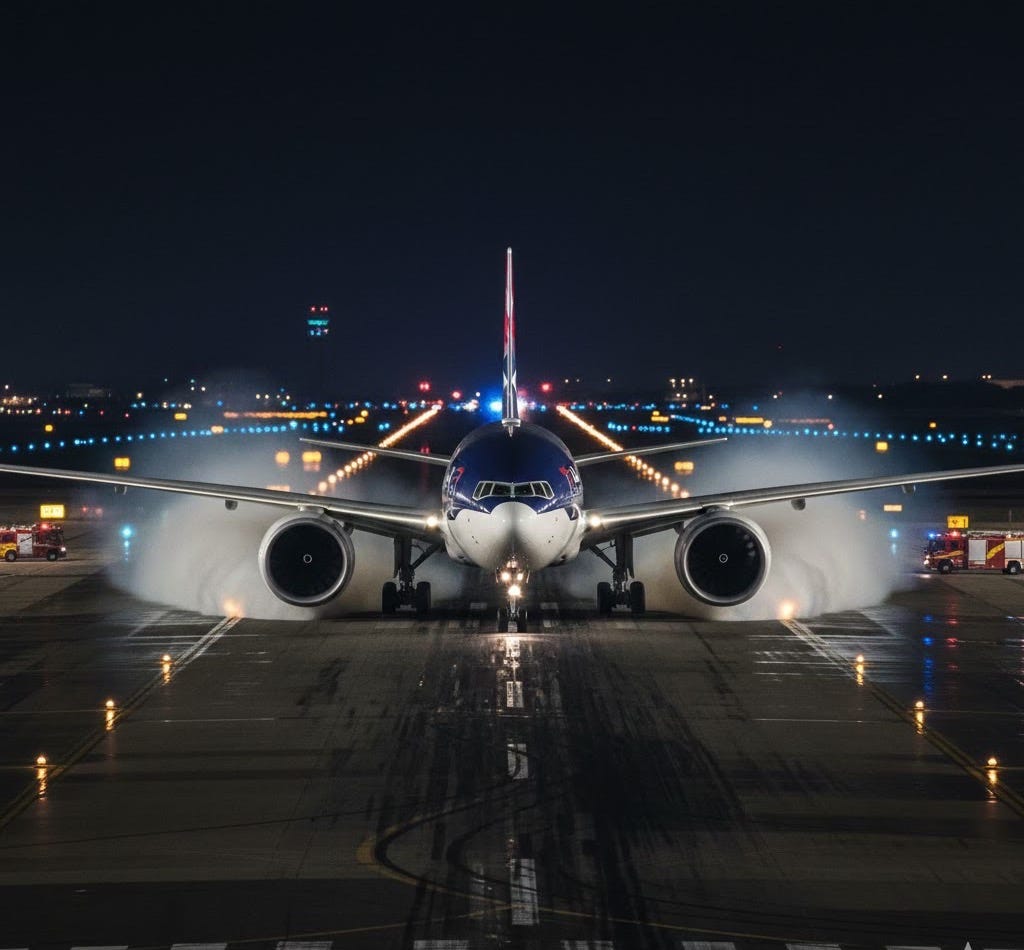
At 178 knots (roughly 330 km/h) a Boeing 777 captain made a decision pilots train for, but almost never execute.
He rejected the takeoff.
The nose wheel was already off the ground.
Sunday evening at São Paulo–Guarulhos, LATAM flight LA8146 was supposed to be climbing westbound over the Atlantic, bound for Lisbon on an overnight crossing. Instead, it ended up on a parallel taxiway, surrounded by fire trucks, its brakes glowing red in the dark, its tires deflated on the concrete and 410 passengers trying to understand what had just happened.
Nobody died.
The aircraft stopped.
But what unfolded in those few seconds and in the hours that followed will almost certainly be studied in simulator training rooms for years.
Runway 10L, Guarulhos, 19h00 local time. That flash of light is 300 tonnes of Boeing 777 trying to stop from 330 km/h after the nose had already lifted off. Filmed by a spotter.
The Architecture of a Takeoff
Most passengers experience takeoff as a single, seamless event. The engines roar, the world blurs past the windows, and then you’re airborne. What they don’t see is that the crew is mentally and procedurally dividing that runway roll into distinct decision zones, calculated fresh before every single departure.
Below 100 knots, the calculus is simple: if something feels wrong, you stop.
A suspicious instrument reading, a door warning light, an instinct. You have time, energy is manageable, and the runway ahead is long. Reject.
Above 100 knots, the physics start working against you. The aircraft weighs hundreds of thousands of pounds and is moving fast. The brakes already warm from taxiing must now absorb enormous kinetic energy in a very short time. They will heat dramatically. They may catch fire. The rubber of the tires will eventually burn too. And those brakes sit directly beneath the wing fuel tanks.
This is why, at most major carriers, the list of acceptable reasons to reject above 100 knots is short and unambiguous:
🔥 Engine fire
🚧 Engine failure
🎯 Loss of directional control
❌ or a condition so catastrophic the aircraft is genuinely unsafe to fly.
A hydraulic problem? Take it airborne. An electrical fault? Take it airborne. The sky is actually a safer place to manage most failures than a runway disappearing beneath you at 160 knots.
V1: The Most Consequential Number Calculated Before Every Flight
V1 is not a fixed number. It is computed fresh before every departure, based on the aircraft’s weight, the outside temperature, the runway length, its surface condition, and obstacle clearance requirements. It represents the last moment at which the crew can initiate a stop and mathematically guarantee the aircraft will not depart the paved surface.
Past V1, the only option is to fly.
The ritual that marks this moment is subtle but deliberate: when the pilot monitoring calls “V1,” the pilot flying moves their hand from the thrust levers. Not because the rules say so, though they do but because the hand on the throttles is the hand that rejects. Removing it is a physical commitment. We are going flying.
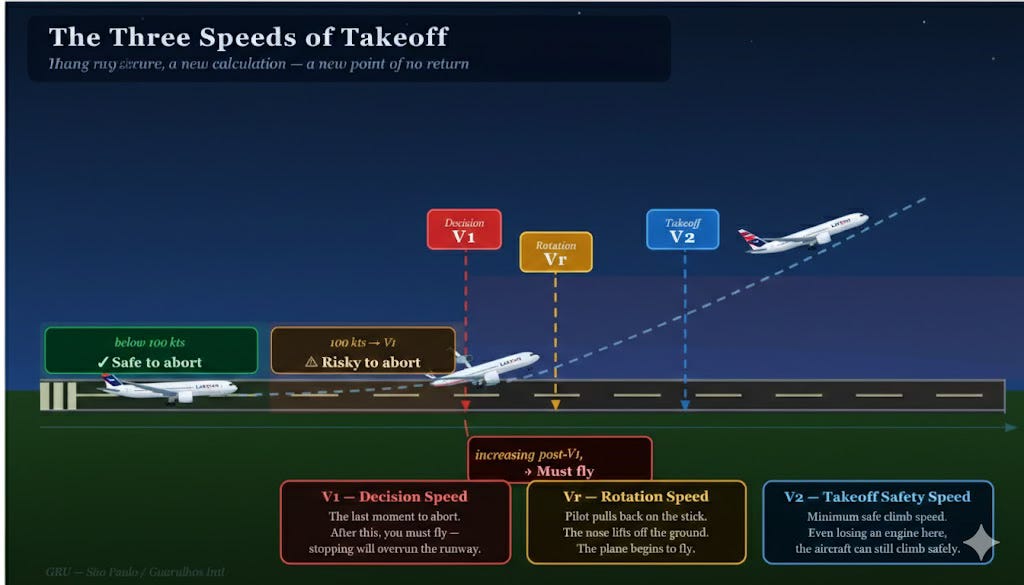
On Sunday evening at Guarulhos, the nose of the 777 was already beginning to rotate upward the nose gear visibly lifting off the runway when the crew apparently initiated the abort. At the speed required to begin rotation on a heavy widebody like the 777, V1 had already passed. The crew had entered the narrow window between Vr, the rotation speed, and V2, the minimum safe climb speed. In standard procedure, that window has only one exit: upward.
They chose the runway instead.
