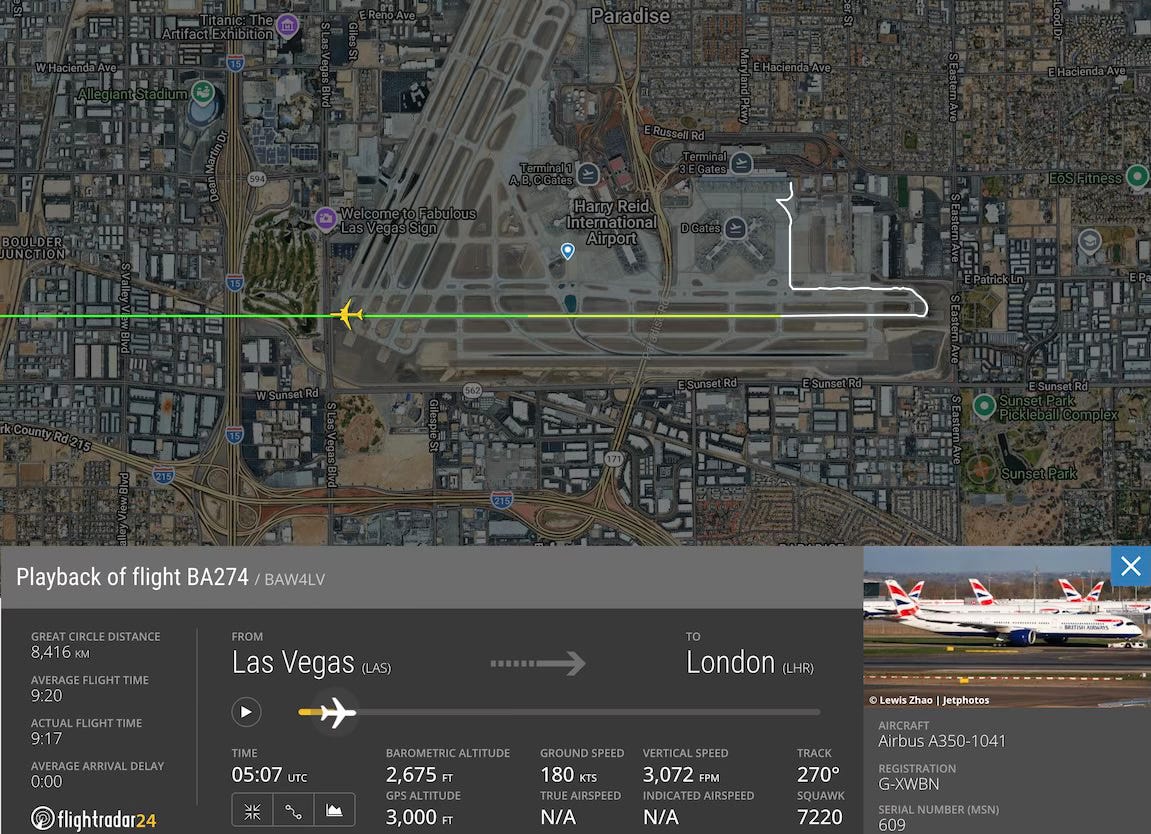

By now you’ve probably seen the footage. Monday night, British Airways flight BA274 departing Las Vegas for London. Sparks flying from the right main gear during rotation. Then, as the landing gear retracts, a wheel breaks free and tumbles back to the runway.
Dramatic? Absolutely. Dangerous? Let me explain why the answer is: not really.
I’ve spent decades in the cockpit, and incidents like this are exactly where aviation’s obsession with redundancy proves its worth. The crew made the right call continuing to London. Let me walk you through why, whether you’re an avgeek who wants the technical details or a nervous flyer who needs reassurance before your next flight.
First, Let’s Talk Numbers
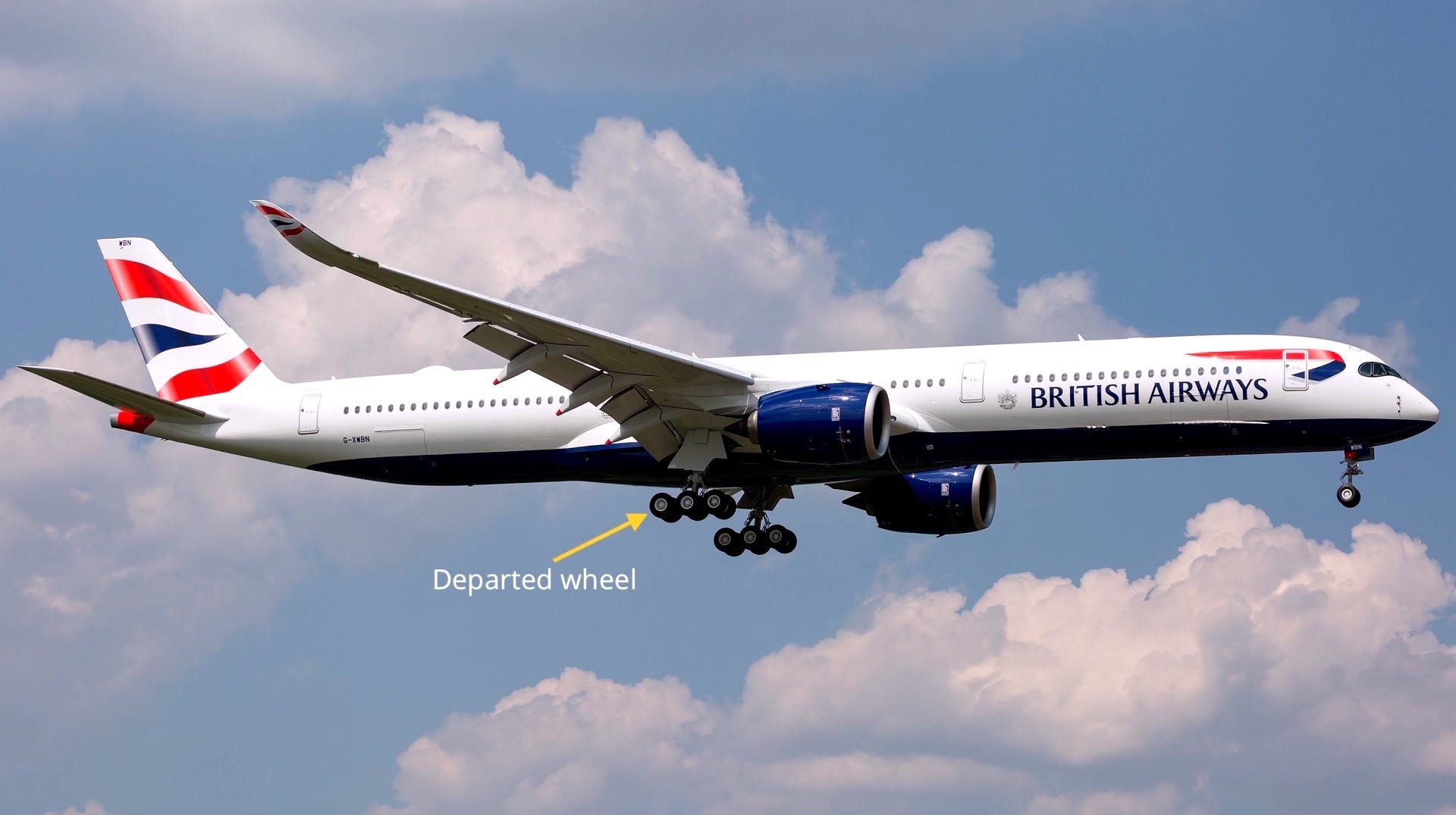
The Airbus A350-1000 isn’t your typical widebody. It’s the stretched, heavy-lift variant of the A350 family, designed to carry up to 350 passengers across oceans. To handle a maximum takeoff weight of 322 tonnes (that’s 710,000 pounds), Airbus equipped it with a six-wheel bogie on each main landing gear twelve main wheels total, plus two on the nose gear. That’s fourteen wheels touching the ground.
The wheel that departed BA274 was the rear-most, outside wheel on the right main landing gear. One wheel out of twelve on the mains. One wheel out of fourteen total.
This is not a coincidence. This is engineering.

Aviation’s Golden Rule: Redundancy, Redundancy, Redundancy
If there’s one principle that defines modern aviation safety, it’s this: critical systems must have backups. And the backups need backups.
The A350’s landing gear is a perfect example. Those six wheels per main gear aren’t there because Airbus couldn’t figure out how to use four (the smaller A350-900 manages just fine with four-wheel bogies). They’re there because the -1000’s higher weight demands better load distribution and because spreading that weight across more wheels means losing one isn’t catastrophic.
Think about it this way: if you’re carrying a heavy load across a frozen lake, would you rather concentrate all that weight on four points or spread it across twelve? Same principle. Each wheel shares the burden, and losing one simply redistributes the load among the remaining five on that leg.
Why Didn’t They Turn Back? 🧐