


Pilot Nick - 11mn read
BLACK BOX · Incident file: FedEx 910, Miami
The short version
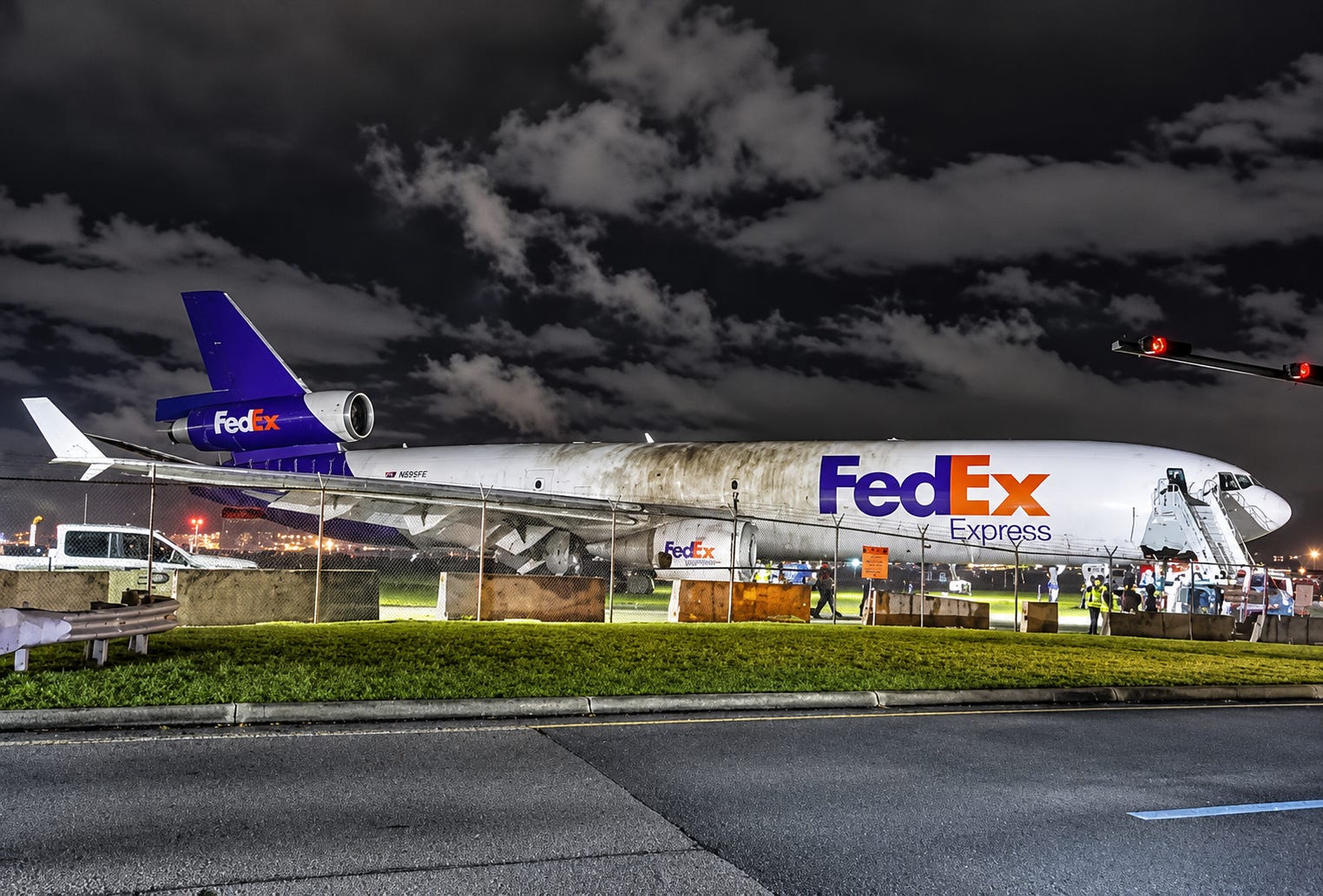
On Wednesday night, a FedEx MD-11 freighter from Memphis ran off the end of runway 26R at Miami, the airport’s shortest runway, and stopped about 1,000 feet past the end. Both pilots walked away unhurt.
A thunderstorm was building just northeast of the field, close to the final approach, and about a quarter inch of rain fell in that hour. The FAA stopped Miami-bound traffic for close to two hours on the night before Thanksgiving.
The public tracking data shows a touchdown about 1,000 feet longer than normal, then about nine seconds when the jet, at around 150 knots, barely slowed down.
Hydroplaning, late spoilers or reversers, and the autobrake setting all fit that data. Only the flight data recorder can tell them apart.
The FAA is investigating and has notified the NTSB. No cause has been established, and I’ll come back to this file when the first findings are out.
At 8:26 p.m. on Wednesday, FedEx flight 910, an MD-11 freighter from Memphis, touched down on runway 26R at Miami in rain, with a thunderstorm building just northeast of the airport. Less than a minute later it came to a stop roughly 1,000 feet beyond the end of the runway, close to the airport fence. The two pilots walked off the airplane. Nobody was hurt.
If you were flying into Miami that night, the night before Thanksgiving, there’s a good chance you spent part of the evening holding somewhere over Florida or sitting at your departure gate. That airplane in the grass was the reason.
The headlines say the jet “overran the runway.” The public tracking data says a lot more. It shows the groundspeed climbing in the last three miles, a touchdown well past the normal spot, and about nine seconds right after touchdown when an airplane doing about 150 knots barely slowed down. Most of this file is about those nine seconds.

Black Box is my recurring series on aviation incidents in the news, and older ones still worth learning from. Every file follows the same rules: the confirmed facts first, a pilot’s reading of the data, the theories kept in a “not yet” box, and no guessing ahead of the investigation.
I went through the ADS-B tracking data’s for this landing second by second. A few things jumped out: the groundspeed climbing about 30 knots on short final, the wheels touching down roughly 1,000 feet past where you’d expect, and a stretch of rollout where the speed barely moves. I ran the stopping math to find out where the margin went.
Then there’s the go-around. It’s the first thing any pilot asks after a landing like this, and on the numbers, this crew may never have crossed a excedence that required one. I’ll explain why, and walk you through the five calls I’d have made from the left seat on a wet night on Miami’s shortest runway.
If this one makes you uneasy about your next landing in the rain, hold on to this: under FAA rules (14 CFR 121.195), an airliner must be able to stop within 60 percent of the runway on a dry day, the required distance goes up another 15 percent when the runway is forecast wet, and the pilots recheck the numbers on the way in with the real weather. Europe's EASA rules set the same margins (CAT.POL.A.230 and CAT.POL.A.235). Even with several things going wrong at once on Wednesday night, both pilots walked away. The airplane stopped about 1,000 feet past the runway's end, which is about how far the cleared safety area beyond most US airline runways extends.
Paid subscribers sit up front with me for the full file: the data, the go-around question and my calls from the left seat.
🎉 Black Friday: the annual plan is $56 instead of $80
Ends Monday, Nov 30, at 11:59 p.m. Eastern.
