


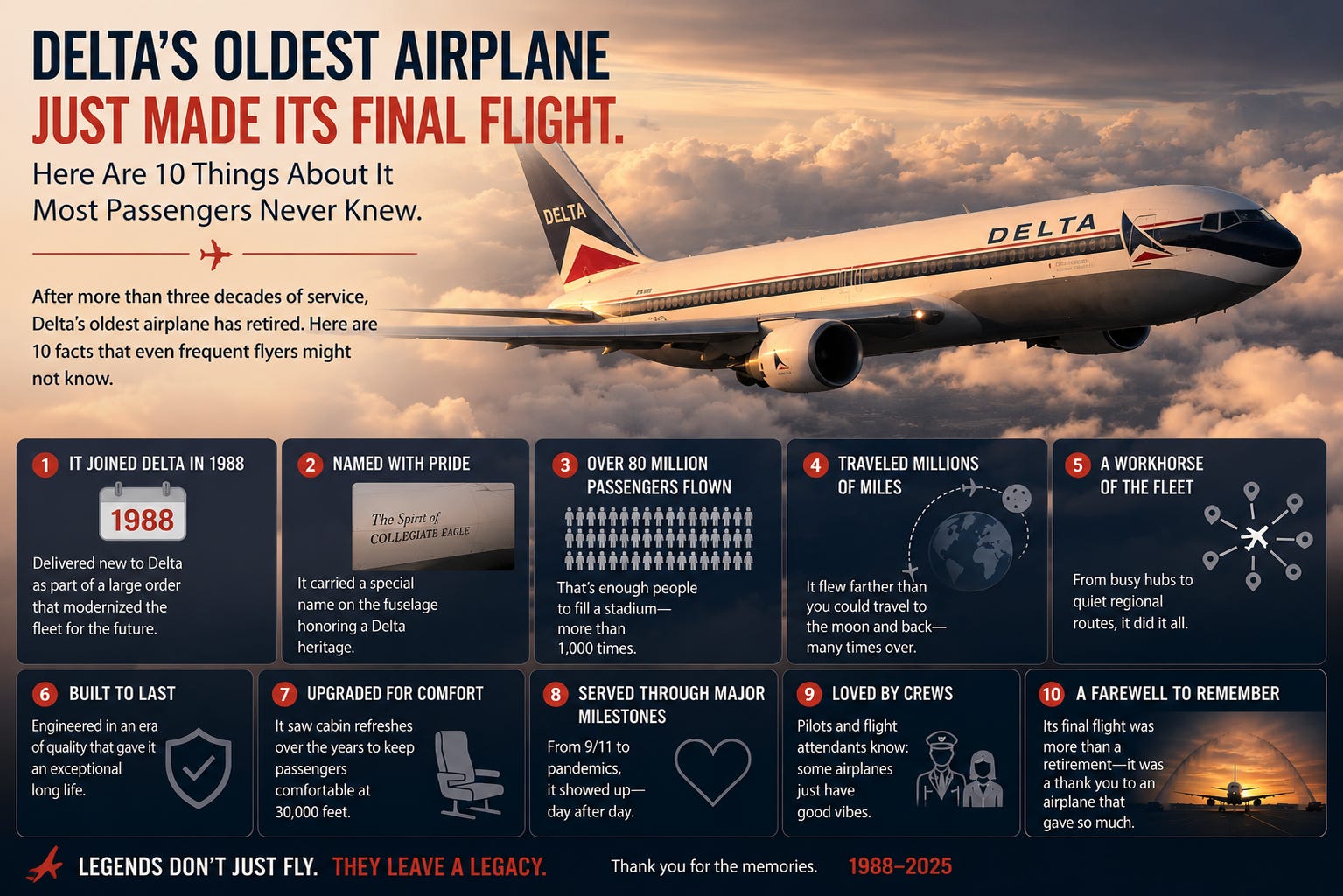
N-171D Boeing B-767-300ER
She was built during the George H.W. Bush administration.
She took her first breath of sky on April 22, 1990 — a test flight out of Boeing’s factory in Everett, Washington. Six weeks later, she was delivered to Delta Air Lines, registration N171DN, and she never wore another airline’s name for the rest of her life.
On April 9, 2026, she flew her final revenue flight — Delta 715 from San Francisco to Atlanta. The next morning, she ferried quietly to Birmingham, Alabama, where she’ll be taken apart, piece by piece.
No fanfare. No water cannon salute. Just one last flight to the scrapper.
That’s a pilot’s airplane. She didn’t need a ceremony. Her logbook spoke for itself.
BY THE NUMBERS
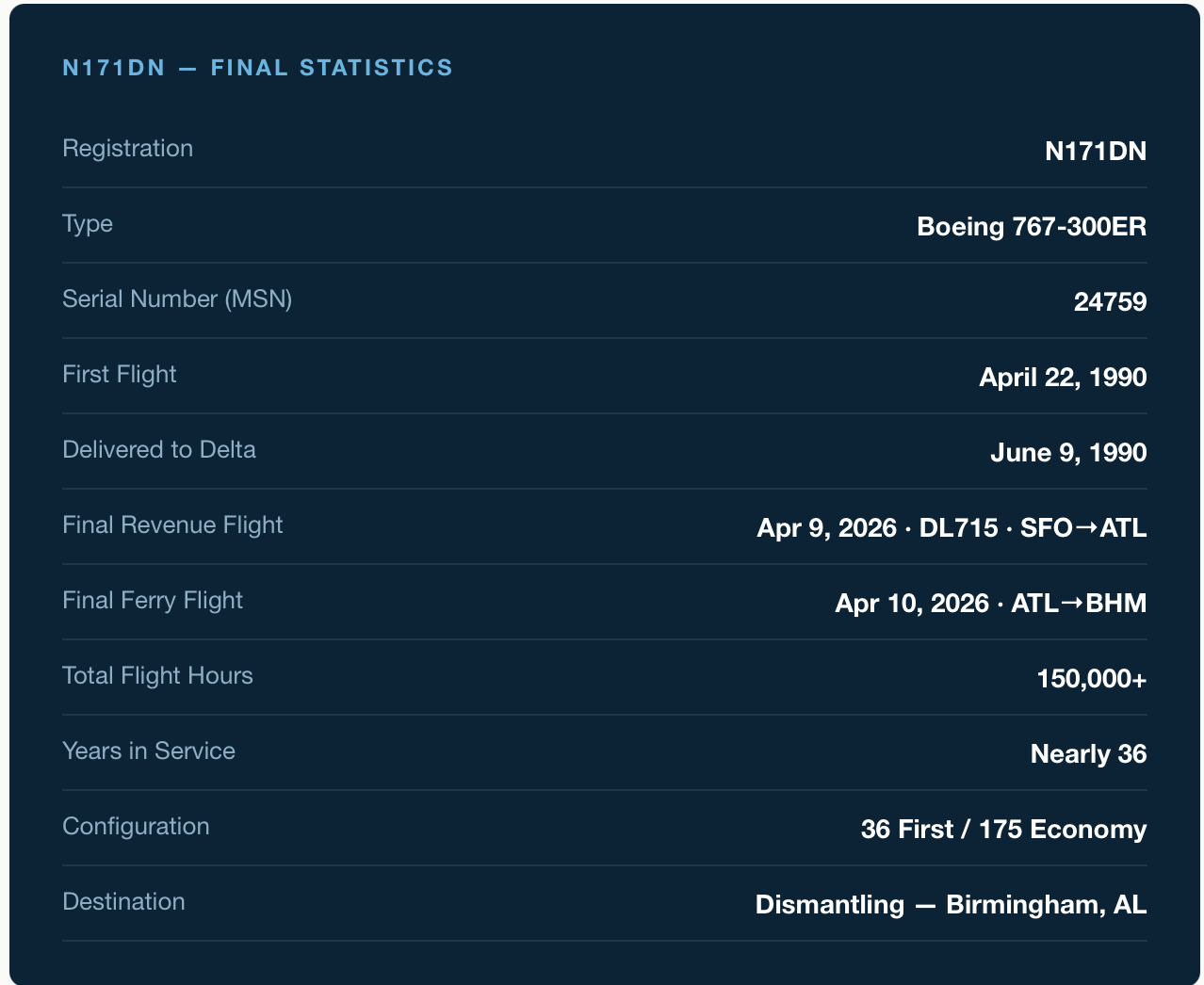
Here’s what 36 years of flying looks like.
Over 150,000 flight hours. Think about that for a second. That’s more than 17 years of continuous, non-stop flight without ever touching the ground. It’s roughly 6,250 days in the air.
She crossed every ocean Delta flies. She connected Atlanta to Europe, to Asia, to Latin America. In her younger years, she was an international workhorse — the kind of airplane that made Delta a global airline. In her later years, she settled into transcontinental routes: ATL to SFO, ATL to JFK, ATL to Phoenix. Still earning her keep. Still carrying passengers. Still running.
The only time she stopped was during COVID. From January 2020 to April 2021, she sat in storage — like most of the world’s fleet. Then she came back and flew for five more years.
Even in her final weeks, she wasn’t parked in a hangar waiting for a retirement party. She was flying real routes, carrying real passengers, generating real revenue. Delta was squeezing every last ounce of value out of this airplane right up to the end. That tells you something about how good she was.
THE AIRPLANE THAT CHANGED THE RULES
This is where it gets fascinating and where this story becomes bigger than one airplane.
Before the 767, there was a hard rule in aviation: twin-engine airplanes could not fly more than 60 minutes from a suitable diversion airport. That meant if you wanted to cross an ocean, you needed three or four engines. Period. The 747. The L-1011 TriStar. The DC-10. Those were your only options.
The thinking was simple. If you lose an engine over the middle of the Atlantic on a twin-engine jet, you’d better be close to land.
In 1980, when Boeing approached the FAA about flying the 767 on long overwater routes, the FAA administrator’s response was blunt. He said he wouldn’t allow twin-engine jets to fly long-haul overwater routes — and he didn’t mean for just a year or two.
But Boeing had the data. The 767’s engines were achieving reliability numbers no previous powerplant had ever matched. The airplane itself had built-in redundancy that made it fundamentally different from anything that came before — dual hydraulic systems, advanced avionics, and an Engine-Indicating and Crew-Alerting System (EICAS) that gave pilots real-time engine health data we’d never had access to before.
In 1985, TWA flew the first ETOPS revenue flight: a 767 from Boston to Paris under a brand-new 120-minute rule. The airplane burned thousands of pounds less fuel than the L-1011 TriStar it replaced on that same route.
By 1991, more passengers were crossing the Atlantic in 767s than in three- and four-engine jets combined.
By 2000, half of all transatlantic crossings were made by 767s.
The 767 didn’t just fly the routes — it invented them. It proved that two engines, proper engineering, and rigorous maintenance were enough to cross any ocean on Earth. Every twin-engine jet you fly on today — the 787, the A350, the 777 — exists because the 767 proved it could be done.
So when you hear that N171DN has been retired, understand what you’re really hearing. You’re hearing the final chapter for one of the airplanes that changed the fundamental rules of how we fly.
But there’s a lot more to this airplane’s story and to the 767 itself that most people never hear about. Including the incredible story of how Delta got its very first one.
✈️ There’s more to this story.
In 1982, three Delta flight attendants did something no airline employees had ever done before or since. That story, plus the 10 facts about this airplane that made me fall in love with the 767 the first time I flew one.
