
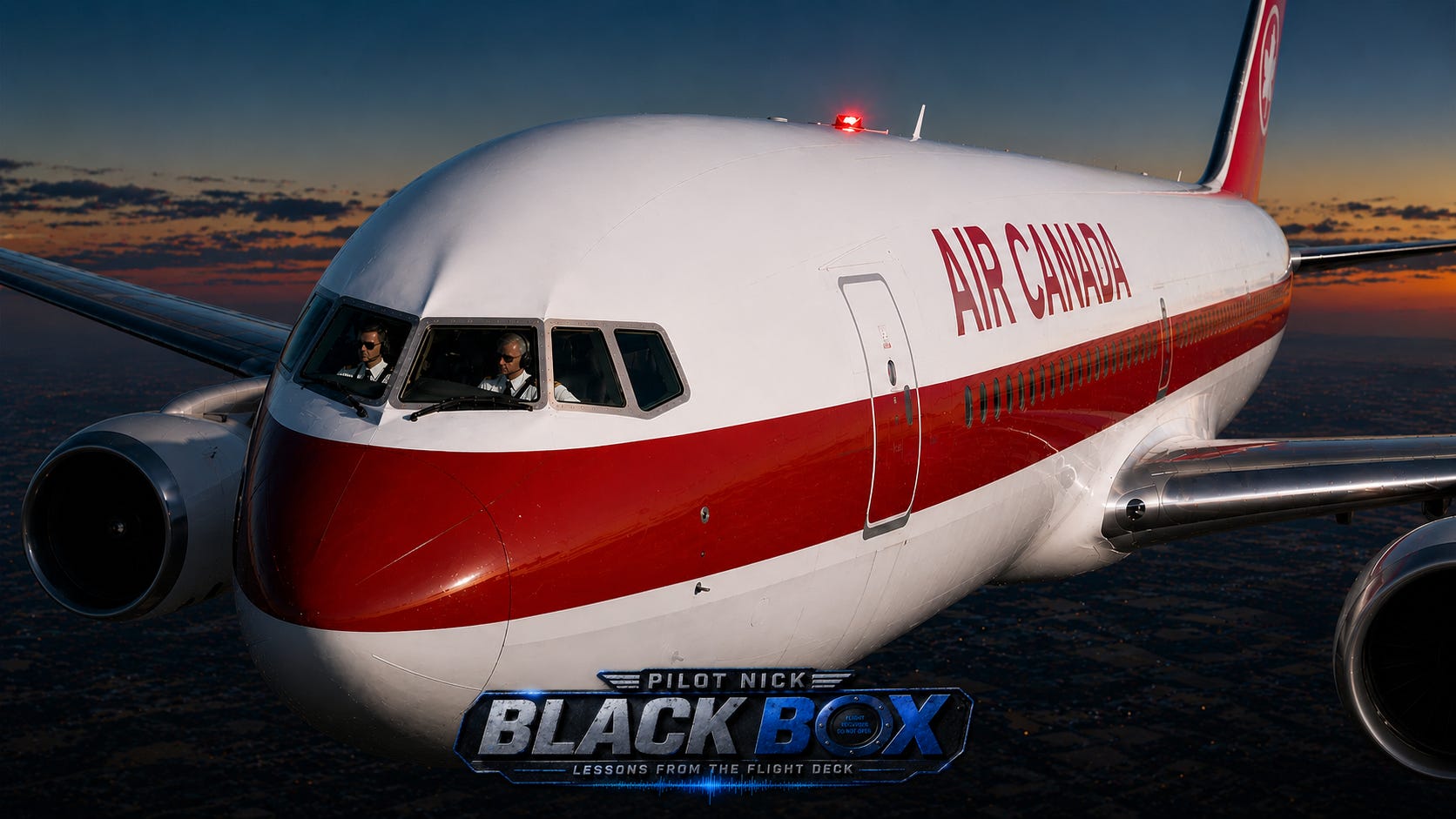
69 Souls Saved by a Hobby
How a brand-new Boeing 767 ran out of fuel at 41,000 feet and why the captain was the only person on Earth who could have landed it.
🕒 12 min read · Black Box Series · Episode 02 · Pilot Nick
July 23, 1983. A Saturday evening in central Canada.
A brand-new Boeing 767, just five months old, is cruising at 41,000 feet over a place called Red Lake, Ontario.
Sixty-one passengers. Eight crew. A standard domestic flight from Montreal to Edmonton.
In the cockpit Captain Robert “Bob” Pearson, 48 years old, 15,000 hours of flight time. Beside him First Officer Maurice Quintal, 36, ex-Royal Canadian Air Force.
It’s a quiet flight. The kind of evening sector pilots love. Smooth air. Clear sky. The sun is going down over the Canadian shield.
Then a single chime fills the cockpit.
Four notes. Soft. Almost polite.
Both pilots glance at the warning panel.
It says the aircraft has a fuel pressure problem on the left side.
Pearson and Quintal exchange a look the look pilots give each other when something on the panel doesn’t quite make sense. Because according to the fuel quantity readout in front of them, they have plenty of fuel.
Plenty.
Ninety seconds later, the left engine flames out.
Thirty seconds after that, the right one follows.
And the world’s most modern airliner a brand-new, twin-engine, computerized 767 becomes the largest glider in commercial aviation history.
What happens in the next 17 minutes is taught in every airline training program on Earth.
Welcome to Black Box · Episode 02
If you’re new here Black Box is the series where I take a real aviation incident and break it down the way a pilot actually thinks about it.
Not the news version. Not the dramatized version.
The version from the left seat.
What the crew saw. What they decided. Why. And most importantly for the nervous flyers reading this what changed afterwards, so that you never have to.
The Strangest Cause in Modern Aviation
Here’s what makes this incident different from almost every other one you’ve ever read about:
There was no storm. No mechanical failure in flight. No fire, no bird strike, no terrorism, no human error in the cockpit at the moment of crisis.
The aircraft was perfect.
The crew was experienced.
The weather was severe clear.
The cause of this incident was already on board quietly, invisibly before the engines even started turning that morning.
It was a number.
A wrong number, written into a fuel slip, hours before takeoff, on the ground in Montreal.
Because in 1983, Air Canada was the first North American airline to switch from imperial units (pounds) to metric (kilograms). The 767 was the first metric aircraft in their fleet. The ground crew had been trained on the new system but the conversion factor on the refuelling slip that day was the old one.
Pounds per litre. Not kilograms per litre.
The result?
Pearson, Quintal, and the ground crew dripsticked the tanks, did the math, and confidently loaded the aircraft with half the fuel they thought they had.
Twenty-two thousand, three hundred kilograms that was the calculation written down.
The actual figure: closer to ten thousand.
They taxied out for a flight to Edmonton with enough fuel to make it roughly halfway.
And no one on board not the captain, not the first officer, not the dispatcher, not the fuelers had any idea.
The fuel quantity gauges that would normally have caught this?
Inoperative. A known fault. Logged, deferred, and legally permitted to fly.
This is the moment the story turns from a procedure into a legend.
Captain Pearson’s PA
There’s no famous quote from this incident the way there is from BA009.
What the passengers heard, instead, was silence.
Not metaphorically literally.
Because when both engines on a 767 quit at altitude, the cabin doesn’t go quiet the way it does in a movie.
It goes quiet in a way you would never expect from an aircraft.
The constant low hum behind the bulkheads gone. The gentle vibration through the floor gone. The whisper of the air conditioning packs gone.
What remains is the sound of wind on aluminium. And the small, uneven creaks of an airframe that is no longer being pushed through the sky.
Pearson keyed the PA briefly. He told the cabin they had a problem. He told them to prepare for an emergency landing.
That was it.
Pearson had less than 17 minutes from the first warning chime to wheels on the ground.
And every one of those minutes was about flying an aircraft that was never, ever supposed to fly the way he was about to fly it.
Behind the Scenes — What Pilots See
Here’s something most passengers don’t know.
In 1983, when you were trained on a 767, the emergency manual didn’t include a procedure for losing both engines.
There simply wasn’t one.
That wasn’t an oversight in the way you might think. It was a statement of statistical reality — at least, the statistical reality Boeing engineers believed at the time. The probability of both engines failing simultaneously on a modern twin-engine jet was considered so vanishingly small that no checklist had been written for it.
The procedures assumed one engine. Always.
So when Pearson and Quintal looked at their emergency manual that evening searching for the section labelled “loss of both engines” they found nothing.
That has changed.
Today, every modern airliner including the one I fly carries a full All Engines Out procedure in its Quick Reference Handbook. Glide speed by weight. Relight envelope. APU start logic. RAT deployment confirmation. Step by step, in the order a pilot needs them.
That checklist exists because of this flight.
But on July 23, 1983, Pearson didn’t have it.
This is the moment that separates a normal pilot from a special one.
Most captains, in this scenario, would have done exactly what their training told them to do fly the aircraft, run the relight checklist.
Pearson did all of those things.
But he also did one thing that almost no other 767 captain on Earth would have known how to do.
He started flying the 767 like a glider.
Because Bob Pearson, in his off-duty life, was a competition glider pilot.
He owned a Blanik L-13 sailplane. He had hundreds of hours flying aircraft with no engines at all. He understood instinctively, in his hands and in his bones, concepts that no airline pilot in 1983 was ever asked to learn.
Best glide speed. Optimum sink rate. The forward slip.
These weren’t 767 manoeuvres.
They weren’t even airline manoeuvres.
They were tools that belonged to a completely different aircraft, in a completely different sport, flown by a completely different kind of pilot.
And Bob Pearson happened to be both.
Minute Zero — 41,000 Feet
Let’s go to the cockpit.
20:00 local time. The aircraft is cruising at Mach 0.80, autopilot engaged, fuel readings showing healthy reserves.
The first warning chime sounds.
Pearson and Quintal scan the panel.
LEFT FUEL PRESSURE LOW.
It’s not a major alarm. It’s a caution. The kind of message that, in a normal flight, means a fuel pump has failed. Annoying. Not dangerous. Even with both pumps off, gravity will feed fuel to the engines in level flight.
Quintal pulls out the checklist. They start running it.
A second chime.
RIGHT FUEL PRESSURE LOW.
Now both pilots are paying attention.
But it still doesn’t add up because the fuel quantity gauges (which they cross-checked manually before departure) show the aircraft has thousands of kilograms of fuel left. Two simultaneous fuel pump failures, on opposite sides of the aircraft, on a five-month-old jet?
Statistically impossible.
Pearson makes a decision: divert to Winnipeg. Closest major airport, full emergency services, long runways. He puts the aircraft into a descent.
Then the left engine flutters.
A low, rolling cough. The kind of sound an engine makes when it’s starving.
And dies.
The Engine That Wasn’t There
A 767 is certified to fly comfortably on one engine. Pearson knows this. He’s done it in the simulator a dozen times. The aircraft will hold altitude, drift down slowly to about 25,000 feet, and continue to its destination.
This is the moment exactly here where the playbook ends.
Because as Pearson begins running the single-engine checklist, the right engine starts to surge.
He looks at it. Quintal looks at it.
And then, in the most quiet, ordinary way possible, the way a kitchen tap stops when someone shuts the water off in another room the second engine simply… stops.
The cockpit lights flicker.
Most of the instrument panel goes dark.
Because the 767 is so modern, so computerized, so dependent on engine-driven generators for its electrical power, that when both engines quit, almost every screen in front of the pilots goes blank.
Pearson and Quintal are now flying a $50 million jet on a tiny set of mechanical backup instruments — an artificial horizon, an altimeter, an airspeed indicator, a magnetic compass.
Through what you and I would call a windscreen.
In a glider.
At 41,000 feet.
He didn’t know it yet but the only thing standing between 69 souls and the boreal forest below was a hobby Bob Pearson had picked up on weekends.
This Has Happened Since
Eighteen years later, almost to the day, it happened again.
An Air Transat A330 over the Atlantic. Fuel leak. Both engines out. 306 people on board.
The captain glided 75 miles in the dark and landed in the Azores. Every passenger walked off.
He had something Bob Pearson didn’t the checklists, the glide tables, the procedures written because of Gimli.
I wrote the full breakdown here 👇🏻
Now back to 1983. Pearson is at 35,000 feet, no engines, no checklist, with a hobby in his back pocket and 17 minutes to land.
🔒 The rest of this story is for paid subscribers.
What Pearson did in the next 17 minutes is one of the most extraordinary pieces of flying in commercial aviation history.
Inside the paid section:
→ The glide speed Pearson guessed and why he was right
→ The forward slip no airline pilot is trained to fly
→ The drag race in progress on the runway he was about to land on
→ What changed in every cockpit because of this flight
→ Why this story should make you feel safer, not more afraid


